Clinical implementation of an automated VMAT treatment planning script for head and neck cancer patients: three-year experience - Report - MDSpire

Clinical implementation of an automated VMAT treatment planning script for head and neck cancer patients: three-year experience

  • By

  • Nataliya Kovalchuk

  • Peng Dong

  • Caressa Hui

  • Ignacio Romero

  • Ziyi Wang

  • Lina Shah

  • Raveena Pandya

  • Michael Xiang

  • Everett J. Moding

  • Michael F. Gensheimer

  • Beth M. Beadle

  • Quynh-Thu Le

  • Lei Xing

  • Yong Yang

  • July 3, 2026

  • 0 min

Share

Clinical Report: Experience Over Three Years with an Automated VMAT Treatment Planning Script

Overview

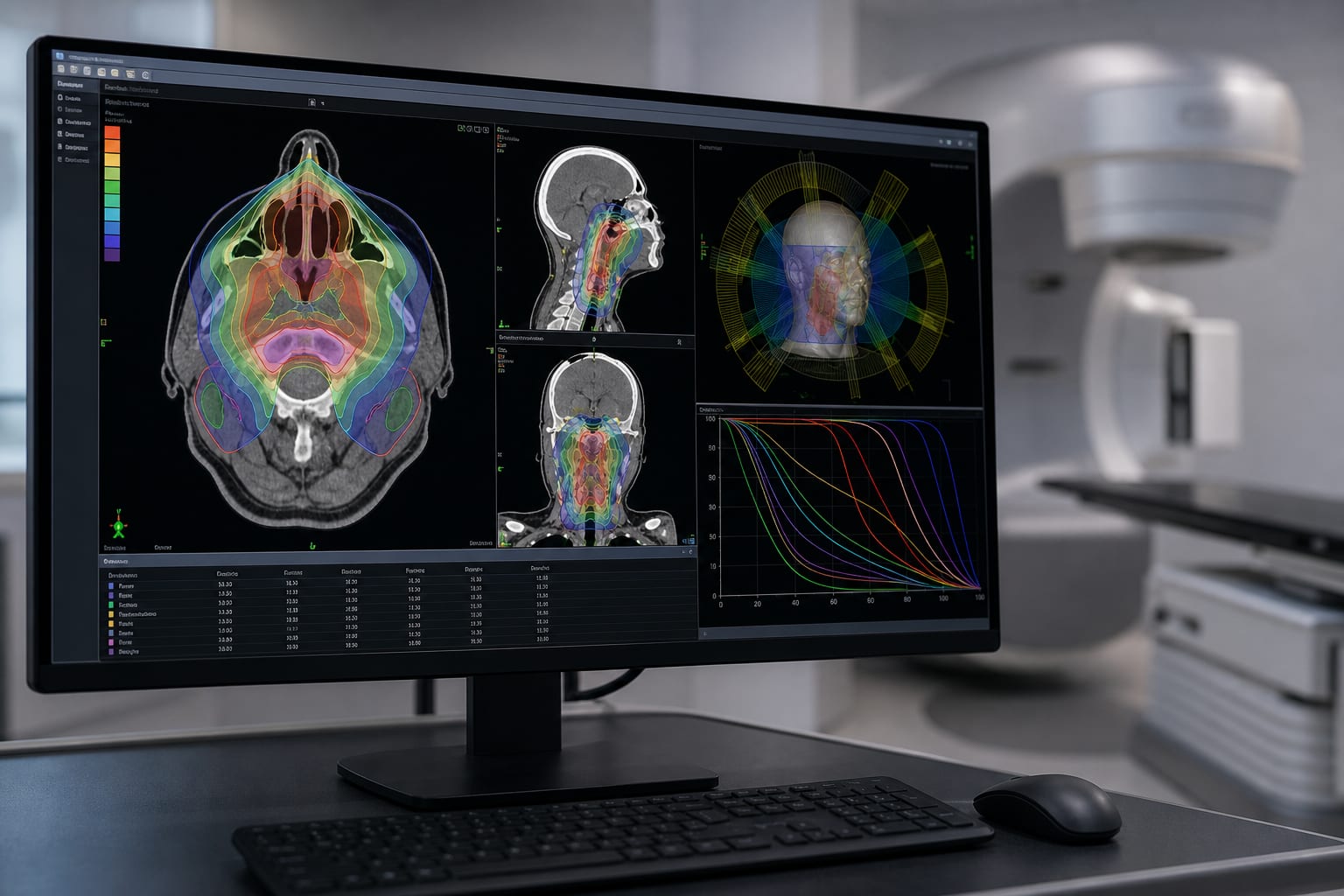
The implementation of an automated VMAT planning script for head and neck cancer improved organ-at-risk sparing while maintaining target coverage.

Background

Radiotherapy for head and neck cancers is complex due to the proximity of critical structures and the need for precise dose delivery. Automation in treatment planning has the potential to enhance efficiency and reduce variability in plan quality. This study evaluates the long-term impact of an automated VMAT planning script on dosimetric outcomes.

Data Highlights

ParameterManual PlansAutomated PlansP-value
PTV D95% CoverageMaintainedMaintained-
Brainstem Dmax107.3 Gy103.7 Gy< 0.001
Spinal Cord Dmax-−2.1 Gy< 0.001
Ipsilateral Parotid Mean Dose-−3.9 Gy< 0.04
Clinical Acceptability86%94%-

Key Findings

  • Automated plans maintained PTV D95% coverage comparable to manual plans.
  • Significant reductions in maximum doses to the brainstem and spinal cord were observed with automated plans.
  • Mean dose reductions were noted for several organs at risk, including the ipsilateral parotid and contralateral submandibular gland.
  • 94% of automated plans were rated clinically acceptable by radiation oncologists.
  • Physicians preferred 7 out of 10 automated plans over manual plans.

Clinical Implications

The automated VMAT planning script demonstrates a viable option for improving treatment planning in head and neck cancer.

Conclusion

The study provides evidence that automated VMAT planning can improve dosimetric outcomes without compromising treatment quality.

Related Resources & Content

  1. NCCN, Oregon.gov, 2025 -- Head and Neck Cancers guideline Version 1.2026
  2. ASTRO, PubMed, 2025 -- Dose-Volume Histogram Compendium of Dose Constraints
  3. Journal of Neuro-Oncology — Analysis of Tumor Control and Toxicity in Benign Intracranial Tumors Treated with HyperArc Radiosurgery Using a Frameless Linac System
  4. Frontiers in Oncology — A volume-controlled, anatomy-driven autoplanning strategy for whole-pelvic volumetric modulated arc therapy
  5. Journal of Neuro-Oncology — Application of IMRT-Enhanced Radiosurgery for the Management of Multiple or Large Irregular Intracranial Lesions and Evaluation of Infrared Frameless Localization Techniques
  6. Clinical Insights on the Use of Customized 3D-Printed Fixation Masks in Radiotherapy
  7. Analysis of Tumor Control and Toxicity in Benign Intracranial Tumors Treated with HyperArc Radiosurgery Using a Frameless Linac System
  8. A volume-controlled, anatomy-driven autoplanning strategy for whole-pelvic volumetric modulated arc therapy
  9. https://www.oregon.gov/oha/HPA/DSI-HERC/MembersOnly/7.5f%20NCCN%201.2026%20head-and-neck.pdf
  10. Dose-Volume Histogram Compendium of Dose Constraints for Treatment Planning: An ASTRO Consensus Paper - PubMed
  11. The Use of Iterative Knowledge-Based Planning Dosimetry Methods to Improve Head and Neck Cancer Radiation Planning - ScienceDirect

Original Source(s)

Related Content