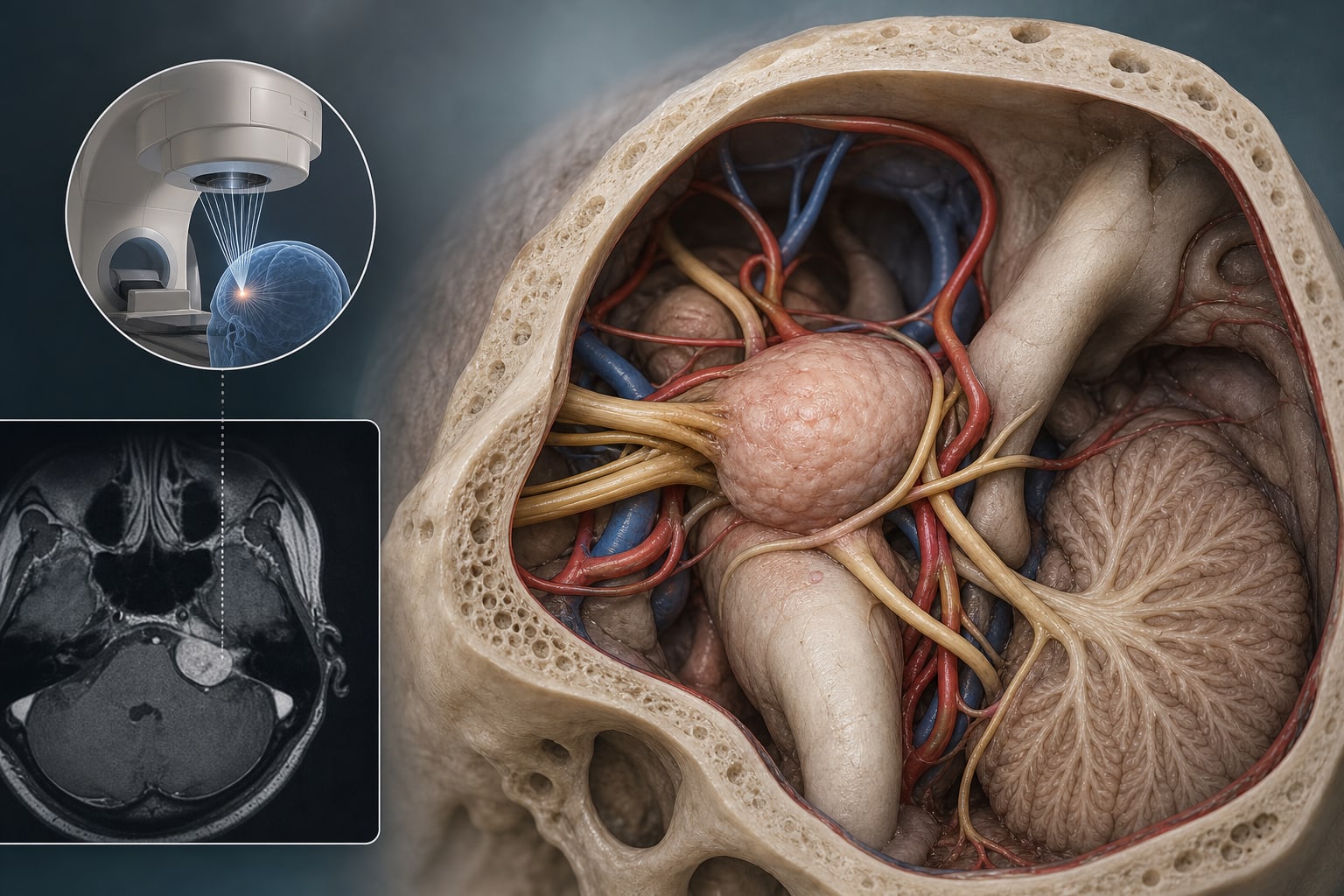
The 4F Technique for Skull Base Reconstruction in Endoscopic Transorbital Surgery
Overview
The 4F technique—utilizing autologous fat, fascia lata, fibrin glue, and additional fat grafting—was applied for osteodural defect reconstruction following superior eyelid endoscopic transorbital approaches (SETOA). In a series of 16 patients with various skull base lesions, this method demonstrated effective watertight closure and low complication rates over a follow-up of 14 to 38 months.
Background
Since the introduction of Trans-Orbital Neuro-Endoscopy Surgery (TONES) in 2010, the superior eyelid endoscopic transorbital approach (SETOA) has become a versatile and safe technique for accessing paramedian anterior and middle skull base lesions. Reconstruction of the osteodural defect after lesion removal remains a critical step to prevent cerebrospinal fluid (CSF) leaks and related complications such as meningitis and pneumocephalus. Various reconstruction methods have been developed to ensure a watertight barrier between intra- and extradural compartments and to eliminate dead space. The 4F technique was developed as a systematic approach to skull base reconstruction during SETOA.
The 4F technique involves intradural autologous fat grafting, extradurally placed fascia lata, fibrin glue fixation, and extradurally placed fat to fill dead space.
Applied in 16 patients undergoing SETOA for various skull base lesions, including meningiomas, schwannomas, metastases, and lymphoma.
Reconstruction achieved watertight closure, effectively preventing CSF leaks and related complications in most cases.
Extended surgical variations included lateral orbital rim removal or displacement with successful reconstruction using the 4F method.
Intentional slight proptosis was left post-reconstruction to accommodate postoperative edema resolution and maintain orbital symmetry.
Follow-up ranging from 14 to 38 months showed favorable functional and esthetic outcomes with minimal reconstruction-related complications.
Clinical Implications
The 4F technique provides a reliable and reproducible method for skull base reconstruction after endoscopic transorbital surgery, minimizing the risk of CSF leaks and associated complications. Its use of autologous tissues combined with fibrin glue ensures a watertight seal and effective dead space management, which is critical for patient safety and optimal postoperative recovery. Surgeons performing SETOA should consider this technique to enhance reconstruction outcomes.
Conclusion
The 4F technique represents an effective and safe approach for osteodural defect reconstruction in endoscopic transorbital skull base surgery, demonstrating promising preliminary results in preventing complications and preserving orbital function and aesthetics.
References
Moe et al. 2010 -- Introduction of Trans-Orbital Neuro-Endoscopy Surgery (TONES)
Moe 2020 -- Recommendations on orbital proptosis management post-reconstruction
by Sergio Corvino, Francesco Corrivetti, Giuseppe Catapano, Giuseppe Corazzelli, Antonio Colamaria, Edisher Maghalashvili, Iacopo Dallan, Domenico Di Maria, Germano Di Matteo, Giorgio Iaconetta, Matteo de Notaris