Preclinical translational screening of palladium(II)-porphyrin photosensitizers across human and Oncopig bladder cancer cell lines - Report - MDSpire

Preclinical translational screening of palladium(II)-porphyrin photosensitizers across human and Oncopig bladder cancer cell lines

  • By

  • Valentina G. Ferreira

  • Maria Eduarda Ehlert

  • Bruna S. Pacheco

  • Fernanda S. S. Souza

  • Isadora Tisoco

  • Lucas Damé Simões

  • Bernardo A. Iglesias

  • Claudia Ó. Pessoa

  • Fabiana K. Seixas

  • Maria Lucia Z. Dagli

  • Laurie A. Rund

  • Kyle M. Schachtschneider

  • Lawrence B. Schook

  • Tiago Veiras Collares

  • July 9, 2026

  • 0 min

Share

Clinical Report: In Vitro Evaluation of Palladium(II)-Porphyrin Photosensitizers

Overview

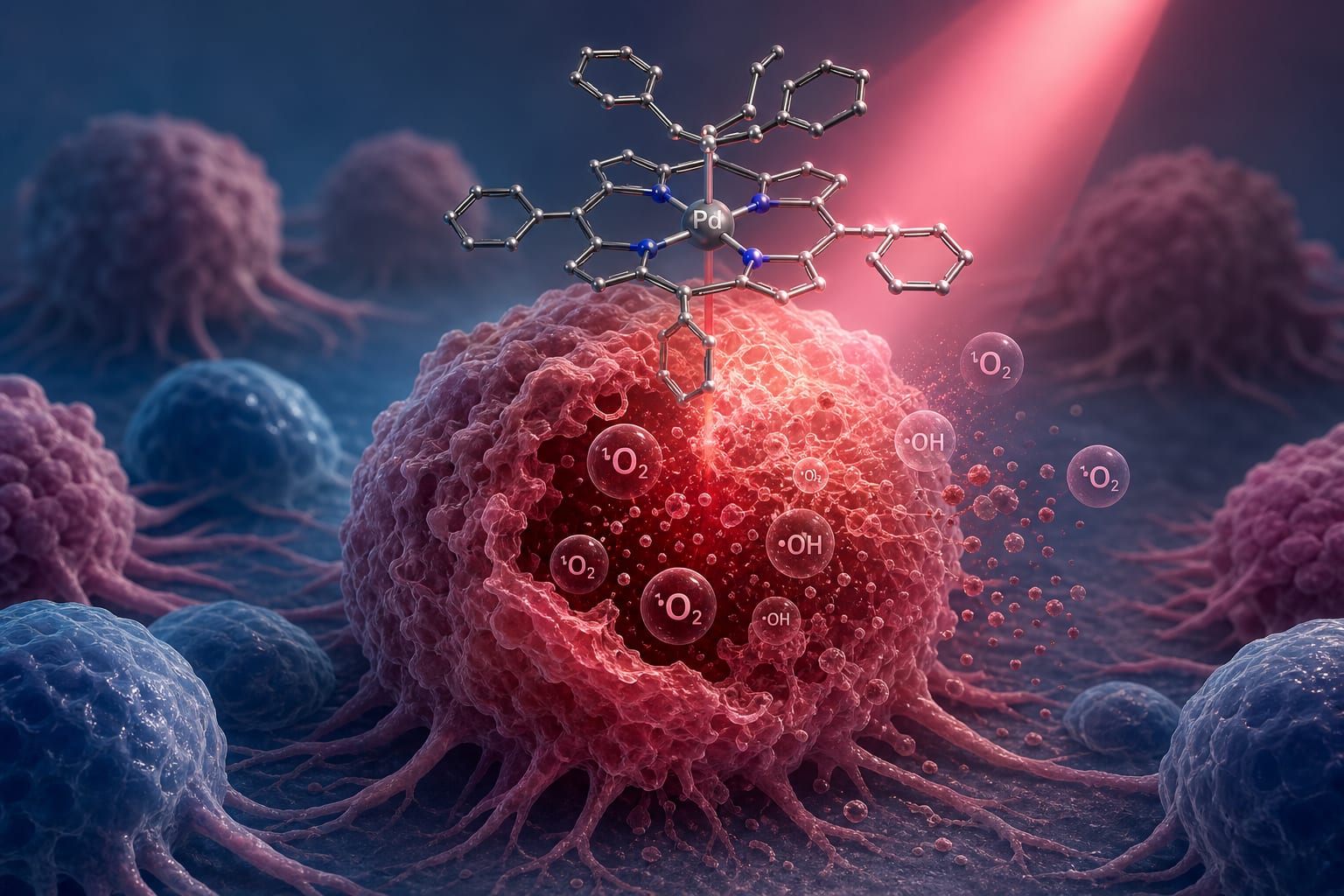
This study evaluates the cytotoxic effects of three palladium(II)-porphyrins in human and Oncopig bladder cancer cell lines. The findings indicate that these compounds exhibit light-dependent cytotoxicity.

Background

Bladder cancer is a prevalent malignancy with high recurrence rates and limited long-term treatment success. The development of new therapies is challenged by the lack of preclinical models that accurately mimic human disease.

Data Highlights

CompoundIC50 (nM)Photodynamic Activity
3-Pd(PPh3)LowHigh
3-Pd(dppf)LowHigh
3-Pd(PEPSI)HighLow

Key Findings

  • All three palladium(II)-porphyrins showed light-dependent cytotoxicity with minimal dark toxicity.
  • 3-Pd(PPh3) and 3-Pd(dppf) demonstrated potent photodynamic activity with nanomolar IC50 values.
  • 3-Pd(PEPSI) exhibited higher IC50 values, indicating lower photodynamic potency.
  • Photoactivation resulted in significant ROS production and upregulation of apoptosis markers.
  • Oncopig-derived cells exhibited responses closely matching human bladder cancer cell lines.

Clinical Implications

The study presents findings on palladium(II)-porphyrins as photosensitizers for bladder cancer photodynamic therapy.

Conclusion

The findings support the use of Pd(II)-porphyrins for bladder cancer treatment.

Related Resources & Content

  1. EAU Guidelines on Non-muscle-invasive Bladder Cancer - Uroweb, 2026 -- Summary of changes
  2. The Oncopig bladder cancer model, an innovative large animal platform for evaluating treatment effects. | Journal of Clinical Oncology, 2025 -- Study on Oncopig model
  3. Archives of Toxicology — Polycyclic Aromatic Hydrocarbons with Carcinogenic Potential Activate CYP1A1 in Human Cells through a p53-Dependent Pathway
  4. Archives of Toxicology — Utilization of HuH6 and other human hepatoma cell lines for genotoxin detection: a promising alternative to animal testing?
  5. Archives of Toxicology — Co-exposure to Benzo[a]pyrene and UV Radiation: Varied Impacts on Oxidative Stress and Genotoxic Effects in Human Keratinocytes and Ex Vivo Skin
  6. Efficacy Assessment of Intravesical Immunomodulators TMX-101 and TMX-202 in a Placebo-Controlled Study Using a Rat Model of Orthotopic Bladder Cancer
  7. EAU Guidelines on Non-muscle-invasive Bladder Cancer - Uroweb
  8. Diagnostic performance of narrow-band imaging and photodynamic diagnosis compared to white light cystoscopy for non-muscle invasive bladder cancer: A network meta-analysis of randomized trials - PMC
  9. The Oncopig bladder cancer model, an innovative large animal platform for evaluating treatment effects. | Journal of Clinical Oncology

Original Source(s)

Related Content