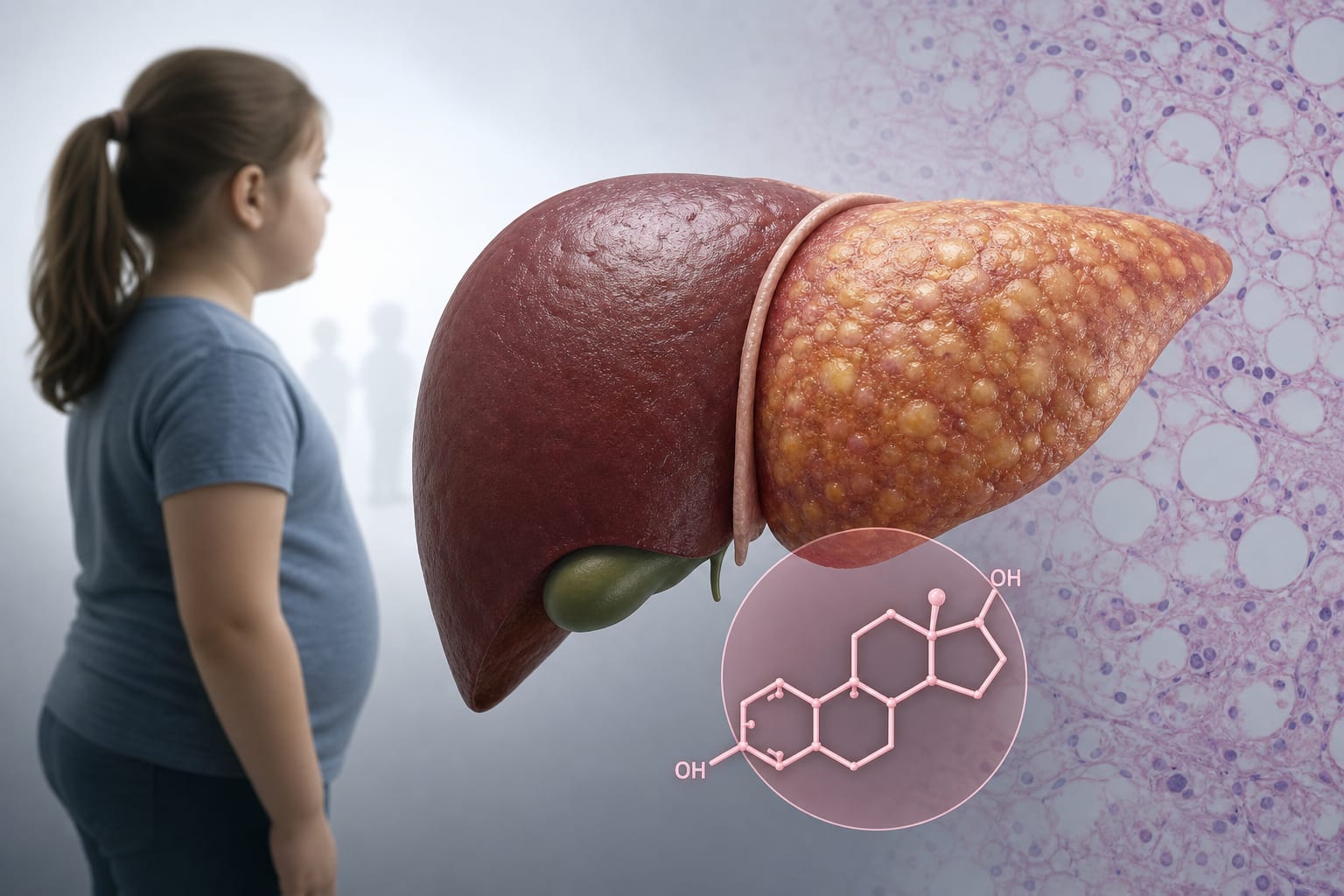
Clinical Report: The Relationship Between Estradiol Levels and MASLD in Pediatrics
Overview
This study investigates the associations between sex hormones and metabolic dysfunction-associated steatotic liver disease (MASLD) in children with overweight and obesity. Key findings indicate that estradiol, Anti-Müllerian hormone (AMH), and sex hormone-binding globulin (SHBG) are inversely associated with MASLD parameters, while androgens show a positive association.
Background
Metabolic dysfunction-associated steatotic liver disease (MASLD) is the leading cause of chronic liver disease in children and adolescents, with a reported prevalence of 34.2% in obese children. Understanding the role of sex hormones in MASLD is crucial, as differences in prevalence between sexes suggest hormonal influences on disease development. Limited pediatric research exists on this topic, necessitating further investigation.
Data Highlights
Hormone
Association with ALT
Association with HS
Association with CAP
Estradiol
Inversely associated (p=0.018)
-
-
AMH
Inversely associated (p=0.048)
Inversely associated (p=0.028)
Inversely associated (p=0.04)
SHBG
Inversely associated (p<0.001)
Inversely associated (p<0.001)
Inversely associated (p<0.001)
Free Testosterone
Positively associated (p=0.006)
Positively associated (p=0.024)
-
Bioavailable Testosterone
Positively associated (p=0.006)
Positively associated (p=0.024)
-
DHEAS
Positively associated (p=0.006)
Positively associated (p=0.042)
-
Key Findings
Estradiol, AMH, and SHBG inversely associate with ALT levels in children with MASLD.
Free testosterone, bioavailable testosterone, and DHEAS positively associate with ALT levels.
AMH and SHBG inversely associate with hepatic steatosis (HS).
Free testosterone, bioavailable testosterone, and DHEAS positively associate with HS.
AMH and SHBG inversely associate with Controlled Attenuation Parameter (CAP).
Follicle stimulating hormone and total testosterone positively associate with CAP.
Clinical Implications
The findings suggest that monitoring estradiol, AMH, and SHBG levels may provide insights into the risk of MASLD in pediatric patients with obesity. Additionally, the positive associations of androgens with MASLD parameters highlight the need for further investigation into their role in disease progression.
Conclusion
This study emphasizes the complex relationship between sex hormones and MASLD in children, indicating that both estrogen and androgen levels may influence disease parameters. Further research is warranted to explore these associations in diverse pediatric populations.
This American Epilepsy Society (AES) practice guideline provides updated, evidence-based recommendations for the management of epilepsy in infants and children aged 1 month to <36 months.