Clinical MAPPs: a personalized healthcare-driven assay for the direct identification of potential T cell epitopes in patients - Report - MDSpire

Clinical MAPPs: a personalized healthcare-driven assay for the direct identification of potential T cell epitopes in patients

  • By

  • Katharina Hartman

  • Guido Steiner

  • Cary M. Looney

  • Michel Siegel

  • Katharine Bray-French

  • Klaudia Brix

  • Sebastian Springer

  • Timothy P. Hickling

  • Niels Janssen

  • Axel Ducret

  • Céline Marban-Doran

  • July 7, 2026

Share

Clinical Report: Personalized Healthcare-Driven Assays for T Cell Epitopes

Overview

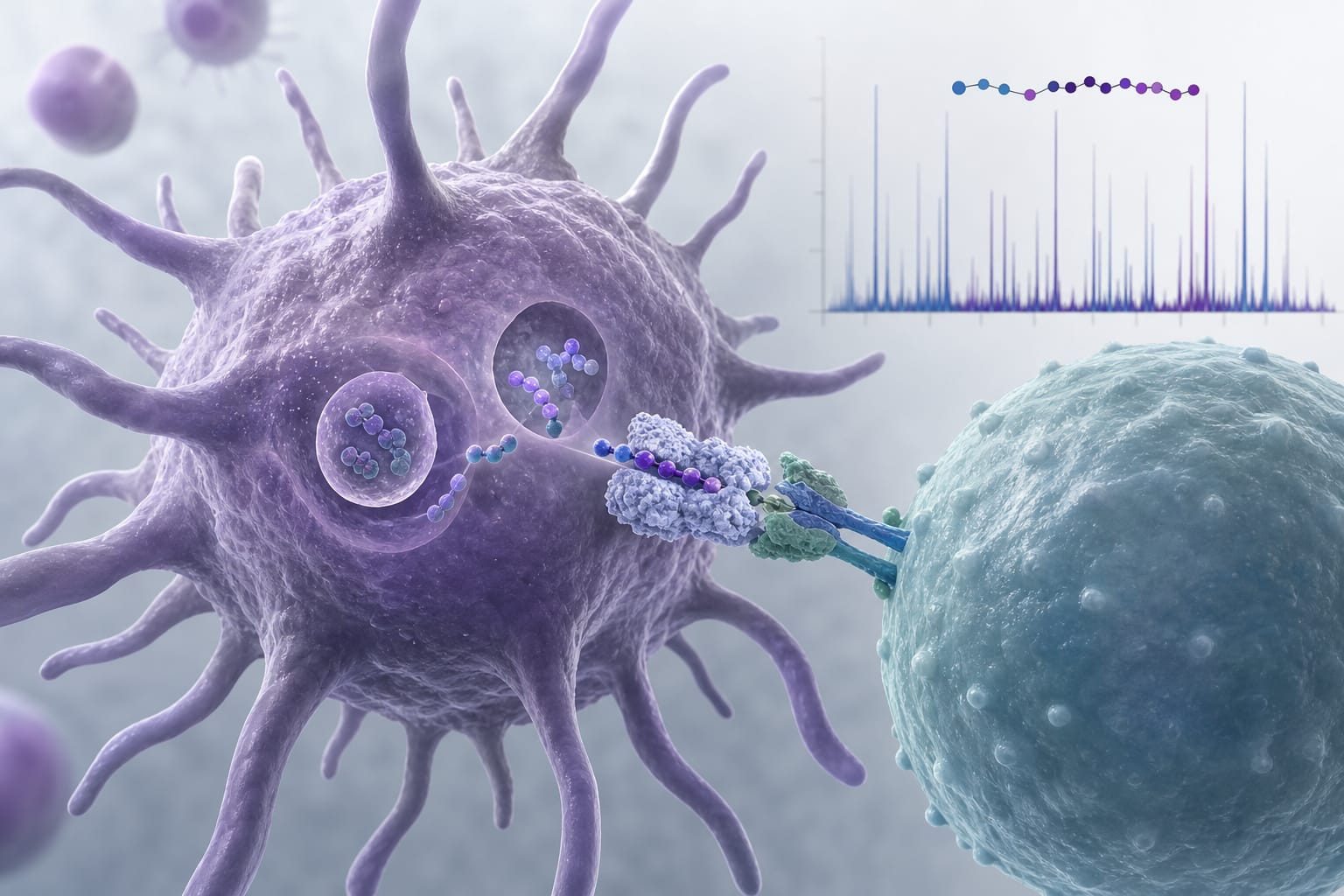
The introduction of clinical MAPPs represents a significant advancement in the personalized assessment of immunogenicity risks associated with therapeutic monoclonal antibodies (mAbs). This optimized assay allows for the identification of MHC-II receptor-associated antibody-derived peptides from low blood volumes.

Background

The development of anti-drug antibodies (ADAs) can significantly impact the efficacy and safety of therapeutic monoclonal antibodies (mAbs). Understanding the immunogenicity of these treatments is crucial for optimizing patient outcomes. The clinical MAPPs assay offers a novel approach to assess immunogenicity risks in individual patients.

Data Highlights

No numerical data or trial results were provided in the source material.

Key Findings

  • Clinical MAPPs is an optimized, miniaturized version of the traditional MAPPs assay designed for clinical use.
  • The assay can work with cryopreserved peripheral blood mononuclear cells from low blood volumes (10 mL).
  • Clinical MAPPs enables personalized characterization of MHC-II receptor-associated antibody-derived peptides before mAb treatment.
  • This assay promises to enhance immunogenicity risk assessments in clinical settings.
  • Traditional MAPPs has been limited to preclinical use due to high cell number requirements from healthy donors.

Clinical Implications

The clinical MAPPs assay may facilitate identification of immunogenicity risks in patients receiving mAb treatments.

Conclusion

The development of clinical MAPPs marks a significant step forward in the personalized assessment of immunogenicity risks.

Related Resources & Content

  1. FDA, HHS, 2025 -- Immunogenicity Information in Human Prescription Therapeutic Protein and Select Drug Product Labeling--Content and Format
  2. The ASCO Post, 2022 -- Results From MAPPYACTS Trial Show the Feasibility and Benefit of Molecular Profiling at Cancer Recurrence in Pediatric Patients KEY POINTS
  3. Blood Cancer Journal, 2022 -- Cytogenetic and Multiplex Molecular Techniques for Risk Stratification in Leukemia: Findings from a Multicenter Validation Study
  4. Blood Cancer Journal, 2025 -- Characterization of Targeted T-cell Responses and T-cell Receptor Specificity for Shared Neoantigens in Acute Myeloid Leukemia
  5. PubMed, 2025 -- Early monitoring of anti-infliximab antibodies by drug-tolerant assay predicts later immunogenicity and drug survival in rheumatic diseases
  6. Blood Cancer Journal — Enhanced Detection of Blood-Based M-Protein in sCR Patients with Multiple Myeloma
  7. Immunogenicity Information in Human Prescription Therapeutic Protein and Select Drug Product Labeling--Content and Format
  8. Early monitoring of anti-infliximab antibodies by drug-tolerant assay predicts later immunogenicity and drug survival in rheumatic diseases - PubMed
  9. MAPPs assays for non-clinical immunogenicity risk assessment: best practices recommended by the European immunogenicity platform

Original Source(s)

Related Content