Clinical Report: Multi-Scale Attention-Enhanced Deep Learning for KOA Grading
Overview
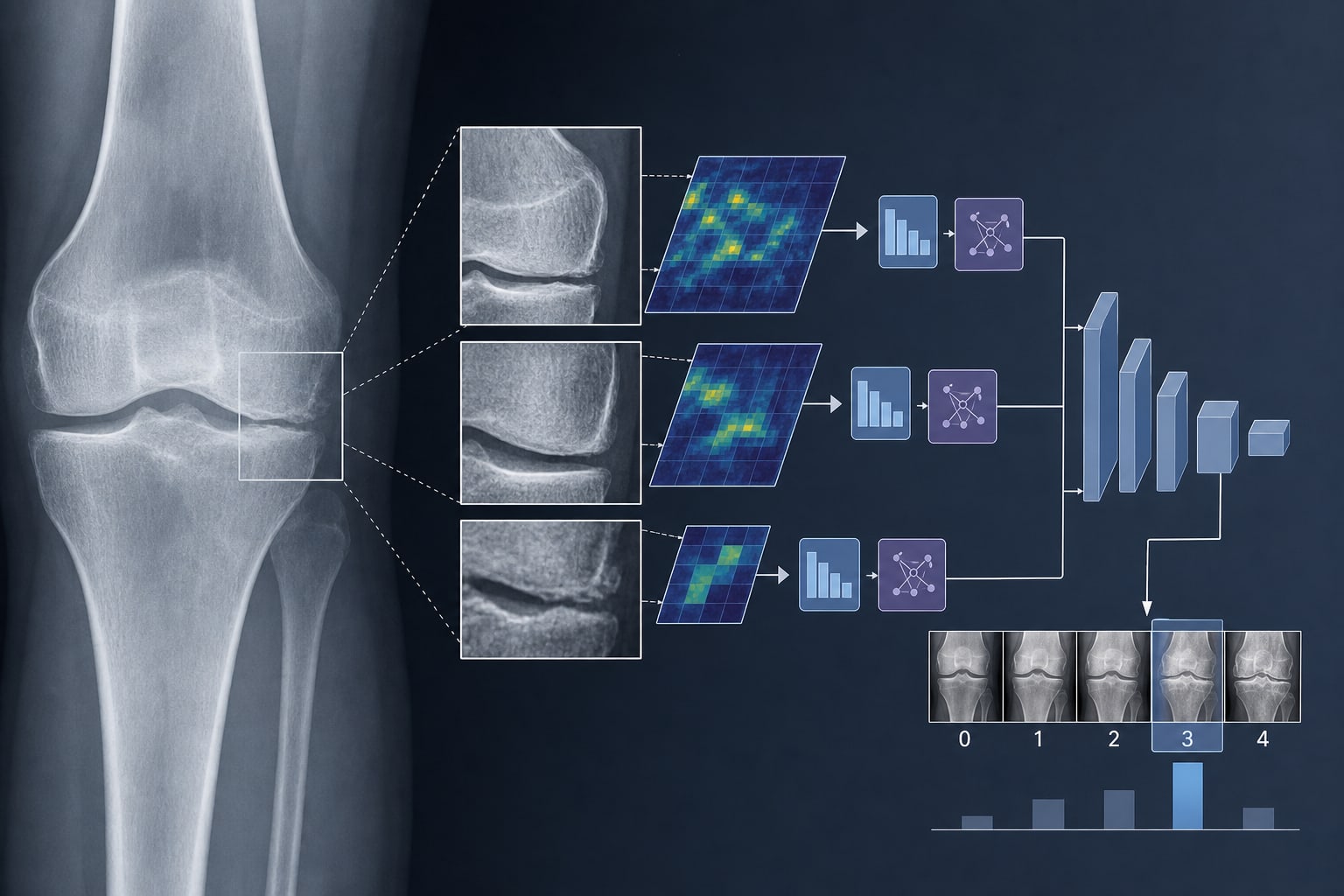
A novel multi-scale attention-guided deep learning framework was developed for automated grading of knee osteoarthritis (KOA) using the Kellgren–Lawrence (KL) system. The model demonstrated superior performance on both internal and external validation datasets, addressing limitations of previous models and enhancing clinical reliability.
Background
Knee osteoarthritis (KOA) is a prevalent degenerative joint disease that significantly impacts patient quality of life. Accurate radiographic grading using the Kellgren–Lawrence system is crucial for treatment decision-making but is often hindered by subjective interpretation and variability among observers. The integration of advanced deep learning techniques offers potential improvements in diagnostic accuracy and efficiency in clinical settings.
Data Highlights
Validation Type
F1 Score
Precision
MCC
Accuracy
Internal
0.726
0.740
0.620
0.726
External
0.656
0.683
0.564
0.685
Key Findings
The multi-scale attention-guided framework outperformed baseline architectures in internal validation.
On external validation, the model maintained robust generalization with only a 4.04% drop in accuracy.
Misclassifications were primarily limited to adjacent KL grades, indicating clinical reliability.
Gradient-weighted Class Activation Mapping (Grad-CAM) showed alignment of model attention with clinically relevant regions.
The model integrates a Feature Pyramid Network, dual-attention mechanisms, and knowledge distillation for enhanced performance.
Clinical Implications
The proposed deep learning framework can facilitate standardized, objective assessment of KOA severity, potentially improving treatment planning and patient outcomes. Its ability to generalize across datasets may enhance the reliability of radiographic evaluations in diverse clinical settings.
Conclusion
This study presents a significant advancement in automated KOA grading through a multi-scale attention-guided deep learning approach, addressing previous limitations and supporting clinical decision-making.