The role of 18F-FDG PET/CT in identifying risk factors for ground-glass nodules in invasive lung adenocarcinoma - Report - MDSpire

The role of 18F-FDG PET/CT in identifying risk factors for ground-glass nodules in invasive lung adenocarcinoma

  • By

  • Wenjun Bao

  • Chenmin Ding

  • Nan Li

  • Min Huang

  • Zaosheng Huang

  • Hailong Li

  • Jing Fan

  • Tiantian He

  • Xibao Mao

  • July 7, 2026

  • 0 min

Share

Clinical Report: Utilizing 18F-FDG PET/CT to Assess Risk Factors in LUAD

Overview

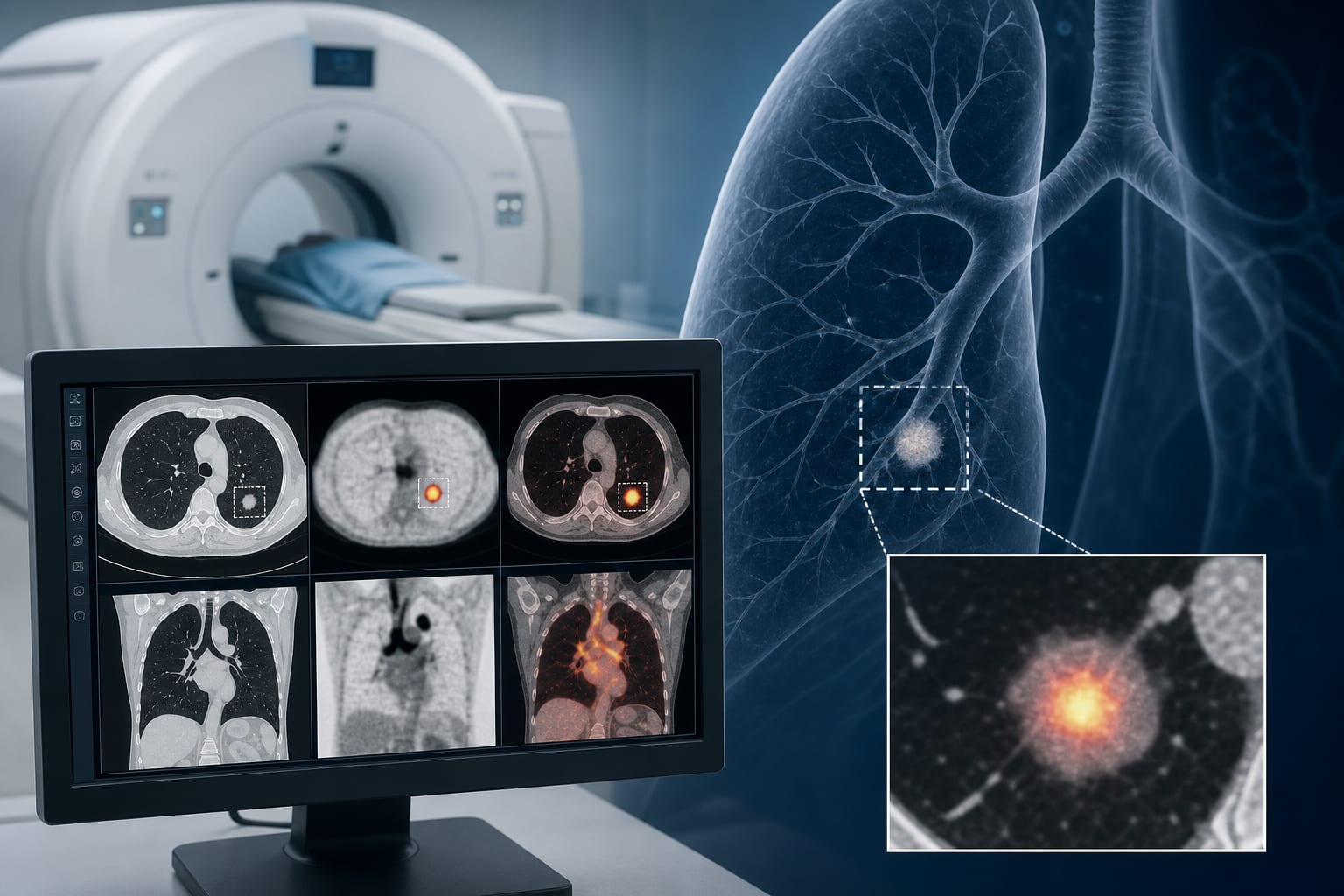
This study developed an 18F-FDG PET/CT-based predictive model to differentiate high-risk invasive lung adenocarcinoma (LUAD) subtypes associated with ground-glass nodules (GGNs). Key independent predictors identified include SUVmax, nodule diameter, and lesion location.

Background

Lung adenocarcinoma (LUAD) is the most common subtype of lung cancer, accounting for about 40% of cases. Micropapillary- and solid-predominant LUAD subtypes are associated with poor prognosis and high recurrence rates. Accurate preoperative risk assessment is crucial for optimizing clinical management.

Data Highlights

ModelAUC (Training)AUC (Test)
Original Model0.9210.855
Optimized Model0.9340.873

Key Findings

  • MPA and SPA subtypes of LUAD are high-risk with unfavorable prognosis.
  • Independent predictors for high-risk LUAD include SUVmax, nodule diameter, and lesion location.
  • The original three-variable model achieved AUCs of 0.921 and 0.855 for training and test cohorts, respectively.
  • The optimized model incorporating CT attenuation and vacuole sign improved AUCs to 0.934 and 0.873.
  • No statistical intergroup differences were found between the original and optimized models (all P > 0.05).

Clinical Implications

The findings support the use of 18F-FDG PET/CT parameters for non-invasive preoperative risk evaluation of high-risk LUAD associated with GGNs.

Conclusion

The study demonstrates that PET/CT-derived metrics can effectively stratify high-risk LUAD.
Related Resources & Content

  1. Frontiers in Medicine, 2026 -- The predictive value of 18F-FDG PET/CT habitat radiomics combined model in evaluating EGFR gene mutations in lung adenocarcinoma
  2. European Radiology, 2024 -- Guidelines for Staging and Restaging in Oncology Using FDG-PET/CT: Recommendations from the European Society for Hybrid, Molecular, and Translational Imaging
  3. Frontiers in Oncology, 2026 -- 18F-FDG PET/CT for Predicting Major Pathological Response to Neoadjuvant Therapy in Non-Small Cell Lung Cancer: A Meta-Analysis
  4. The ASCO Post, 2012 -- FDG-PET Falls Short for Diagnosis of Non–Small Cell Lung Cancer
  5. Non-Small Cell Lung Cancer, Version 4.2026, NCCN Clinical Practice Guidelines In Oncology - PubMed
  6. Correlation between [18F]-FDG PET/CT findings and pathological subtypes of lung adenocarcinoma presenting as ground-glass opacity - PubMed
  7. Micropapillary or solid component predicts worse prognosis in pathological IA stage lung adenocarcinoma: A meta-analysis - PubMed
  8. Non-Small Cell Lung Cancer, Version 4.2026, NCCN Clinical Practice Guidelines In Oncology - PubMed
  9. Correlation between [18F]-FDG PET/CT findings and pathological subtypes of lung adenocarcinoma presenting as ground-glass opacity - PubMed
  10. Micropapillary or solid component predicts worse prognosis in pathological IA stage lung adenocarcinoma: A meta-analysis - PubMed

Original Source(s)

Related Content