Baseline 18F-FDG PET/CT habitat radiomics versus dual-channel deep learning for predicting interim PET early metabolic response in diffuse large B-cell lymphoma: a comparative study - Report - MDSpire
Advertisement
Baseline 18F-FDG PET/CT habitat radiomics versus dual-channel deep learning for predicting interim PET early metabolic response in diffuse large B-cell lymphoma: a comparative study
Clinical Report: Predicting Early Metabolic Response in DLBCL Using Radiomics
Overview
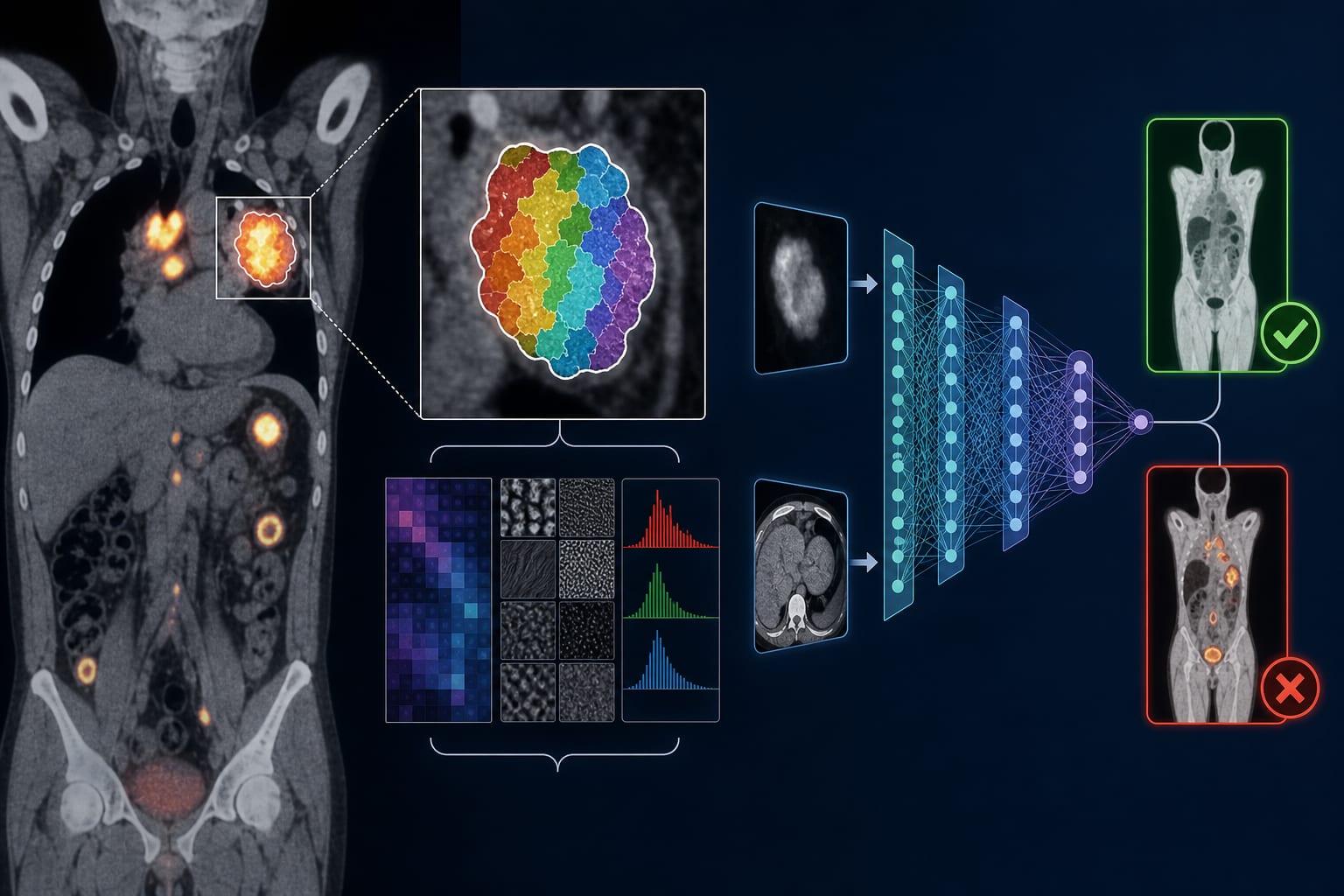
This study developed and compared baseline 18F-FDG PET/CT habitat radiomics and dual-channel deep learning models for predicting early metabolic response (EMR) in patients with diffuse large B-cell lymphoma (DLBCL). The habitat radiomics model demonstrated superior performance over the deep learning model, suggesting its potential as a decision-support tool for risk stratification.
Background
Diffuse large B-cell lymphoma (DLBCL) is the most common subtype of non-Hodgkin lymphoma, accounting for 25-30% of cases. Despite advancements in treatment, a significant proportion of patients experience inadequate responses to therapy, highlighting the need for effective early identification of those at risk. Baseline imaging techniques, such as 18F-FDG PET/CT, can provide valuable insights for predicting treatment outcomes.
Data Highlights
Model
AUC
Specificity
Accuracy
Habitat_MLP
0.871 (95% CI: 0.7563–0.9857)
0.903
0.822
DL_DenseNet161
0.793 (95% CI: 0.6409–0.9444)
0.677
0.711
Key Findings
The habitat radiomics model (Habitat_MLP) outperformed the dual-channel deep learning model (DL_DenseNet161) in predicting EMR in DLBCL.
Habitat_MLP achieved an AUC of 0.871, while DL_DenseNet161 achieved an AUC of 0.793.
Habitat_MLP demonstrated higher specificity (0.903) and accuracy (0.822) compared to DL_DenseNet161.
The study utilized a cohort of 148 patients, with 101 classified as EMR and 47 as non-EMR based on iPET Deauville scores.
Calibration curves and decision curve analysis indicated favorable performance of the Habitat_MLP model.
Radiomics features were extracted from both whole-tumor and habitat subregions to enhance predictive accuracy.
Clinical Implications
The findings suggest that the habitat radiomics model can serve as a robust tool for early metabolic response prediction in DLBCL, potentially guiding treatment decisions. Clinicians may consider integrating this model into routine practice for improved risk stratification and management of patients undergoing therapy.
Conclusion
The habitat radiomics model derived from baseline 18F-FDG PET/CT shows promise in enhancing early response prediction in DLBCL patients. Its superior performance underscores the importance of advanced imaging techniques in clinical decision-making.