Evaluation of cerebral hemodynamic assessment from time-of-flight magnetic resonance angiography using a topological network-based model with Transcranial Doppler measurements - Report - MDSpire
Advertisement
Evaluation of cerebral hemodynamic assessment from time-of-flight magnetic resonance angiography using a topological network-based model with Transcranial Doppler measurements
Clinical Report: Assessment of Cerebral Hemodynamics via Time-of-Flight MRA
Overview
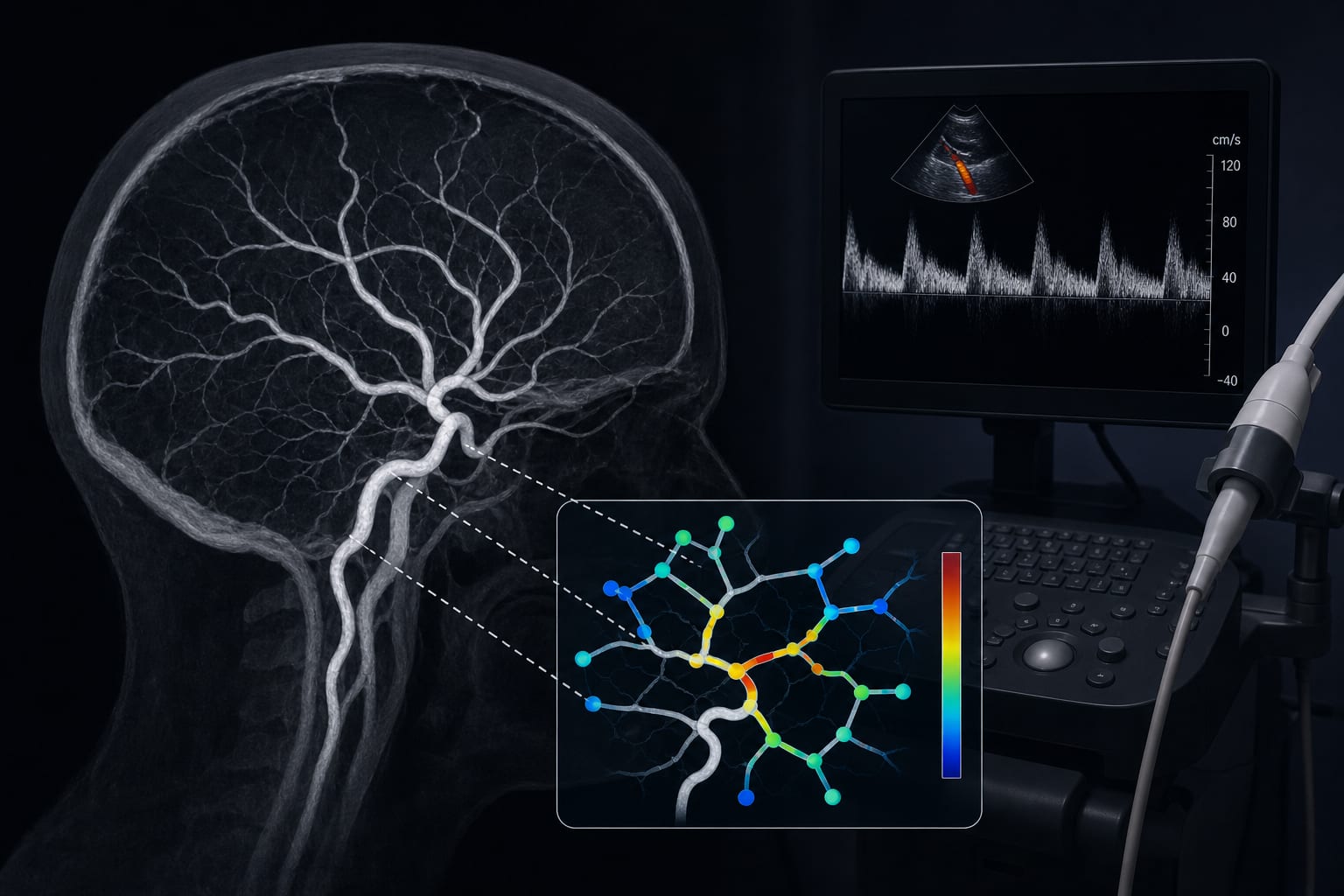
This study evaluates the performance of Dr. NEAR flow (DNF) in estimating cerebral hemodynamics by comparing DNF-calculated velocities with Transcranial Doppler (TCD) measurements in 113 patients. The findings indicate a significant positive correlation between the two modalities.
Background
Quantitative measurement of cerebral hemodynamics is critical for diagnosing and managing cerebrovascular diseases. Traditional methods like TCD have limitations, including operator dependency and inadequate acoustic windows, which can hinder accurate assessments. The development of DNF aims to provide a comprehensive and non-invasive approach to evaluating cerebral blood flow and pressure.
Data Highlights
Parameter
Value
Pearson’s correlation coefficient
r = 0.74
p-value
< 0.0001
Key Findings
DNF was evaluated in 113 patients with cerebrovascular diseases.
700 arterial-level velocity pairs were analyzed for correlation between DNF and TCD.
A statistically significant positive correlation was found (r = 0.74, p < 0.0001).
DNF provides a non-invasive alternative to TCD for assessing cerebral hemodynamics.
Patient-specific inflow boundary conditions were defined using TCD measurements.
Clinical Implications
The DNF method may provide an alternative for assessing cerebral hemodynamics in patients where TCD is limited.
Conclusion
The study supports DNF as a non-invasive tool for cerebrovascular assessment.