Intermittent theta burst stimulation enhances the efficacy of brain–computer interface in upper limb rehabilitation post-stroke - Report - MDSpire

Intermittent theta burst stimulation enhances the efficacy of brain–computer interface in upper limb rehabilitation post-stroke

  • By

  • Xiaoqian Xia

  • Xiaoyu Kang

  • Lingyun Jia

  • Qianhui Wang

  • Linyao Zhang

  • Ruoqing Zhang

  • Yizheng Wang

  • Xiaoli Wu

  • Xiaogang Chen

  • Lixu Liu

  • June 19, 2026

  • 0 min

Share

Clinical Report: Enhancing Upper Limb Rehabilitation Post-Stroke

Overview

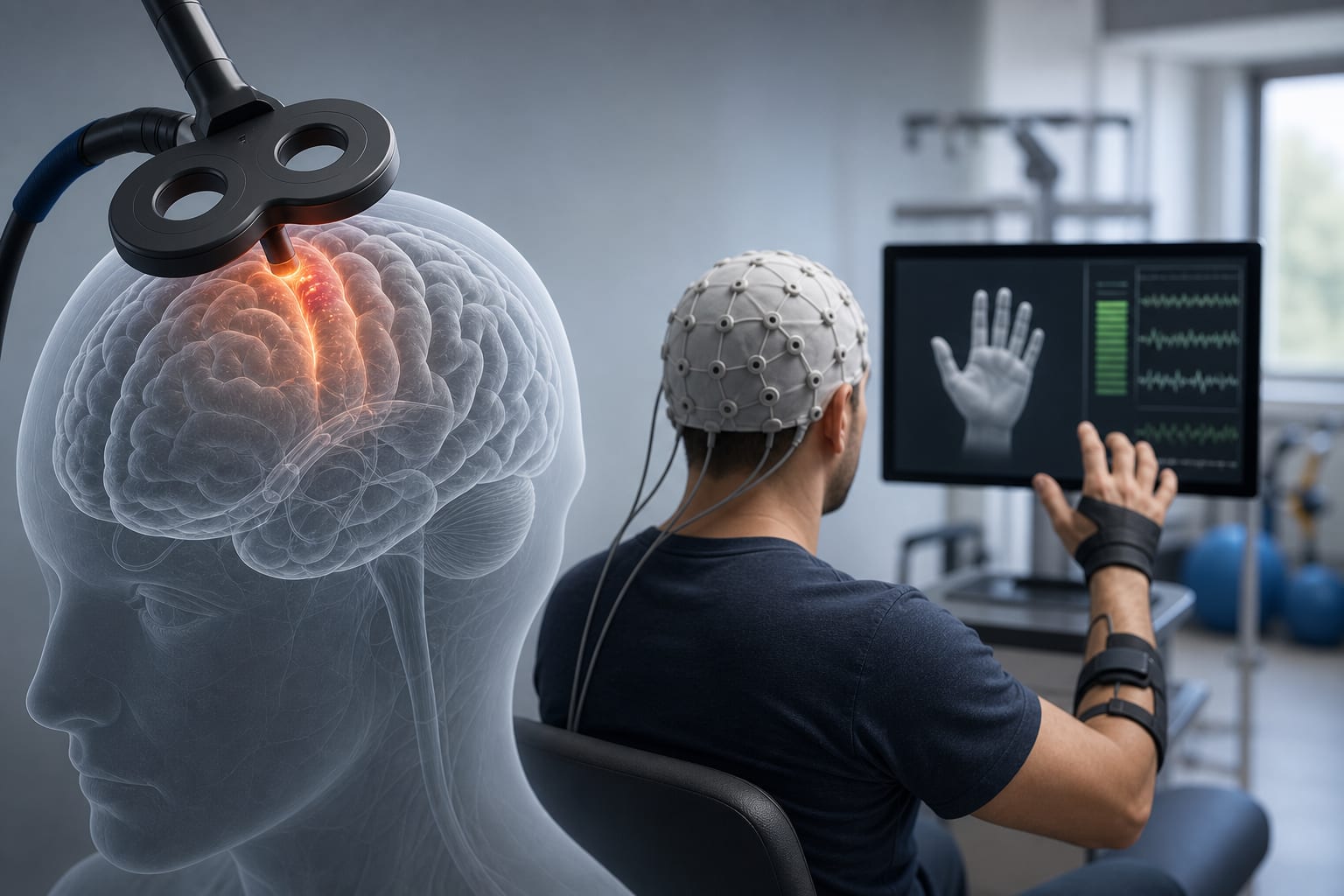
This exploratory study investigates the effects of intermittent theta burst stimulation (iTBS) combined with brain-computer interface (BCI) training on upper limb rehabilitation in stroke patients. Results indicate that the iTBS + BCI group showed improvements in Fugl-Meyer Assessment scores and BCI task accuracy compared to the BCI group alone.

Background

Stroke is a leading cause of disability worldwide, with a significant proportion of survivors experiencing upper limb motor dysfunction. Traditional rehabilitation methods often fall short in promoting comprehensive recovery, particularly in distal motor skills. The integration of BCI technology with neuromodulatory techniques like iTBS may offer new avenues for enhancing motor recovery in this population.

Data Highlights

Outcome MeasureiTBS + BCI GroupBCI Groupp-value
FMA-UE ImprovementSignificantNot significant0.008
BCI Task Accuracy87.22 ± 10.83%68.24 ± 5.75%0.041
ERD Over Affected CortexDeeper ERDShallower ERD0.001
Laterality Index ShiftTowards affected sideNo shift0.017

Key Findings

  • The iTBS + BCI group showed greater improvement in FMA-UE scores at week 4 compared to the BCI group.
  • BCI task accuracy was significantly higher in the iTBS + BCI group.
  • Only the iTBS + BCI group demonstrated deeper Event-Related Desynchronization (ERD) over the affected sensorimotor cortex.
  • The Laterality Index shifted towards the affected side only in the iTBS + BCI group.
  • Attention improvement correlated negatively with BCI task accuracy in the iTBS + BCI group.

Clinical Implications

The findings suggest that incorporating iTBS with BCI training may enhance cortical excitability and improve motor recovery outcomes in stroke patients. This approach could address the challenge of 'BCI illiteracy' and promote better rehabilitation strategies.

Conclusion

Sequential application of iTBS prior to BCI training may represent a promising strategy for enhancing upper limb rehabilitation in stroke patients, warranting further investigation in larger trials.

Related Resources & Content

  1. Frontiers in Neurology, 2026 -- The effect of non-invasive brain stimulation combined with motor imagery on upper limb motor function and activities of daily living in stroke patients: A systematic review and Meta-analysis
  2. Frontiers in Neurology, 2026 -- High-dose accelerated intermittent theta burst stimulation targeting the primary motor cortex for gait and cognitive functions in cerebral small vessel disease: a randomized controlled trial
  3. Frontiers in Neurology, 2026 -- Effects of Non-Invasive Neural Stimulation Modalities on Upper Limb Function in Subacute Stroke: A Systematic Review and Meta-Analysis
  4. European Stroke Organisation (ESO) guideline on motor rehabilitation - PMC
  5. Frontiers in Neurology — Transcranial magnetic stimulation combined with functional near-infrared spectroscopy to elucidate the neurophysiological mechanisms of post-stroke hemiplegia: a systematic review
  6. Effect of intermittent theta burst stimulation on upper limb function in stroke patients: a systematic review and meta-analysis
  7. European Stroke Organisation (ESO) guideline on motor rehabilitation - PMC
  8. Rehabilitation with brain-computer interface and upper limb motor function in ischemic stroke: A randomized controlled trial - ScienceDirect

Original Source(s)

Related Content