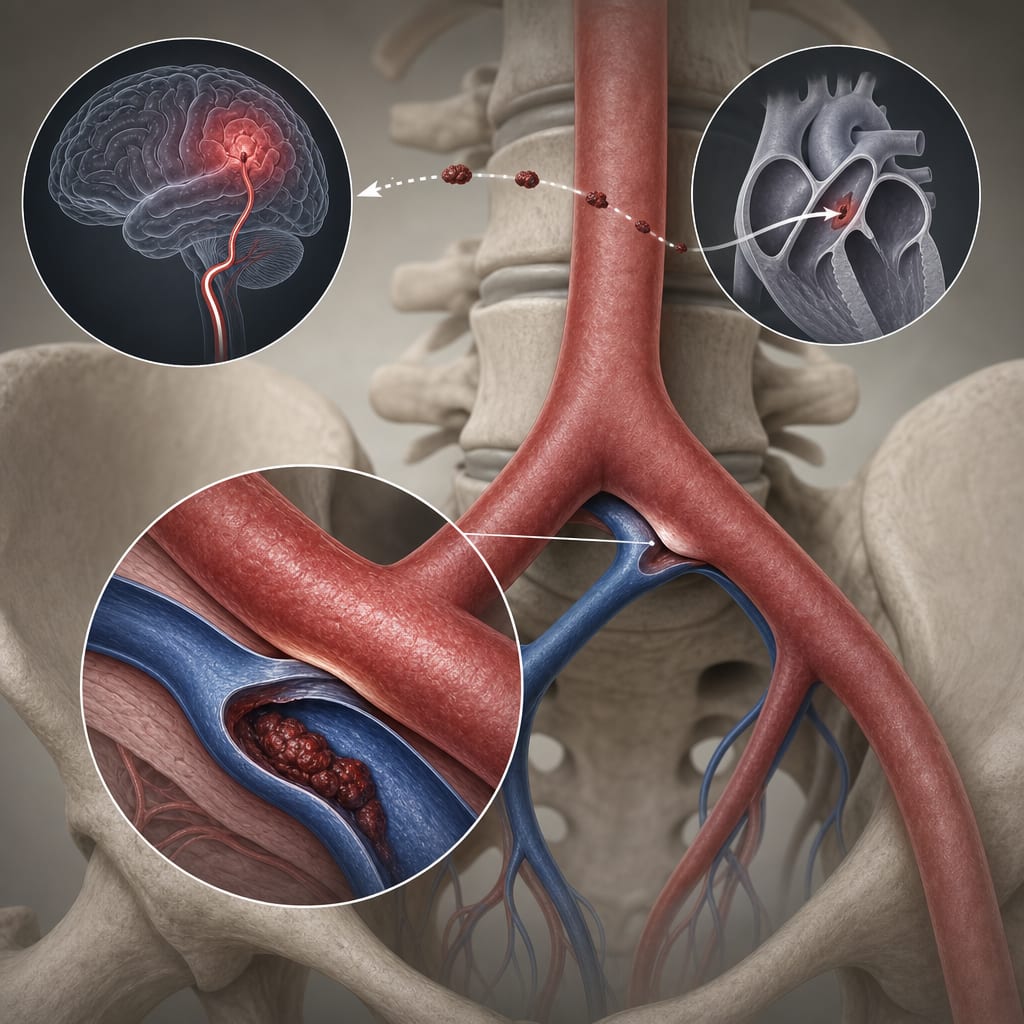
Clinical Report: May-Thurner Syndrome: An Underlying Cause of Ischemic Stroke in Younger Adults
Overview
Expand on the connection between MTS and ASD, particularly how they contribute to stroke risk.
Background
Stroke in young adults often poses a diagnostic challenge due to the absence of traditional risk factors, with many cases remaining cryptogenic. May-Thurner syndrome, characterized by the compression of the left iliac vein by the right iliac artery, is a significant but underrecognized cause of venous thromboembolism that can lead to serious complications, including ischemic stroke. Understanding MTS is crucial for timely diagnosis and management in younger patients presenting with stroke.
Data Highlights
Diagnostic Study
Findings
Brain MRI
3-mm left parietal ischemic infarct
Transthoracic Echocardiogram
Small ASD with an aneurysm
CT Pelvis
Possible 1-cm filling defect in the distal right internal iliac vein
MRV/MRA
Mild-to-moderate narrowing of the left common iliac vein consistent with MTS
Key Findings
May-Thurner syndrome is estimated to account for 2-5% of all DVTs.
Significant left common iliac vein compression occurs in approximately 24% of asymptomatic individuals.
The patient presented with right-sided weakness and aphasia, indicative of ischemic stroke.
Comprehensive hypercoagulable workup was negative, highlighting the need for anatomical evaluations.
Triptans were discontinued due to their vasoconstrictive properties, and propranolol was initiated for migraine prophylaxis.
Clinical Implications
Healthcare providers should consider anatomical variants like MTS in young patients presenting with ischemic stroke, especially when traditional risk factors are absent. A thorough cardiovascular evaluation, including imaging studies, is essential for accurate diagnosis and management.
Conclusion
This case underscores the importance of recognizing May-Thurner syndrome as a potential cause of ischemic stroke in younger adults, which can significantly impact treatment and prevention strategies.
For years, chronic stroke patients heard familiar feedback regarding their ability to regain strength and mobility after ischemic strokes caused upper-extremity deficits.