Localized surface plasmon resonance-based point-of-care testing for pediatric sepsis - Report - MDSpire

Localized surface plasmon resonance-based point-of-care testing for pediatric sepsis

  • By

  • Xiao Zhang

  • Jing Zhang

  • Minghao Wang

  • Zelin Liu

  • Zhibo Gai

  • Xia Li

  • July 16, 2026

Share

Clinical Report: Point-of-Care Diagnostic Testing for Pediatric Sepsis Utilizing Localized Surface Plasmon Resonance Technology

Overview

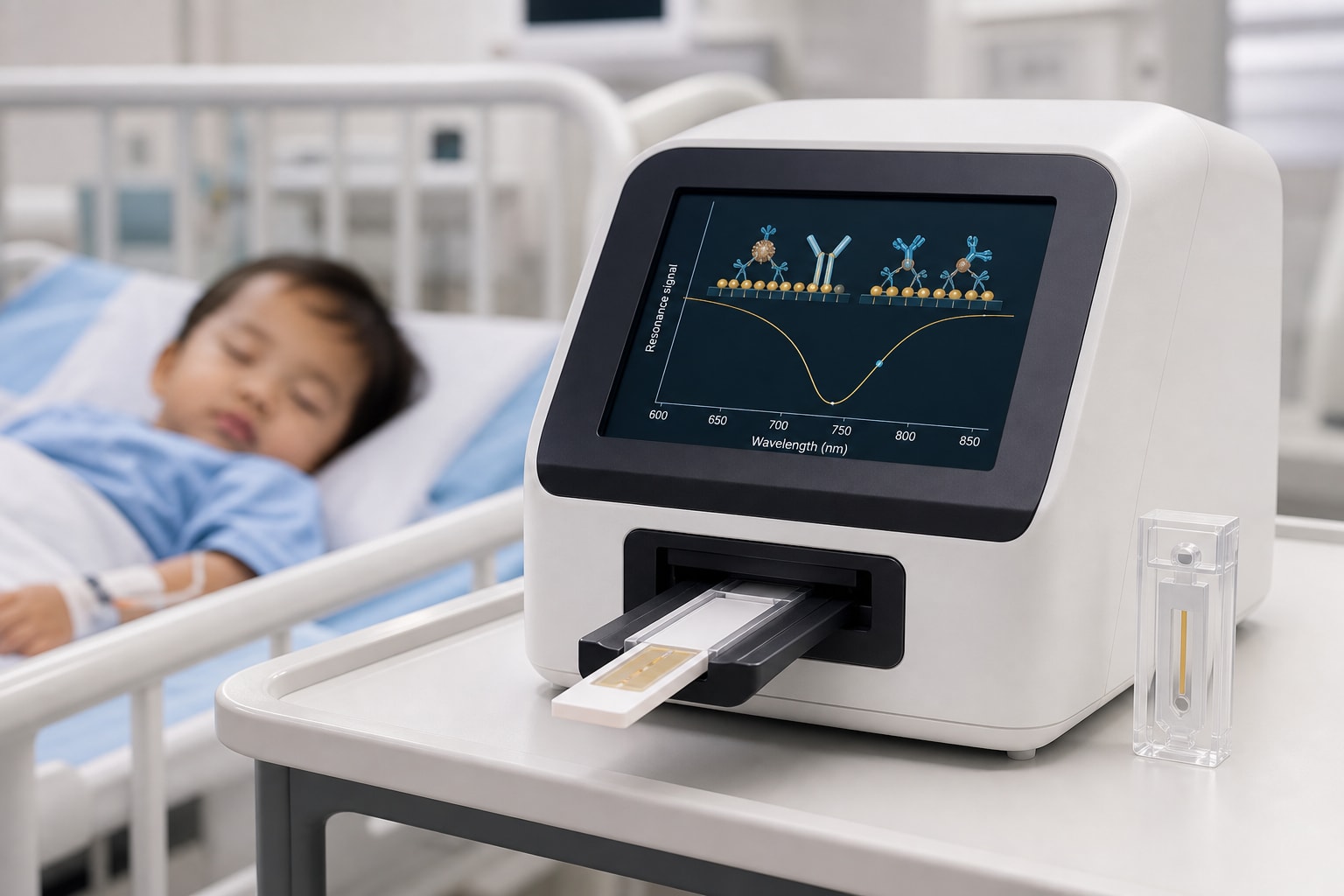
This review highlights the role of localized surface plasmon resonance (LSPR) technology in developing point-of-care testing (POCT) for pediatric sepsis.

Background

Sepsis is a leading cause of mortality in children, with timely diagnosis being crucial for effective management. Conventional diagnostic methods are often too slow, delaying necessary treatment. The development of POCT, particularly using LSPR technology, aims to provide rapid and sensitive detection of biomarkers.

Data Highlights

No specific numerical data or trial results were provided in the source material.

Key Findings

  • Sepsis accounts for millions of childhood deaths annually, with high mortality rates in critically ill children.
  • Conventional diagnostic methods can take 24 to 72 hours, delaying targeted therapy.
  • LSPR technology enables label-free, sensitive detection of biomolecular interactions.
  • POCT systems based on LSPR can improve clinical decision-making in both high-resource and limited-resource settings.
  • The review discusses the current state of LSPR-based POCT development and its future directions.

Clinical Implications

The integration of LSPR-based POCT in pediatric healthcare could enhance the speed and accuracy of sepsis diagnosis.

Conclusion

LSPR technology represents an advancement in the diagnostic landscape for pediatric sepsis, addressing needs for rapid and accurate testing.

Related Resources & Content

  1. The pathologist, The 5-Hour Sepsis Test: No Cultures Required, 2026 -- A clinical study demonstrating rapid diagnostics for sepsis.
  2. Open Forum Infectious Diseases, Evaluating the Health Benefits and Economic Implications of a Point-of-Care Diagnostic for Neonatal Sepsis and Serious Bacterial Infections in Infants: A Modeling Study Across Two Environments, 2022 -- A study on the cost-effectiveness of POCT for neonatal sepsis.
  3. BMJ Paediatrics Open, Future perspectives on the use of molecular assays for pathogen identification in neonatal sepsis, 2023 -- A survey study on molecular assays for neonatal sepsis.
  4. Infection — Assessment of a connected device for isothermal molecular diagnostics
  5. International Consensus Criteria for Pediatric Sepsis and Septic Shock
  6. Surviving Sepsis Campaign International Guidelines for the Management of Sepsis and Septic Shock in Children 2026
  7. Managing suspected sepsis in under 16s: NICE Guidance
  8. Part 8: Pediatric Advanced Life Support: 2025 American Heart Association and American Academy of Pediatrics Guidelines for Cardiopulmonary Resuscitation and Emergency Cardiovascular Care | Pediatrics | American Academy of Pediatrics
  9. Identifying the thresholds of C-reactive protein, procalcitonin, and interleukin-6 among children ≤36 months’ old with fever without source at risk of serious bacterial infections: a systematic review and meta-analysis - PMC
  10. Systematic review and meta-analysis of the diagnostic value of four biomarkers in detecting neonatal sepsis in low- and middle-income countries | BMJ Paediatrics Open
  11. Frontiers | Diagnostic performance of interleukin-27 and C-reactive protein in neonatal sepsis: an updated systematic review and meta-analysis
  12. A comparative evaluation of salivary and serum procalcitonin to identify infants with serious bacterial infections | European Journal of Pediatrics | Springer Nature Link
  13. Multiple cross displacement amplification coupled with a lateral flow biosensor for ultra-rapid and highly sensitive detection of Escherichia coli in neonatal sepsis | Microbiology Spectrum
  14. Frontiers | Localized surface plasmon resonance-based point-of-care testing for pediatric sepsis
  15. Recent advances in the biosensing platforms for sepsis diagnosis
  16. Point-of-care biosensors for infectious disease diagnosis: recent updates and prospects

Original Source(s)

Related Content