Development of an interpretable machine learning model and web application for peri-colonoscopy hypoglycemia risk in hospitalized patients undergoing colonoscopy - Report - MDSpire
Advertisement
Creation of an interpretable machine learning framework and web tool for assessing hypoglycemia risk during colonoscopy in hospitalized individuals
Clinical Report: Machine Learning Framework for Hypoglycemia Risk in Colonoscopy
Overview
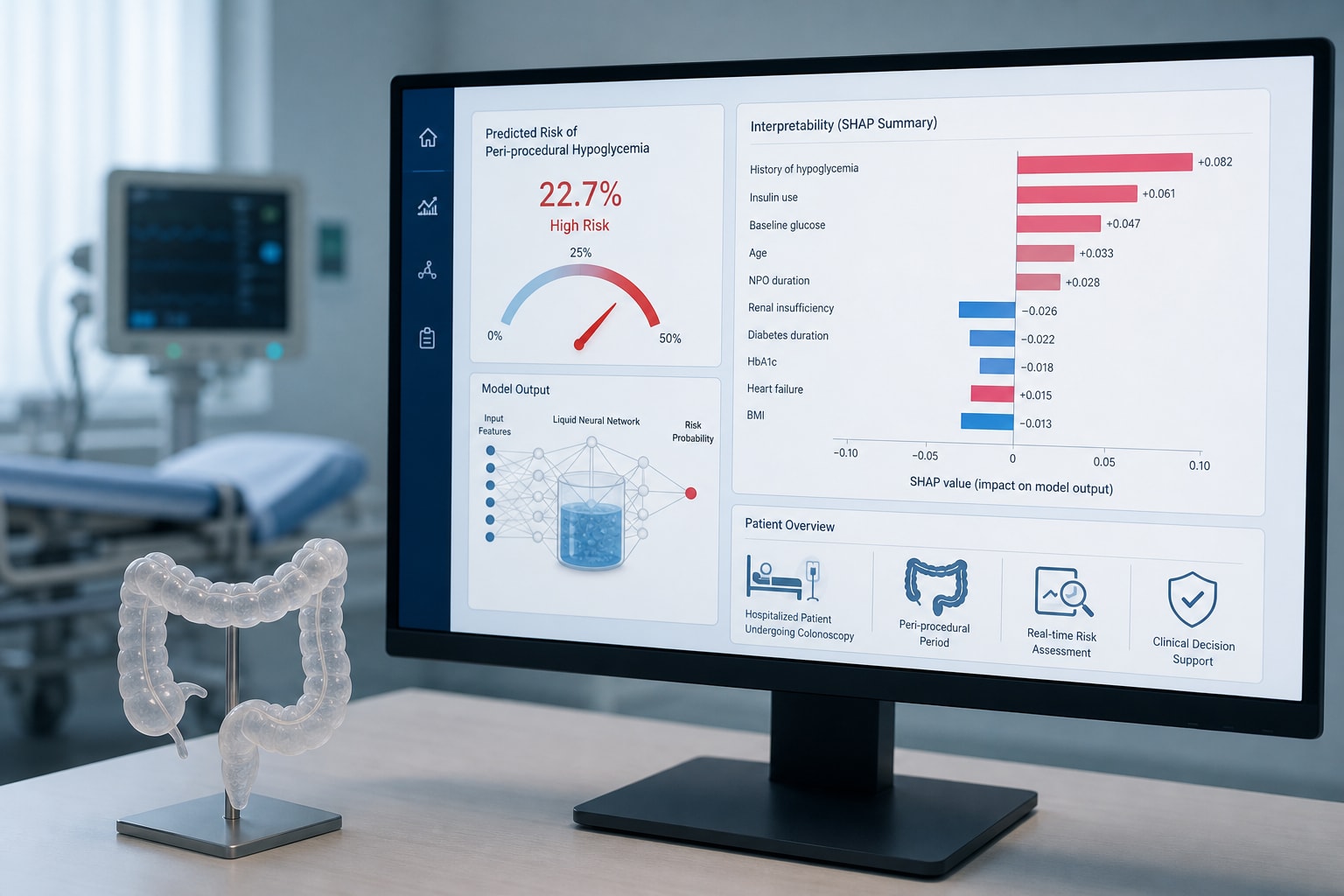
This study developed and validated a liquid neural network (LNN) model to predict peri-procedural hypoglycemia in hospitalized patients undergoing colonoscopy. The model demonstrated strong predictive performance.
Background
Colonoscopy is vital for colorectal cancer management, but the bowel preparation process can disrupt glucose homeostasis, leading to hypoglycemia. Identifying patients at risk for hypoglycemia is important in hospitalized individuals.
Data Highlights
Model
AUC
Sensitivity
Specificity
LNN
0.851
76.83%
85.50%
RF
0.831
-
-
XGBoost
0.829
-
-
LR
0.765
-
-
DCT
0.750
-
-
Key Findings
The incidence of peri-procedural hypoglycemia was 15.2% among the studied population.
Seven features were identified as significant predictors of hypoglycemia: bowel preparation solution volume, sex, fasting duration, nutritional risk, insulin use, history of diabetes mellitus, and albumin.
The LNN model achieved the highest AUC of 0.851.
The external validation of the web application yielded an AUC of 0.848 with a sensitivity of 74.07% and specificity of 86.52%.
SHAP analysis highlighted nutritional risk, albumin, and sex as principal predictors of hypoglycemia risk.
Clinical Implications
The LNN-based model provides a tool for assessing hypoglycemia risk in hospitalized patients undergoing colonoscopy.
Conclusion
The developed LNN model predicts peri-procedural hypoglycemia in hospitalized patients and maintains good performance in external validation.