How Widespread GLP-1 Advertising May Shape Body Image
-
By
-
Anna Zucker
-
October 19, 2026
Clinical Report: How Widespread GLP-1 Advertising May Shape Body Image
Overview
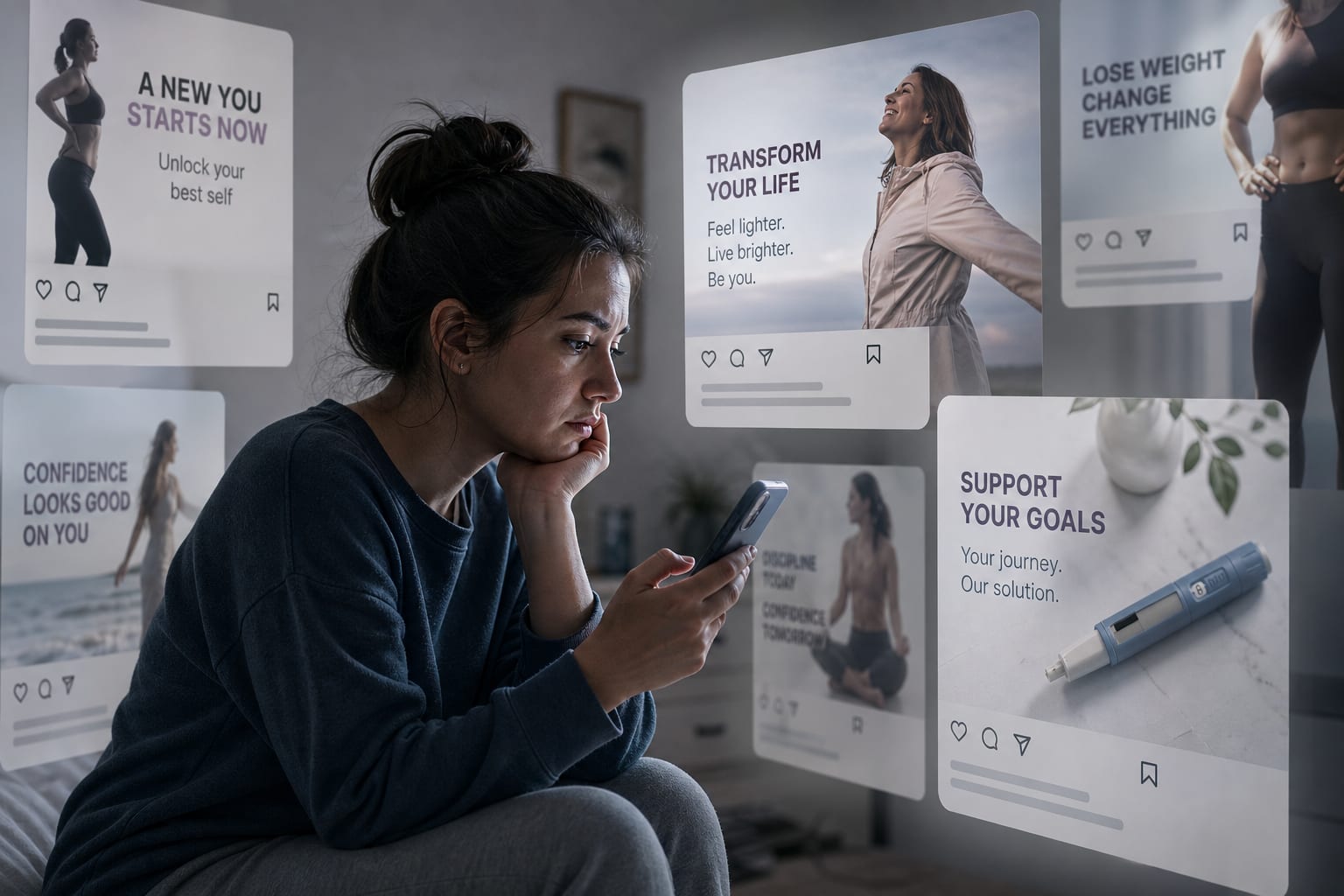
GLP-1 advertisements commonly frame treatment as a route to confidence and personal transformation, beyond messages about health, safety, and access. Evidence about the effects of repeated exposure on body image and disordered eating remains limited, although clinicians have reported concerns about advertising and disordered-eating behaviors.
Background
GLP-1 receptor agonists have become prominent medications for weight management, with Wegovy approved for this use in 2021 and Zepbound in 2023. The source describes widespread promotion through television and social media, including advertisements for FDA-approved products and compounded versions that direct consumers toward online assessments and possible telehealth prescriptions. Body image is an individual’s subjective perception of their body, and body-image distortion can be a component of severe eating disorders. The article raises concern that advertising may connect weight loss with self-worth while noting that the psychological effects of repeated exposure have not been adequately studied.
Data Highlights
| Measure or source | Finding |
|---|---|
| Worldwide GLP-1 sales, 2025 | US $79 billion |
| 2025 BMC Public Health study | Examined 90 FDA-approved GLP-1 advertisements posted on Facebook and Instagram from February 2023 to February 2024. Advertisements emphasized emotional and psychological effects, including confidence and transformation, alongside health, safety, consultation, support, ease, and affordability. |
| NEDA community survey | Received 2,670 responses. GLP-1 advertising was not a survey response option, but clinicians raised it in open-ended responses and described links between unavoidable advertising and increased disordered-eating behaviors in clients. |
Key Findings
- The 2025 study of 90 Facebook and Instagram advertisements found frequent appeals to confidence and becoming a “new you”; its authors said linking weight loss to these outcomes may reinforce societal beauty ideals and contribute to body dissatisfaction, particularly among vulnerable populations.
- A 2026 article in Body Image described body image as a potential motivator, mediator, and moderator throughout GLP-1 treatment. Its authors cautioned that weight loss does not reliably produce a healthier relationship with one’s body and that dissatisfaction may persist or appear as increased monitoring and anxiety about weight regain.
- The 2026 article called for research into whether internet-based access affects reasons for GLP-1 use and treatment participation, particularly when treatment is pursued for appearance-related reasons.
- In NEDA’s survey of 2,670 respondents, GLP-1 advertising was not a listed response option, but clinicians raised it in open-ended responses and reported links between unavoidable advertising and increased disordered-eating behaviors in clients.
- NEDA CEO Jessica Scheer said data collection has not kept pace with what appears in people’s feeds and treatment rooms. She reported that people attempting to opt out of GLP-1 advertising said the advertisements continued to appear, complicating efforts to limit exposure to comparison-triggering material.
- Dietitian Lauren Newman noted that GLP-1 medications can be helpful and life-changing for many people, while also carrying risks, side effects, and potential downsides; she expressed concern that advertising can imply weight reduction makes someone a better self.
Clinical Implications
The source identifies enhanced telehealth screening and more stringent advertising standards as possible ways to protect vulnerable populations without stigmatizing people who may benefit from treatment. The 2025 joint advisory described in the web research context specifies baseline screening for disordered eating before GLP-1 therapy and notes that telehealth and digital platforms can support ongoing nutritional and behavioral care.
Conclusion
GLP-1 advertising often presents medication as a means of emotional and personal transformation, while the effects of repeated exposure on body image and disordered eating remain insufficiently studied. The source calls attention to screening and advertising standards while recognizing that these medications may benefit some individuals.
Related Resources & Content
- BMC Public Health, 2025 — Study of FDA-approved GLP-1 advertisements on Facebook and Instagram (full title and authors not provided)
- Body Image, 2026 — Article on body image throughout GLP-1 treatment (full title and authors not provided)
- National Eating Disorders Association — Community survey on social media and eating disorders (year and URL not provided)
- American Diabetes Association, Diabetes Care, 2026 — 8. Obesity and Weight Management for the Prevention and Treatment of Diabetes: Standards of Care in Diabetes–2026
- American College of Lifestyle Medicine, American Society for Nutrition, Obesity Medicine Association, and The Obesity Society, 2025 — Joint advisory on GLP-1 therapy and disordered-eating screening (title and URL not provided)
- Acta Paediatrica — Dynamics of Body Composition and Metabolic Risk in Adolescents With Obesity Under GLP-1 Receptor Agonist Therapy
- the medicine maker — Regulators Sound Alarm on Dangers of Unapproved and Illicit GLP-1 Drugs
- Frontiers in Endocrinology — Reproductive Health and Aesthetic Ideals: The Rising Adoption of GLP-1 Receptor Agonists Amidst Limited Evidence
- Nature Medicine — Real-World, Digital-First GLP-1 Receptor Agonist Treatment for Women
- 8. Obesity and Weight Management for the Prevention and Treatment of Diabetes: Standards of Care in Diabetes–2026
- Semaglutide and Cardiovascular Outcomes in Obesity without Diabetes
- Dynamics of Body Composition and Metabolic Risk in Adolescents With Obesity Under GLP-1 Receptor Agonist Therapy
- Regulators Sound Alarm on Dangers of Unapproved and Illicit GLP-1 Drugs
- Reproductive Health and Aesthetic Ideals: The Rising Adoption of GLP-1 Receptor Agonists Amidst Limited Evidence
- Real-World, Digital-First GLP-1 Receptor Agonist Treatment for Women
- Meeting highlights from the Pharmacovigilance Risk Assessment Committee (PRAC) 8-11 April 2024 | European Medicines Agency (EMA)
Based on findings from:
GLP-1 Ads Are Everywhere. What Are They Doing to Our Body Image?
Anna Zucker. Journal Of Medical Internet Research, 2026.
https://www.jmir.org/2026/1/e113477
This content is an AI-generated, fully rewritten summary based on a published scholarly article. It does not reproduce the original text and is not a substitute for the original publication. Readers are encouraged to consult the source for full context, data, and methodology.