Preoperative Cobb angle-guided surgical decision-making between percutaneous kyphoplasty and short-segment fixation with vertebroplasty in stage III Kümmell disease without neurological deficits: a two-center retrospective study - Report - MDSpire

Guiding Surgical Choices in Stage III Kümmell Disease Without Neurological Deficits: A Retrospective Analysis of Preoperative Cobb Angle in Comparing Percutaneous Kyphoplasty and Short-Segment Fixation with Vertebroplasty Across Two Centers

  • By

  • Jun Hu

  • Long Tang

  • Yi Liu

  • Hong Yang

  • Yu Qiao

  • Xin Wang

  • July 17, 2026

Share

Clinical Report: Guiding Surgical Choices in Stage III Kümmell Disease

Overview

This study compares the outcomes of percutaneous kyphoplasty (PKP) and short-segment fixation with vertebroplasty (SSF+VP) in patients with stage III Kümmell disease without neurological deficits, focusing on operative time, blood loss, hospital stay, and pain outcomes as measured by VAS scores.

Background

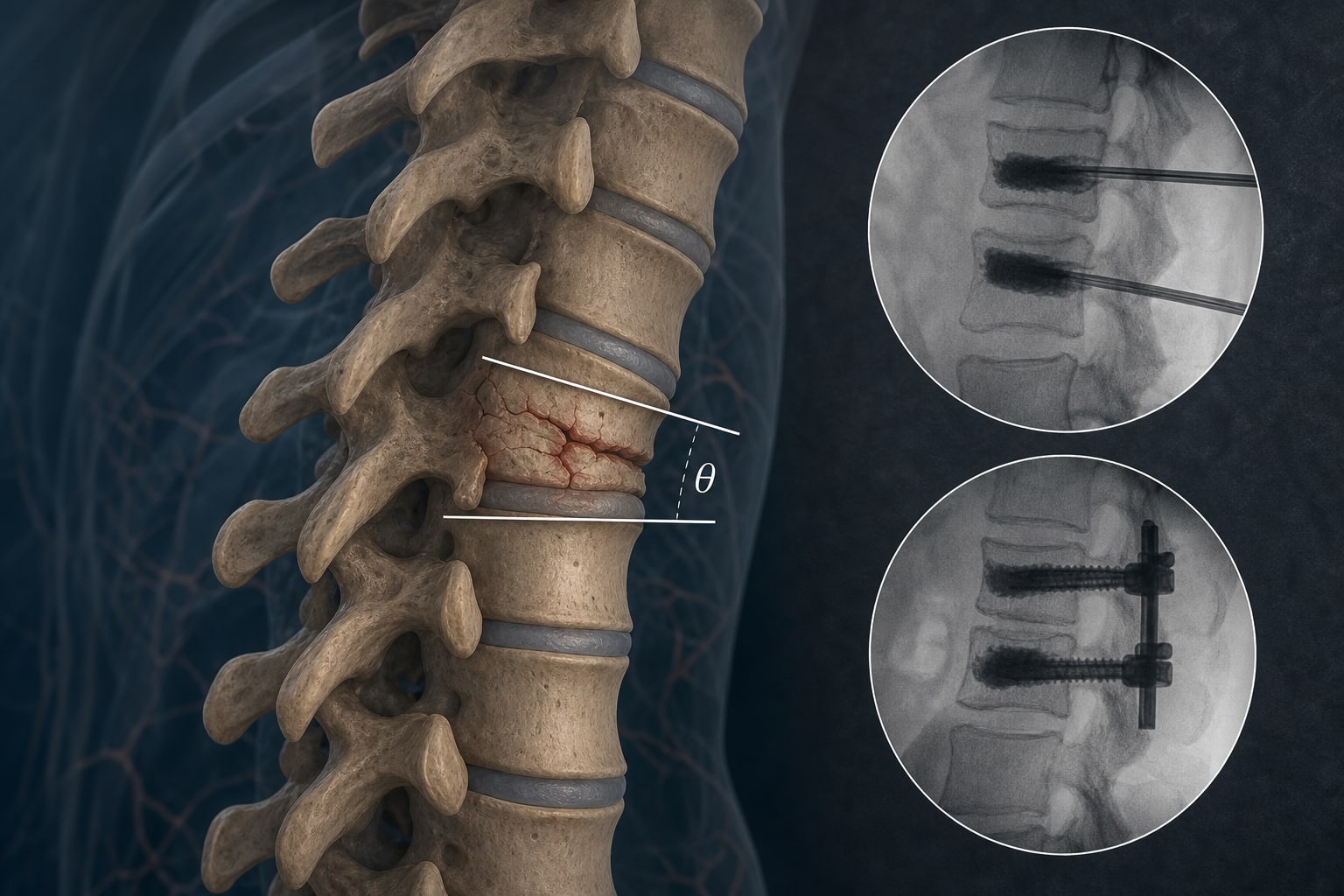
Kümmell disease (KD) is an osteonecrotic disorder of the vertebral body, primarily affecting elderly patients with osteoporosis. Stage III KD is characterized by significant vertebral collapse and kyphotic deformity, presenting challenges in surgical management. Understanding optimal surgical strategies is crucial for effective pain relief and prevention of long-term complications.

Data Highlights

ParameterPKPSSF+VP
Operative TimeShorterLonger
Blood LossLessMore
Cement VolumeSmallerLarger
Hospital StayShorterLonger
Final Follow-up VASHigherLower
Final Cobb AngleHigherLower

Key Findings

  • PKP resulted in shorter operative time and less blood loss compared to SSF+VP.
  • SSF+VP achieved lower postoperative and final Cobb angles with less Cobb angle loss.
  • In the PKP group, Cobb angle loss was positively correlated with final VAS scores.
  • The optimal preoperative Cobb angle cut-off for predicting residual pain after PKP was identified as 25.95°.
  • SSF+VP showed better intermediate-term pain outcomes in patients with severe kyphosis.

Clinical Implications

Preoperative Cobb angle assessment can aid in surgical decision-making for patients with stage III KD.

Conclusion

Both PKP and SSF+VP improved pain and function in stage III KD without neurological deficits.

Related Resources & Content

  1. Frontiers | Preoperative Cobb angle-guided surgical decision-making between percutaneous kyphoplasty and short-segment fixation with vertebroplasty in stage III Kümmell disease without neurological deficits: a two-center retrospective study
  2. Efficacy and safety of vertebroplasty versus posterior pedicle screw in treating stage III Kummell’s disease without neurological deficits: A systematic review and meta-analysis - PMC
  3. Assessment of Carbon Fiber-Reinforced Polyetheretherketone Vertebral Body Replacement in Patients with Spinal Tumors in the Thoracic and Lumbar Regions
  4. Epidemiology and Risk Factors for Kyphotic Deformity After Surgical Resection of Cervical Intradural Tumors in Adults: A Population-Based Analysis
  5. Frontiers in Surgery — Anterior Vertebrectomy and O-Arm Navigation for Old L5 Traumatic Fractures with Kyphotic Deformity: A Retrospective Case Series of Clinical and Radiological Outcomes
  6. Frontiers in Surgery — Unilateral extrapedicular vs. bilateral transpedicular percutaneous kyphoplasty in osteoporotic vertebral compression fractures: an exploratory systematic review and meta-analysis
  7. New Evidence-Based Clinical Guidelines for Adult Vertebral Fractures
  8. Efficacy and safety of vertebroplasty versus posterior pedicle screw in treating stage III Kummell’s disease without neurological deficits: A systematic review and meta-analysis - PMC
  9. Frontiers | Preoperative Cobb angle-guided surgical decision-making between percutaneous kyphoplasty and short-segment fixation with vertebroplasty in stage III Kümmell disease without neurological deficits: a two-center retrospective study

Original Source(s)

Related Content