Endothelial ferroptosis in blood–brain barrier dysfunction and neuroinflammation: mechanisms and immune–vascular crosstalk - Report - MDSpire

Endothelial ferroptosis in blood–brain barrier dysfunction and neuroinflammation: mechanisms and immune–vascular crosstalk

  • By

  • Yue Liu

  • Lei Yin

  • Peng Zhang

  • Wangwen Li

  • June 4, 2026

  • 0 min

Share

Clinical Report: Ferroptosis in Endothelial Cells and Blood-Brain Barrier Integrity

Overview

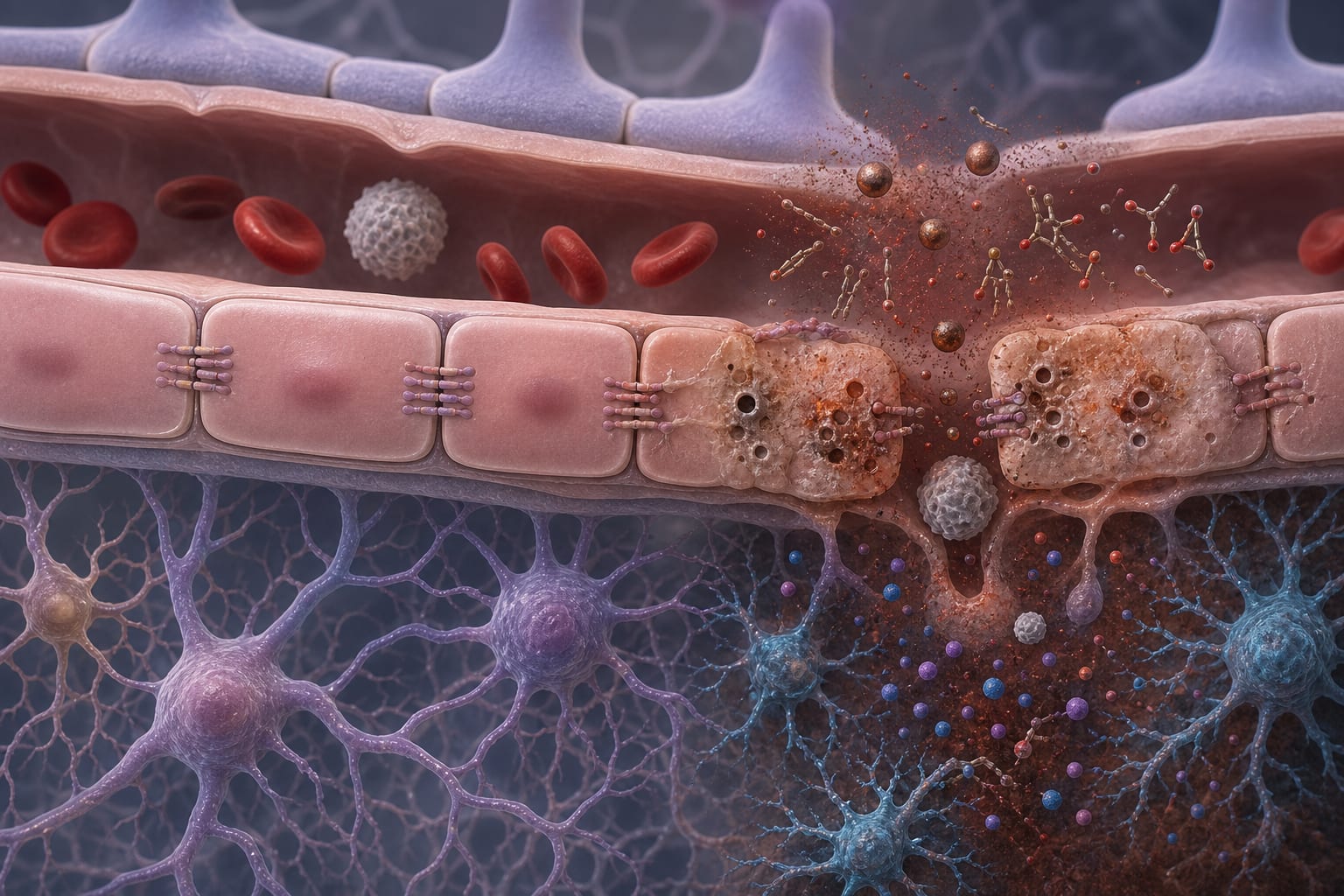
This review highlights the role of ferroptosis in brain microvascular endothelial cells (BMECs) and its implications for blood-brain barrier (BBB) integrity and neuroinflammation. It emphasizes the need for further research into BMEC-specific models and potential therapeutic strategies targeting endothelial ferroptosis.

Background

Ferroptosis is an iron-dependent form of regulated cell death that has been primarily studied in neurons and glial cells. However, the impact of ferroptosis on BMECs is critical as these cells form the BBB, which is essential for maintaining central nervous system homeostasis. Understanding the mechanisms of ferroptosis in BMECs could provide insights into early BBB dysfunction and neuroinflammatory processes in various CNS disorders.

Data Highlights

No numerical data or trial data presented in the article.

Key Findings

  • BMEC ferroptosis may contribute to BBB leakage and neuroinflammatory amplification.
  • The SLC7A11–GPX4 axis and Nrf2 signaling are crucial in regulating BMEC ferroptosis.
  • Ferroptosis in BMECs can lead to the release of damage-associated molecular patterns, promoting immune responses.
  • Direct experimental evidence indicates that BMEC ferroptosis contributes to hypoxia-induced BBB injury.
  • Therapeutic strategies targeting endothelial ferroptosis are still investigational and require further validation.

Clinical Implications

Clinicians should be aware of the potential role of BMEC ferroptosis in BBB dysfunction and neuroinflammation. Future therapeutic approaches may need to consider targeting ferroptosis pathways to mitigate BBB injury and associated neuroinflammatory responses.

Conclusion

Ferroptosis represents a significant but underexplored mechanism linking endothelial dysfunction and neuroinflammation. Further research is essential to develop targeted therapies and biomarkers for clinical application.

Related Resources & Content

  1. Frontiers in Immunology, 2026 -- Ferroptosis-immune crosstalk in CNS diseases: mechanisms and translational insights
  2. Archives of Toxicology, 2023 -- Regulation of Ferroptosis via Nrf2 and Its Role in Neurodegenerative Disorders
  3. Frontiers in Neurology, 2026 -- Decoding ferroptosis in intracerebral hemorrhage: multidimensional monitoring and integrative perspectives beyond single biomarkers
  4. Frontiers in Cardiovascular Medicine — Iron-dependent ferroptosis in cardiac microvascular endothelial cells: a key link between dysregulated iron homeostasis and microcirculatory injury during myocardial ischemia-reperfusion
  5. 2026 Guideline for the Early Management of Patients With AIS - Professional Heart Daily | American Heart Association
  6. European Stroke Organisation (ESO) and European Association of Neurosurgical Societies (EANS) guideline on stroke due to spontaneous intracerebral haemorrhage - PMC
  7. Ferroptosis inhibitors: mechanisms of action and therapeutic potential | Cellular and Molecular Life Sciences | Springer Nature Link
  8. Early neurological improvement with deferoxamine after intracerebral hemorrhage: A post hoc analysis of the i-DEF trial
  9. Deferoxamine in Aneurysmal Subarachnoid Hemorrhage - Clinical Trials Registry - ICH GCP
  10. Frontiers | Efficacy and safety of edaravone dexborneol in acute ischemic stroke: systematic review and meta-analysis
  11. Edaravone dexborneol for ischemic stroke with sufficient recanalization after thrombectomy: a randomized phase II trial - PubMed
  12. Edaravone dexborneol protects against cerebral ischemia/reperfusion-induced blood-brain barrier damage by inhibiting ferroptosis via activation of nrf-2/HO-1/GPX4 signaling - PubMed
  13. Frontiers | Endothelial Ferroptosis in Blood–Brain Barrier Dysfunction and Neuroinflammation: Mechanisms and Immune–Vascular Crosstalk
  14. Ferroptosis biomarkers predict the outcomes of patients with acute ischemic stroke undergoing endovascular thrombectomy | Scientific Reports
  15. Endothelial mitochondria in the blood-brain barrier | Fluids and Barriers of the CNS | Springer Nature Link

Original Source(s)

Related Content