Comparison of learning curves and cross-over effects using articulating laparoscopic instruments versus standard laparoscopic instruments - Report - MDSpire

Comparison of learning curves and cross-over effects using articulating laparoscopic instruments versus standard laparoscopic instruments

  • By

  • Jean-Paul Bereuter

  • Maximiliano Emmanuel Ceron Malpica

  • Mark Enrik Geissler

  • Josephine Runge

  • Jasmin Hasanovic

  • Anne Selbmann

  • Rona Berit Geissler

  • Grit Krause-Jüttler

  • Alexander Kern

  • Jürgen Weitz

  • Marius Distler

  • Felix von Bechtolsheim

  • Jakob Dobroschke

  • Florian Oehme

  • June 19, 2026

  • 0 min

Share

Clinical Report: Evaluation of Learning Curves and Cross-Over Impacts

Overview

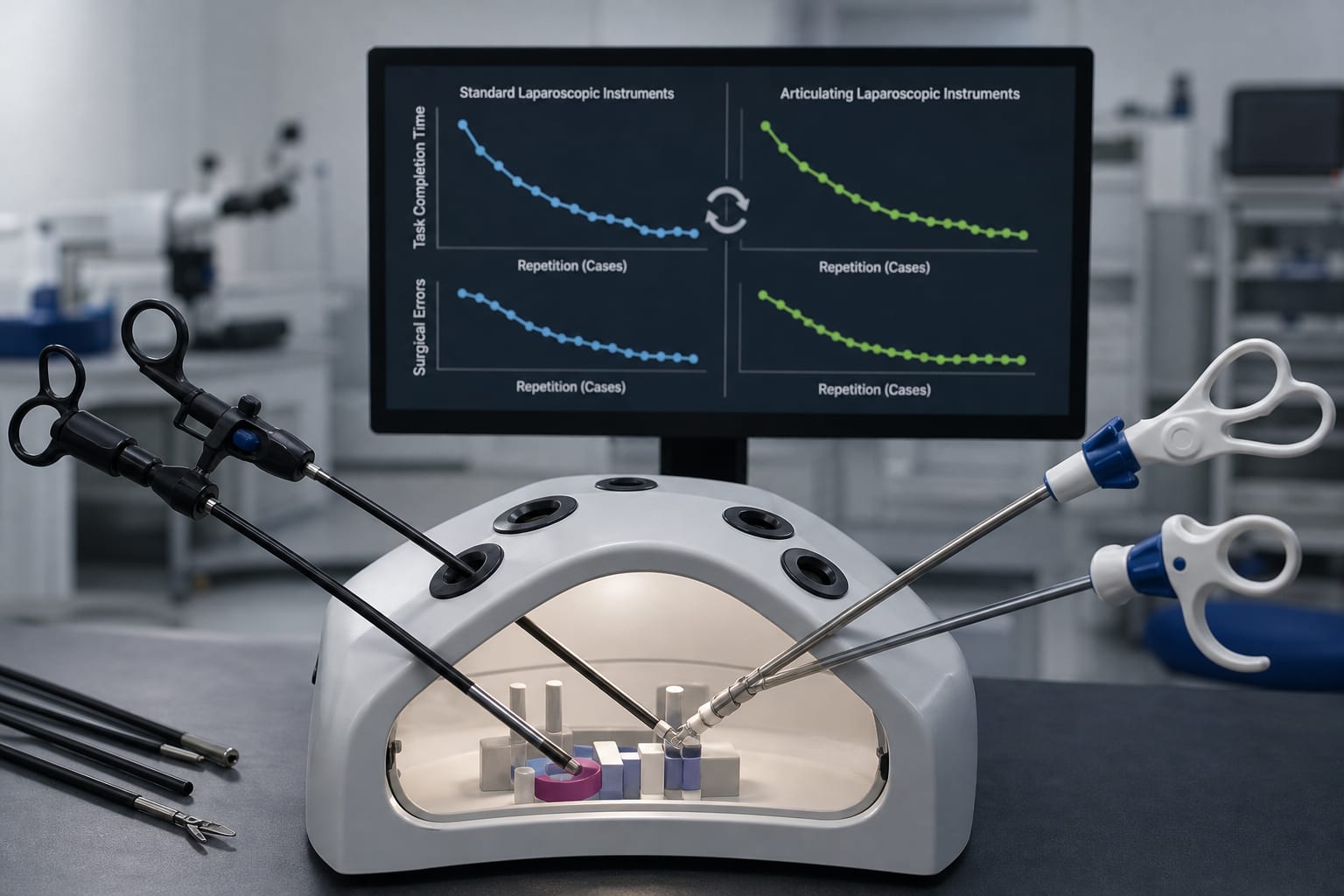
This study evaluates the learning curves and performance of articulating versus standard laparoscopic instruments among medical students. Findings indicate differences in task completion time and error rates.

Background

Laparoscopic surgery is a common minimally invasive technique, yet it poses ergonomic and technical challenges due to the limitations of standard instruments. Articulating laparoscopic instruments have been developed to enhance maneuverability and access in confined surgical spaces. Understanding the learning curves associated with these instruments is crucial for optimizing surgical training and improving patient outcomes.

Data Highlights

No numerical data available in the source material.

Key Findings

  • Articulating laparoscopic instruments (ALI) provide an additional degree of freedom compared to standard laparoscopic instruments (SLI).
  • Participants trained with ALI showed differences in task completion time and error rates compared to those trained with SLI.
  • The study involved 53 medical students with no prior laparoscopic experience, highlighting the learning curve for novices.
  • Training included standardized tasks such as peg transfer and surgical suture and knot tasks.
  • Performance was assessed using the ForceSense device to measure force exertion and motion parameters.

Clinical Implications

The findings from this study provide data on the learning curves associated with different instruments.

Conclusion

This study provides insights into the comparative learning curves of articulating versus standard laparoscopic instruments.

Related Resources & Content

  1. Journal of Gastrointestinal Surgery, 2021 -- Innovative Multi-joint Articulating Tool for Single Incision Laparoscopic Appendectomy
  2. Training Novices in Laparoscopy with Complex Curved Instruments Utilizing 2D and 3D Visualization Techniques, 2024
  3. Surgical Endoscopy, 2025 -- Evaluation of Laparoscopic Surgical Proficiency Utilizing Computerized Analysis Metrics: ScopePro Trainer
  4. Surgical Endoscopy, 2022 -- Assessment of Laparoscopic Proficiency: An Objective Analysis of the Learning Curve
  5. Evidence-Based Guidelines for Instrument and Handle Selection for Ergonomic Optimization in Laparoscopic Surgery, ScienceDirect
  6. Comparative study of proficiency improvement in ArtiSential® according to conventional laparoscopic, 2025
  7. Evidence-Based Guidelines for Instrument and Handle Selection for Ergonomic Optimization in Laparoscopic Surgery - ScienceDirect
  8. https://coloproctol.org/upload/pdf/ac-2025-00227-0032.pdf
  9. Comparative study of proficiency improvement in ArtiSential® according to conventional laparoscopic

Original Source(s)

Related Content