Clinical Report: AI-Driven Expert Guidance for Suturing Training in Surgery
Overview
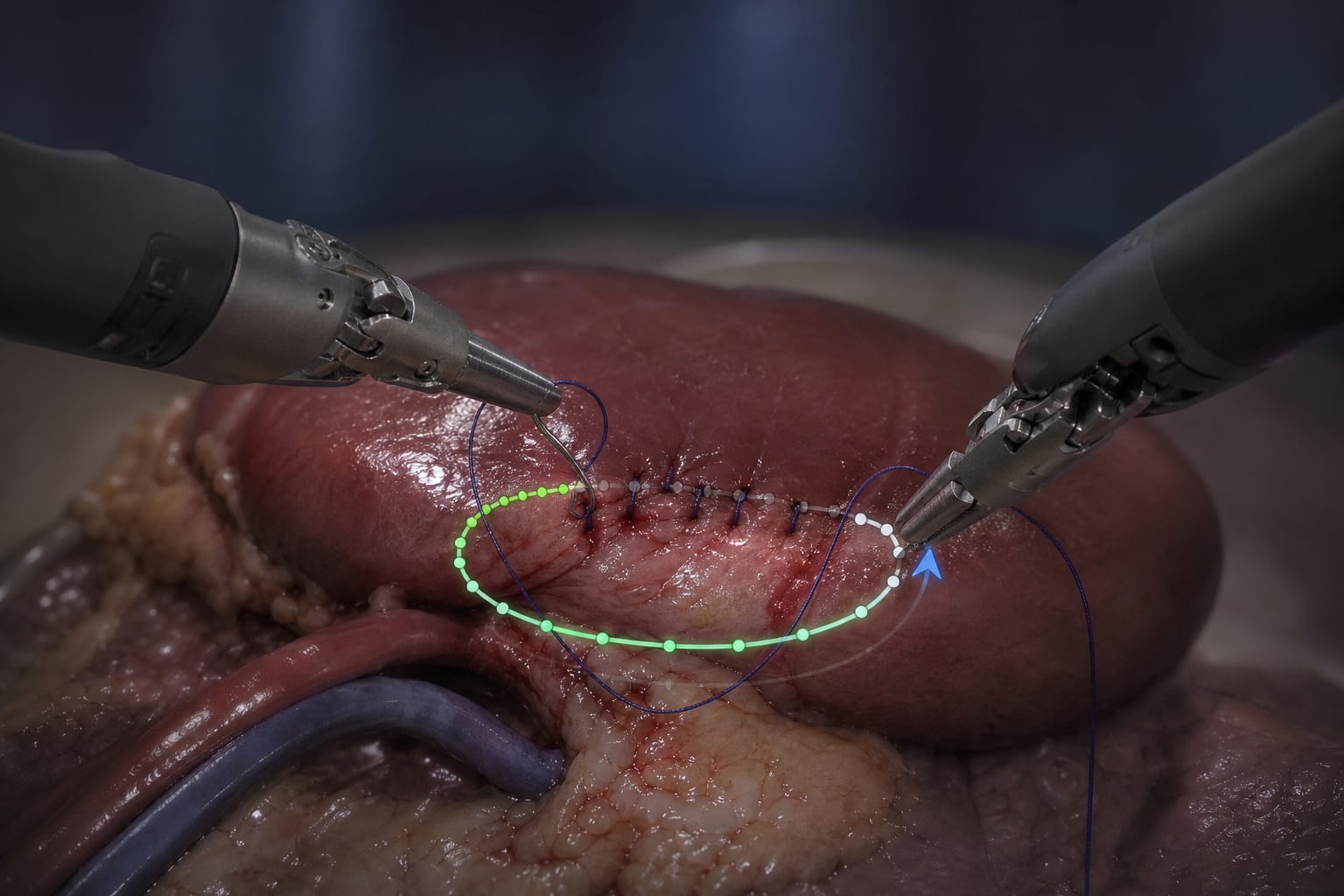
This study evaluates an AI framework that learns expert suturing trajectories from surgical videos to provide real-time guidance for novice trainees in renal wound suturing.
Background
Suturing is a critical yet challenging component of robot-assisted surgeries, requiring high levels of skill and precision. Traditional training methods often necessitate extensive practice under expert supervision, which can be resource-intensive. The integration of artificial intelligence in surgical training presents a novel approach.
Data Highlights
Metric
Value
Average Displacement Error
34.25 pixels
Final Displacement Error
52.54 pixels
Inference Latency
32.7 ms
Annotated Frames
18,515
Complete Suturing Actions
806
Valid Trajectory Samples
24,897
Key Findings
The AI model achieved an average displacement error of 34.25 pixels in trajectory prediction.
In a pilot study, novice trainees with AI guidance outperformed unguided trainees in six of eight performance measures.
The model demonstrated a final displacement error of 52.54 pixels under test conditions.
AI guidance provided an end-to-end inference latency of 32.7 ms.
The dataset used for training included 18,515 annotated frames and 806 complete suturing actions.
Clinical Implications
Further studies are needed to assess long-term retention of skills and clinical applicability.
Conclusion
Further investigation through larger multicenter trials is warranted.
Randomized trial finds a topical anti-inflammatory patch provided similar pain relief, function, and safety as oral therapy during the first 6 weeks after surgery.