Risk factors for esophageal stricture after circumferential endoscopic submucosal dissection: a preliminary, multicenter, retrospective, case-control study - Report - MDSpire

Risk factors for esophageal stricture after circumferential endoscopic submucosal dissection: a preliminary, multicenter, retrospective, case-control study

  • By

  • Yang Bai

  • Wei-Xing Yang

  • Min Qiao

  • Xin Yang

  • June 11, 2026

  • 0 min

Share

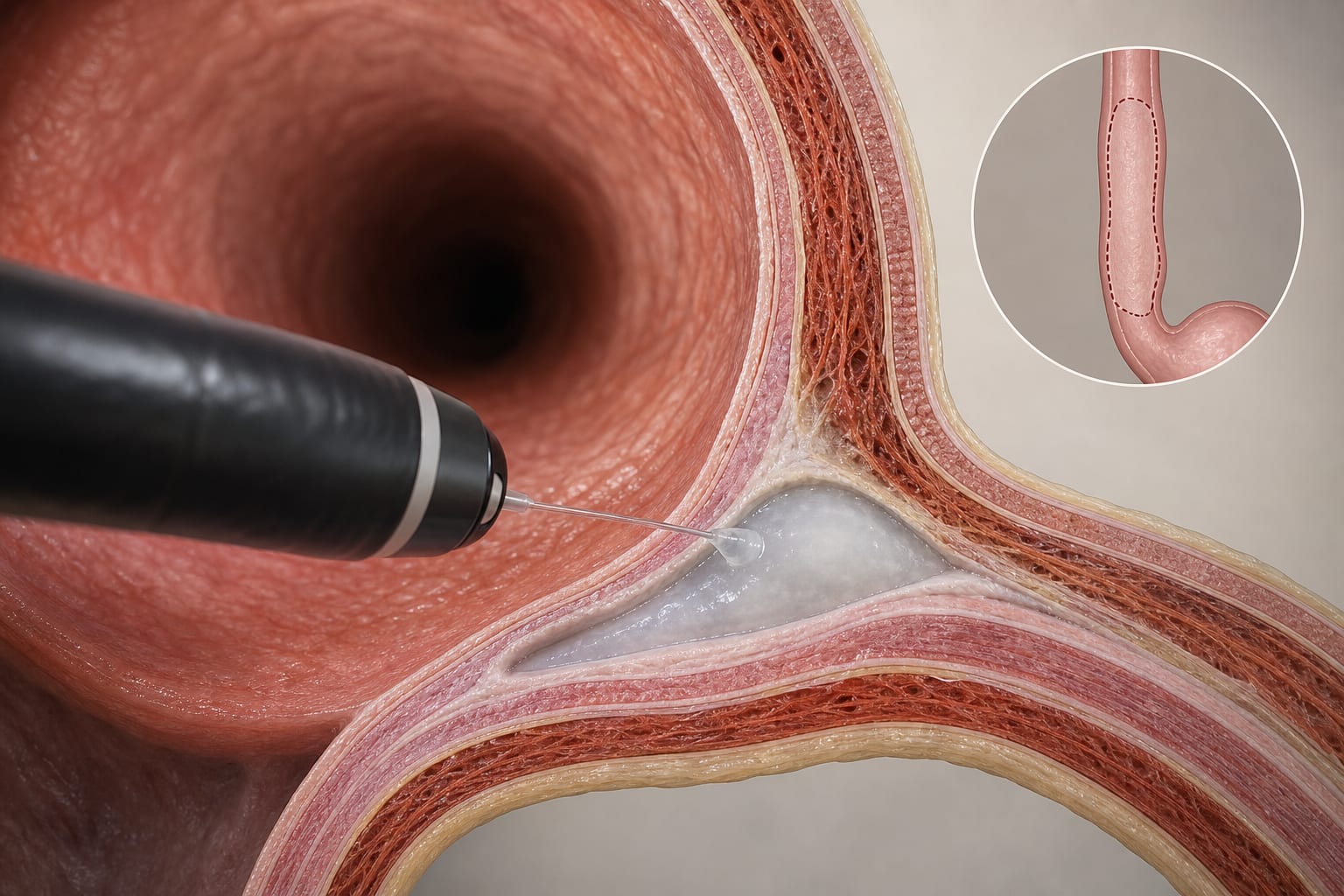
Clinical Report: Identifying Risk Factors for Esophageal Stricture Following cESD

Overview

{'remove': ['SSPS shows a protective effect against stricture formation.']}

Background

{'remove': ['Identifying risk factors and effective prophylactic strategies is crucial for improving patient outcomes.']}

Data Highlights

GroupPatients
Stricture28
Non-Stricture27

Key Findings

{'add': ['Findings are preliminary and require validation in larger studies.']}

Clinical Implications

{'remove': ['Clinicians should consider the longitudinal length of circumferential involvement when assessing the risk of post-cESD stricture.', 'The use of SSPS may offer a more effective prophylactic strategy compared to CST, particularly in high-risk patients.']}

Conclusion

{'remove': ['The study provides preliminary evidence that a longitudinal length of circumferential involvement >50 mm is a significant risk factor for esophageal stricture post-cESD, and that SSPS may offer superior protection compared to CST.']}

Related Resources & Content

  1. American Society for Gastrointestinal Endoscopy, ASGE, 2023 -- Guideline on endoscopic submucosal dissection
  2. Pharmacological therapy for preventing esophageal stricture after endoscopic submucosal dissection: a systematic review and network meta-analysis, PMC
  3. Are Steroids Effective in the Prevention of Esophageal Stenosis After Endoscopic Submucosal Dissection?: A Systematic Review and Meta-Analysis, PubMed
  4. Surgical Endoscopy — Factors Influencing Incomplete Resection in Pharyngeal Endoscopic Submucosal Dissection and Long-Term Outcomes Post-Resection
  5. Surgical Endoscopy — Assessing the Safety and Effectiveness of Submucosal Tunneling Endoscopic Resection for Large Esophageal Subepithelial Lesions
  6. Surgical Endoscopy — Outcomes of Early Stage Large Esophageal Carcinoma Patients Following Double- and Single-Tunnel Super Minimally Invasive Surgery: A Multicenter Retrospective Analysis
  7. Surgical Endoscopy — Factors Contributing to Anastomotic Strictures and Their Management Following Ivor Lewis Esophagectomy
  8. American Society for Gastrointestinal Endoscopy guideline on endoscopic submucosal dissection for the management of early esophageal and gastric cancers: methodology and review of evidence
  9. ESGE Guidelines | ESGE
  10. Pharmacological therapy for preventing esophageal stricture after endoscopic submucosal dissection: a systematic review and network meta-analysis - PMC
  11. Are Steroids Effective in the Prevention of Esophageal Stenosis After Endoscopic Submucosal Dissection?: A Systematic Review and Meta-Analysis - PubMed
  12. Risk Prediction Models of Esophageal Strictures After Endoscopic Submucosal Dissection: A Systematic Review and Meta-Analysis - PubMed
  13. Submucosal steroid pre-injection strategy to prevent oesophageal stricture after circumferential endoscopic submucosal dissection - PubMed
  14. Efficacy of polyglycolic acid sheet plus oral steroid on the esophageal stricture after endoscopic submucosal dissection: a propensity score matched retrospective study | BMC Surgery | Springer Nature Link

Original Source(s)

Related Content