Exploring Non-Motor Symptoms in Parkinson's Disease: An Evaluation of Existing Classification Systems and Their Limitations
-
By
-
Asad Makhani
-
Tiago A. Mestre
-
Anne-Mary Abe
-
June 8, 2026
Clinical Report: Exploring Non-Motor Symptoms in Parkinson's Disease
Overview
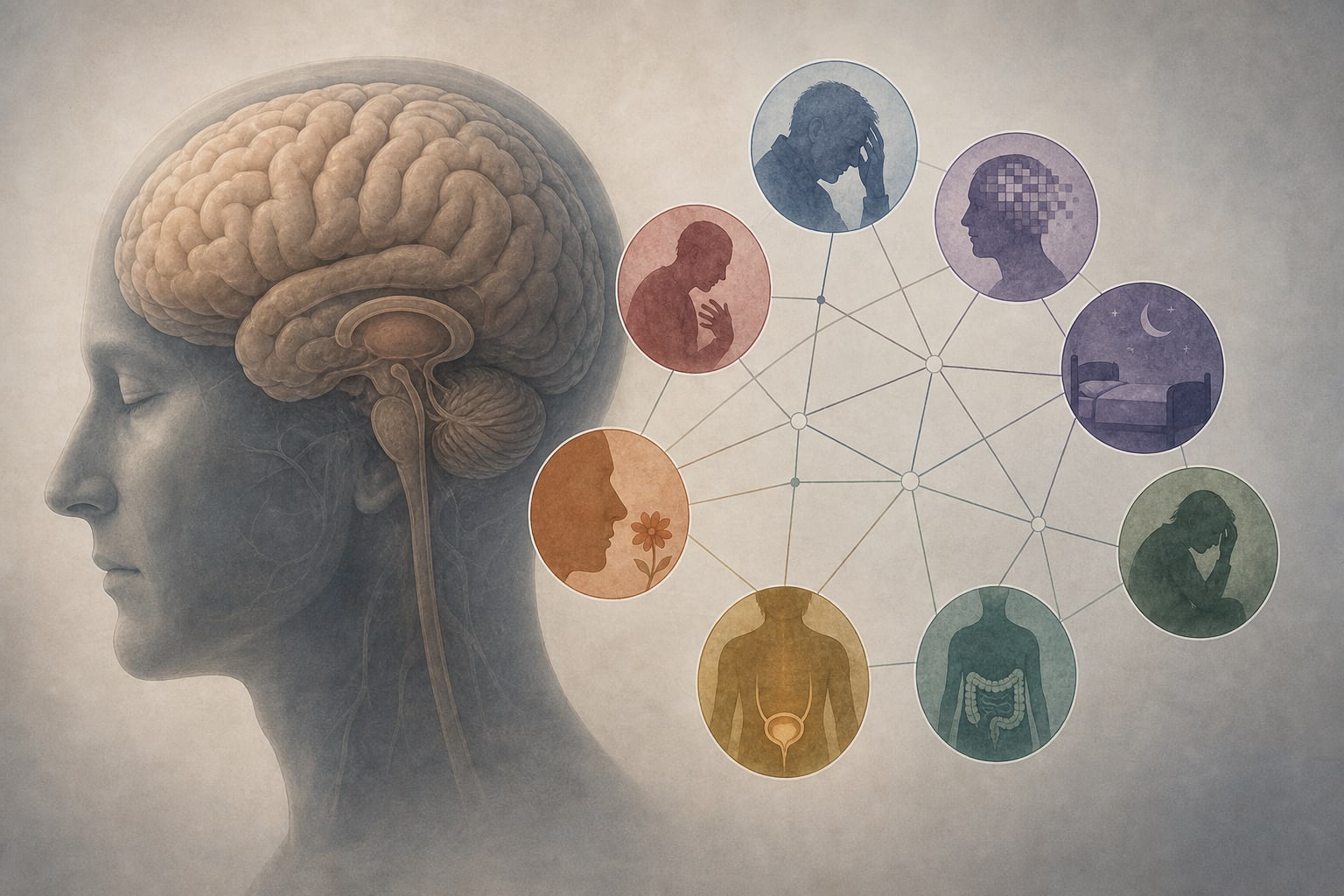
Non-motor symptoms (NMS) in Parkinson's disease (PD) are prevalent and significantly affect quality of life, yet they remain under-recognized and undertreated. Current classification systems inadequately capture the complexity and interrelationship of these symptoms, highlighting the need for improved frameworks.
Background
Non-motor symptoms are common in Parkinson's disease and contribute to a diminished quality of life for both patients and caregivers. Despite their prevalence, NMS are often overlooked in clinical settings, leading to inadequate management. Understanding and classifying these symptoms is crucial for enhancing patient care and treatment outcomes.
Data Highlights
No numerical or trial data provided in the source material.
Key Findings
- NMS in PD include anxiety, cognitive impairment, autonomic dysfunction, and sleep disorders.
- Approximately 45% of drug-naïve PD patients experience severe to very severe NMS burden.
- The number of NMS has a greater impact on quality of life than motor symptoms across all stages of PD.
- Current classification systems may not adequately reflect the complexity and heterogeneity of NMS presentations.
- Emerging classification models are being explored to better capture the multifaceted nature of NMS.
Clinical Implications
Healthcare professionals should be aware of the high prevalence of NMS in PD and their significant impact on patient quality of life. Improved recognition and management of these symptoms are essential for comprehensive patient care.
Conclusion
The inadequacy of current classification systems for NMS in Parkinson's disease necessitates further exploration of emerging models to enhance understanding and treatment of these complex symptoms.
Related Resources & Content
- NICE, Parkinson’s disease in adults, 2024 -- Guidelines on NMS management
- Weintraub, Validation of the International Parkinson and Movement Disorder Society Non‐Motor Symptoms Questionnaire, 2025 -- Study on MDS-NMS-Q
- npj Digital Medicine — Innovative Remote Evaluation of Motor and Cognitive Functions in Parkinson's Disease: Utilizing Large Datasets, Machine Learning, and Telehealth Solutions
- npj Digital Medicine — Multimodal brain network topology and enhanced computer-aided diagnosis in Parkinson’s Disease: a systematic review and meta-analysis
- Brain — Cognitive and neuropsychiatric profiles distinguish atypical parkinsonian syndromes
- Frontiers in Neurology — Discrepancies in symptom concerns and burden from the perspectives of parkinson's disease patients, caregivers, and physicians
- Innovative Remote Evaluation of Motor and Cognitive Functions in Parkinson's Disease
- Multimodal brain network topology and enhanced computer-aided diagnosis in Parkinson’s Disease
- Cognitive and neuropsychiatric profiles distinguish atypical parkinsonian syndromes
- Parkinson’s disease in adults
- Validation of the International Parkinson and Movement Disorder Society Non‐Motor Symptoms Questionnaire (MDS‐NMS‐Q) - Weintraub - 2025 - Movement Disorders - Wiley Online Library
- Role of Prucalopride in the Treatment of Chronic Constipation in Parkinson's Disease: A Randomized Controlled Trial - PubMed
Based on findings from:
Parkinson’s disease beyond motor symptoms: a review of the validity and limitations of current classification of non-motor symptoms
Asad Makhani, Tiago A. Mestre, Anne-Mary Abe. Frontiers In Psychiatry, 2026.
https://www.frontiersin.org/journals/psychiatry/articles/10.3389/fpsyt.2026.1831447/full
This content is an AI-generated, fully rewritten summary based on a published scholarly article. It does not reproduce the original text and is not a substitute for the original publication. Readers are encouraged to consult the source for full context, data, and methodology.