Comparison of the short-term efficacy of percutaneous endoscopic transforaminal lumbar interbody fusion with the application of a expandable versus PEEK cage for the treatment of lumbar degenerative disease - Report - MDSpire
Conexiant’s news site is now MDSpire News. Learn more
Advertisement
Short-Term Outcomes of Percutaneous Endoscopic Transforaminal Lumbar Interbody Fusion Using Expandable Versus PEEK Cages for Lumbar Degenerative Disease
Clinical Report: Expandable Versus PEEK Cages in Endoscopic TLIF
Overview
The supplied article describes a retrospective comparison of expandable and static PEEK cages used during percutaneous endoscopic transforaminal lumbar interbody fusion (PE-TLIF) for lumbar degenerative disease. The provided excerpt explains the study rationale and eligibility criteria but does not include the patient cohort details or comparative outcome results.
Background
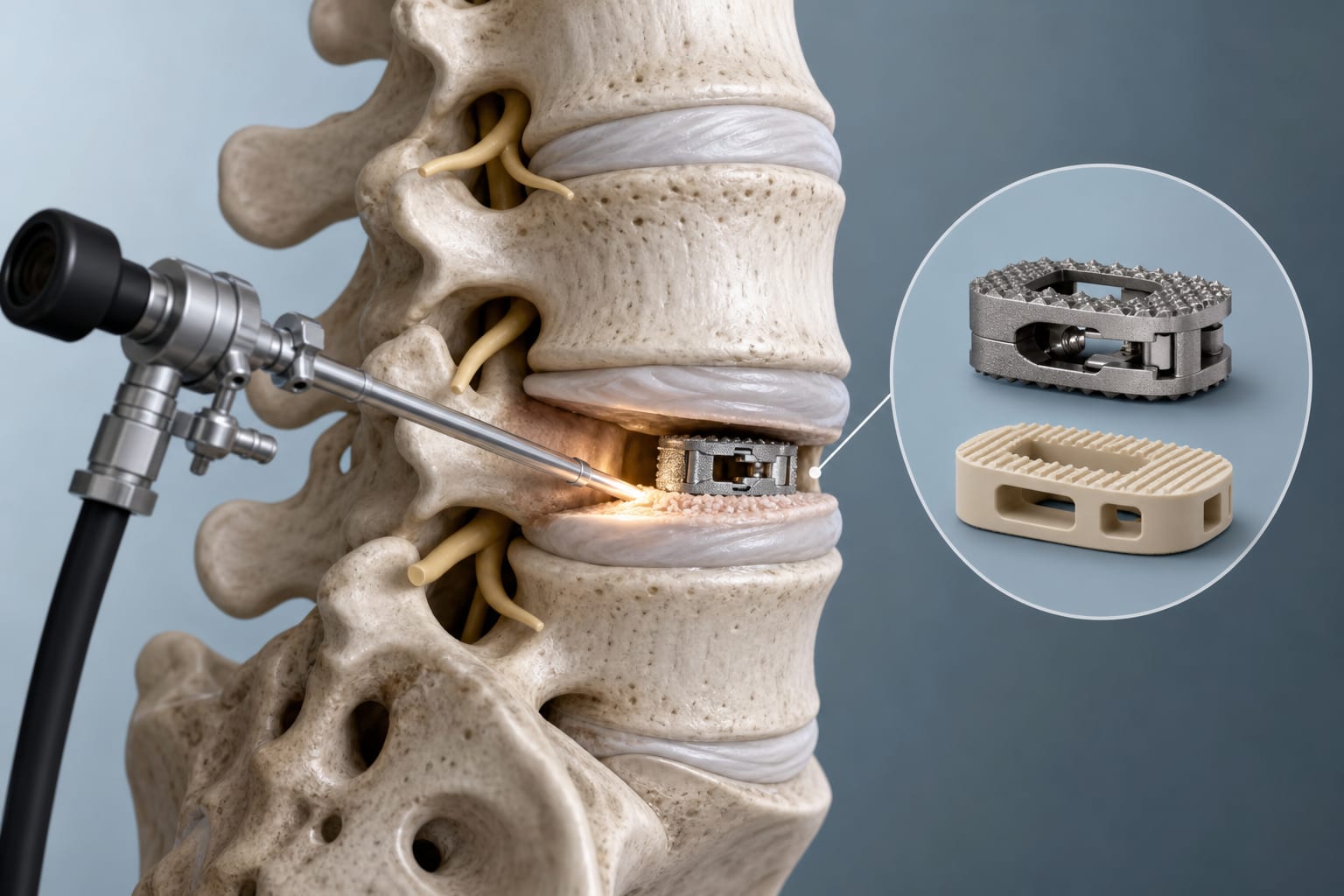
Lumbar degenerative disease, including disc herniation, spinal stenosis, and spondylolisthesis, is described as a major cause of low back pain and lower-extremity radiculopathy in middle-aged and older adults. The article notes that conventional open fusion can involve substantial blood loss and paraspinal tissue injury, while endoscopic fusion is intended to limit posterior tissue disruption and support faster recovery. Static PEEK cages are widely used, but their fixed dimensions can constrain insertion and intervertebral-space restoration in the narrow endoscopic working channel. Expandable cages are inserted at a smaller volume and enlarged in situ; the study compares their clinical and radiological outcomes with static PEEK cages.
Data Highlights
The supplied article excerpt provides no sample size, follow-up duration, numerical outcomes, or between-group comparisons. It reports eligibility criteria including persistent symptoms despite three months of systematic conservative treatment and excludes, among other conditions, grade III–IV spondylolisthesis and severe osteoporosis.
Key Findings
The article is a retrospective investigation comparing expandable cages with conventional static PEEK cages during PE-TLIF for lumbar degenerative disease.
Eligible diagnoses included lumbar disc herniation, grade I–II degenerative or isthmic spondylolisthesis, and segmental instability with disc herniation or spinal stenosis.
Eligibility required imaging findings concordant with symptoms and signs, with symptoms persisting despite three months of regular, systematic conservative treatment.
Patients with severe lumbar spinal stenosis, severe osteoporosis, grade III–IV spondylolisthesis, prior lumbar surgery, or deformity requiring correction were excluded.
The article describes static PEEK cages as fixed-dimension implants and identifies limited distraction and potential migration or subsidence as concerns in the endoscopic setting.
The supplied related-article context includes a 2026 systematic review and meta-analysis of expandable versus static cages in MIS-TLIF; it reports subsidence as the most consistent differentiating outcome and cautions that heterogeneous definitions, imaging methods, and follow-up limit interpretation.
Clinical Implications
The supplied excerpt establishes the study population and the rationale for comparing cage designs, but it does not provide results sufficient to determine comparative clinical or radiological effectiveness. The related systematic review context advises caution in interpreting pooled subsidence findings because primary studies used heterogeneous definitions, imaging modalities, and follow-up intervals.
Conclusion
The article addresses whether expandable cages offer different short-term clinical and radiological outcomes from static PEEK cages in PE-TLIF. The provided material does not report the study’s comparative results, so no conclusion about which cage performed better can be drawn from this excerpt.
These 10 states make it more practical for physicians to participate in hospital ownership by aligning statutory structure, corporate practice of medicine rules, and population trends.