BIRC3-CASP8 axis orchestrates the PANoptosis spectrum: taming the inflammatory storm to prevent post-ischemic heart failure - Report - MDSpire

BIRC3-CASP8 axis orchestrates the PANoptosis spectrum: taming the inflammatory storm to prevent post-ischemic heart failure

  • By

  • Quancheng Han

  • Huajing Yuan

  • Yitao Xue

  • Yan Li

  • Yiding Yu

  • June 29, 2026

  • 0 min

Share

Clinical Report: The Role of the BIRC3-CASP8 Pathway in Regulating PANoptosis

Overview

This study investigates the BIRC3-CASP8 axis in regulating PANoptosis during myocardial ischemia/reperfusion injury.

Background

Heart failure is a significant global health issue, often exacerbated by myocardial ischemia/reperfusion injury. Understanding the mechanisms of cell death, particularly the interplay between apoptosis, pyroptosis, and necroptosis, is crucial for developing strategies to mitigate heart failure progression. The concept of PANoptosis integrates these pathways and may offer insights into therapeutic interventions.

Data Highlights

No numerical data or trial data provided in the source material.

Key Findings

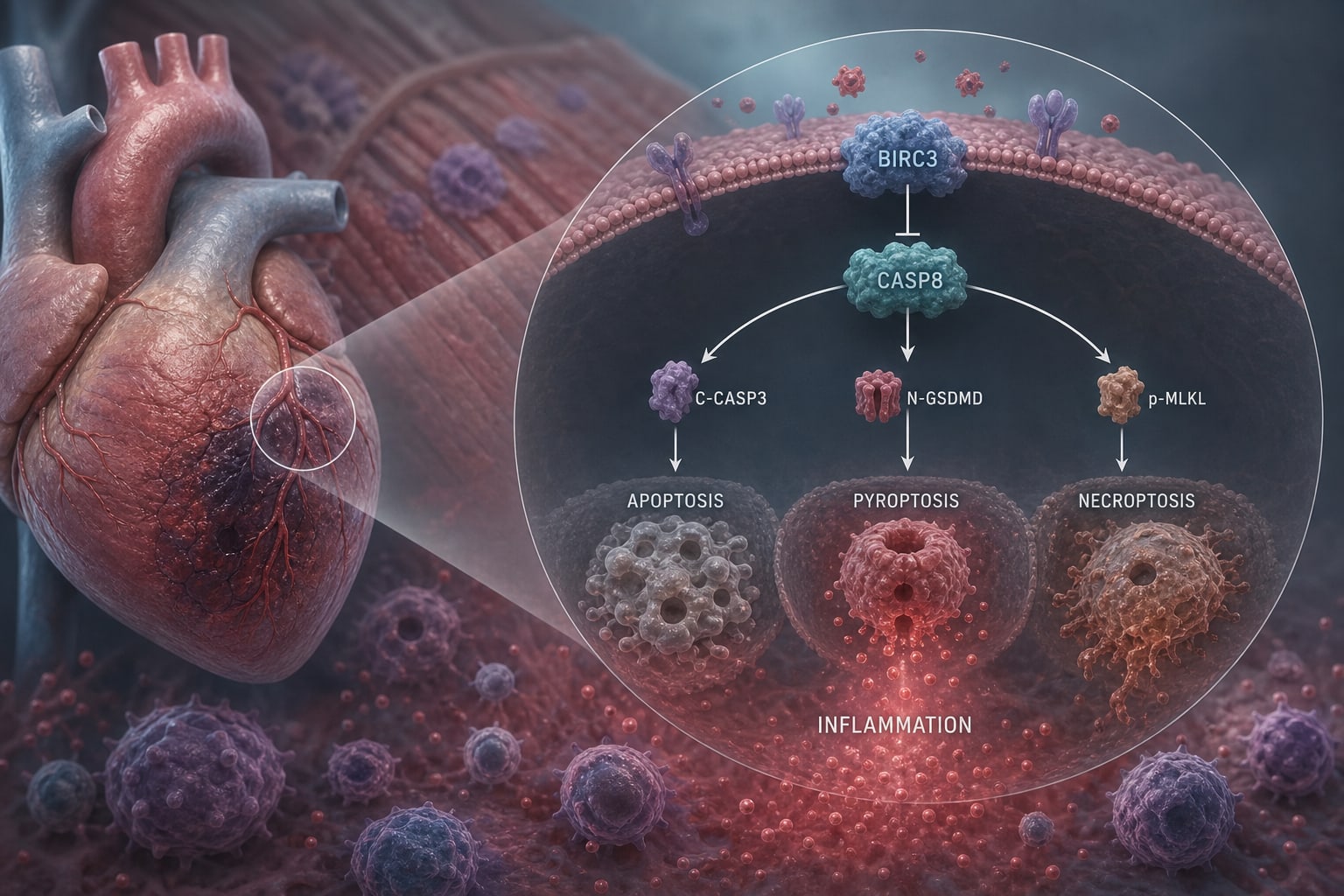
  • I/R injury activates PANoptosis, characterized by interdependent crosstalk among cell death pathways.
  • BIRC3 functions as a critical checkpoint that inhibits CASP8, promoting pyroptosis and necroptosis.
  • Silencing BIRC3 leads to disinhibition of CASP8, favoring apoptosis and preserving cell membrane integrity.
  • This shift in cell death modality reduces the release of inflammatory mediators and limits damage to surrounding cardiomyocytes.

Clinical Implications

Modulating the BIRC3-CASP8 axis could represent a novel strategy to alter the mode of cell death in myocardial I/R injury. This approach may help preserve myocardial function and limit the inflammatory response associated with heart failure.

Conclusion

The findings highlight the role of the BIRC3-CASP8 pathway in regulating PANoptosis.

Related Resources & Content

  1. Frontiers | BIRC3-CASP8 Axis Orchestrates the PANoptosis Spectrum: Taming the Inflammatory Storm to Prevent Post-Ischemic Heart Failure
  2. 2025 ACC/AHA/ACEP/NAEMSP/SCAI Guideline for the Management of Patients With Acute Coronary Syndromes
  3. Targeting Inflammation After Acute Myocardial Infarction | JACC
  4. Basic Research in Cardiology — Investigating the Impact of Remote Ischaemic Conditioning on Inflammation: Insights into Innate Immunity and Cytokine Activity
  5. Basic Research in Cardiology — Modulation of STAT3 and Its Involvement in Cardioprotective Mechanisms Through Conditioning: Emphasis on Non-Genomic Effects on Mitochondrial Function
  6. Basic Research in Cardiology — The RISK Pathway's Role in Mitochondrial Function and Cardioprotection: An Origin Story
  7. Basic Research in Cardiology — Exploring the RISK Pathway and Its Implications
  8. 2025 ACC/AHA/ACEP/NAEMSP/SCAI Guideline for the Management of Patients With Acute Coronary Syndromes: A Report of the American College of Cardiology/American Heart Association Joint Committee on Clinical Practice Guidelines
  9. Targeting Inflammation After Acute Myocardial Infarction | JACC
  10. Frontiers | BIRC3-CASP8 Axis Orchestrates the PANoptosis Spectrum: Taming the Inflammatory Storm to Prevent Post-Ischemic Heart Failure

Original Source(s)

Related Content