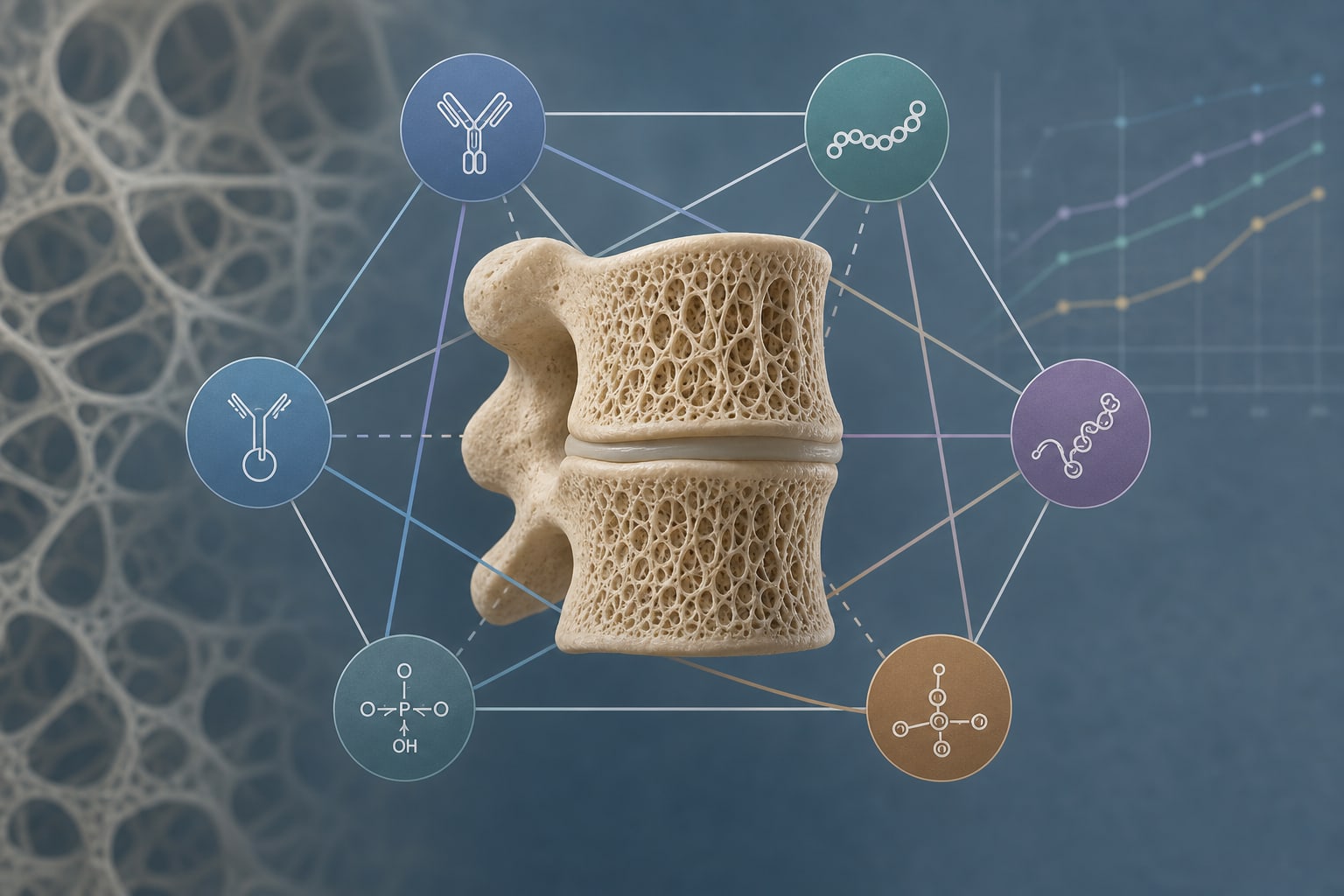
Clinical Report: Creation and assessment of a nomogram for predicting osteoporosis risk among individuals with rheumatoid arthritis
Overview
This study developed and validated a nomogram to predict osteoporosis risk in rheumatoid arthritis (RA) patients, identifying key clinical and laboratory predictors. The model demonstrated good discrimination and calibration, highlighting its potential utility in clinical practice.
Background
Rheumatoid arthritis significantly increases the risk of osteoporosis, yet existing predictive tools often fail to account for RA-specific factors. With approximately 27.6% of RA patients affected by osteoporosis, there is a critical need for effective screening methods to prevent complications such as fractures and disability. This nomogram aims to address this gap by integrating relevant clinical and metabolic variables.
Data Highlights
Predictor
Odds Ratio
Female sex
—
HAQ-DI
—
ALP
—
ApoA1/ApoB ratio
—
FFA
—
BMI
—
Key Findings
132 out of 349 RA patients (37.8%) had osteoporosis.
Independent predictors included female sex, HAQ-DI, elevated ALP, increased ApoA1/ApoB ratio, higher FFA, and lower BMI.
The nomogram achieved AUROCs of 0.812 in the training cohort and 0.788 in the validation cohort.
Good calibration was confirmed with a Hosmer–Lemeshow p > 0.05.
The nomogram provides a practical tool for identifying RA patients at high risk for osteoporosis, facilitating targeted screening and early intervention. Clinicians should consider integrating this tool into routine assessments to improve patient outcomes.
Conclusion
The developed nomogram shows promise in predicting osteoporosis risk among RA patients, but further validation in diverse populations is necessary before clinical implementation.