Association of a novel meibomian gland dysfunction composite score with corneal nerve parameters and ocular surface symptoms in dry eye disease - Report - MDSpire

Association of a novel meibomian gland dysfunction composite score with corneal nerve parameters and ocular surface symptoms in dry eye disease

  • By

  • Yao Yao

  • Zhaoxiang Xu

  • Yanhao Ma

  • Lijin Cui

  • Xiaotong Ren

  • Jian Guo

  • July 10, 2026

Share

Clinical Report: Correlation of a New Composite Score for Meibomian Gland Dysfunction

Overview

This study developed a composite score for meibomian gland dysfunction (MGD) and assessed its correlation with corneal nerve metrics and ocular surface symptoms in patients with dry eye disease (DED).

Background

Dry eye disease (DED) is a prevalent condition that significantly impacts patients' quality of life. MGD is a major contributor to DED, affecting a substantial proportion of patients. Understanding the relationship between MGD severity and corneal nerve metrics is important.

Data Highlights

ParameterCorrelation Coefficient (r)p-value
MGD composite score vs OSDI0.769< 0.01
MGD composite score vs CNFL-0.709< 0.01
OSDI vs CNFL-0.868< 0.01

Key Findings

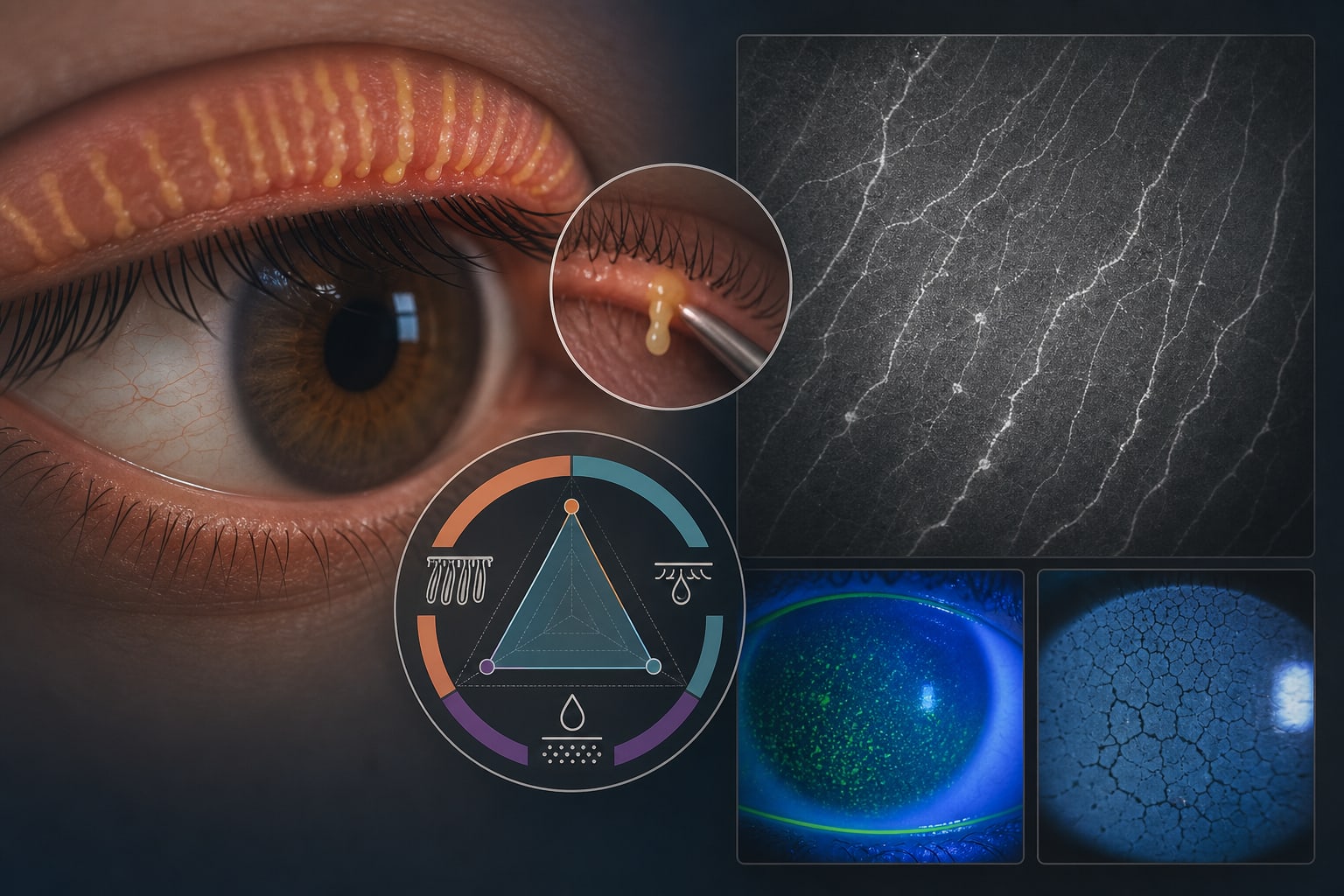
  • The MGD composite score (0–9) integrates gland dropout, expressibility, and meibum quality.
  • Higher MGD grades correlate with shorter corneal nerve fiber length and increased microneuromas.
  • MGD composite score positively correlates with OSDI scores, indicating worse symptoms.
  • Partial correlation analysis shows a decrease in the association between MGD score and OSDI when controlling for nerve length.
  • Microneuroma count correlates positively with symptoms such as pain and photophobia.

Clinical Implications

The MGD composite score provides a comprehensive assessment of disease severity in DED patients.

Conclusion

The study highlights the association between the MGD composite score and corneal nerve metrics.

Related Resources & Content

  1. TFOS DEWS III, American Journal of Ophthalmology, 2025 -- Diagnostic Methodology
  2. Ocular surface epithelial immune cells and corneal nerves in dry eye disease, ScienceDirect, 2025 -- A systematic review and meta-analysis
  3. Contact Lens Spectrum — MEIBOMIAN GLANDS AND DRY EYE SYMPTOMS
  4. Contact Lens Spectrum — Maintaining Ocular Surface Wellness
  5. Contact Lens Spectrum — Contact Lens Case Reports
  6. Ophthalmic Professional — Efficiency in Dry Eye Testing
  7. MEIBOMIAN GLANDS AND DRY EYE SYMPTOMS
  8. Maintaining Ocular Surface Wellness
  9. Contact Lens Case Reports
  10. TFOS DEWS III: Diagnostic Methodology - ScienceDirect
  11. Ocular surface epithelial immune cells and corneal nerves in dry eye disease - A systematic review and meta-analysis of in vivo confocal microscopy data - ScienceDirect
  12. Efficacy and utility of clinical examination in predicting meibomian gland atrophy - ScienceDirect

Original Source(s)

Related Content