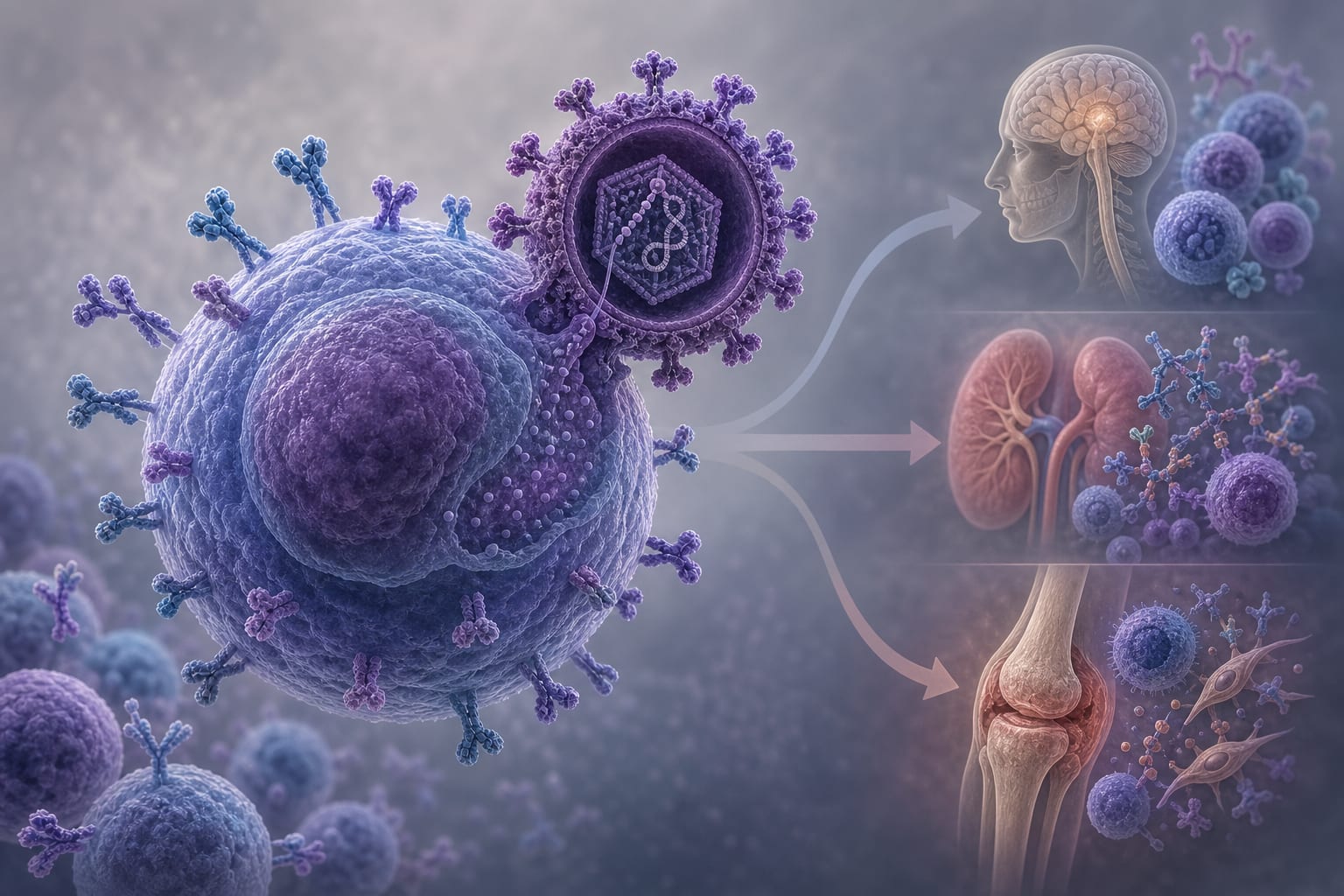
Comparative Analysis of Autoimmune Mechanisms Linked to Epstein-Barr Virus
-
By
-
Fathima Shabnam
-
Gulfaraz Khan
-
July 21, 2026
Clinical Report: Comparative Analysis of Autoimmune Mechanisms Linked to EBV
Background
Epstein-Barr virus (EBV) is a highly prevalent herpesvirus linked to various autoimmune diseases. Understanding the mechanisms by which EBV contributes to these conditions is crucial for developing targeted preventive and therapeutic strategies. The interplay between EBV and host genetics further complicates its role in autoimmunity.
Data Highlights
No numerical data or trial data available in the source material.
Key Findings
- EBV is associated with immune dysfunction through latent proteins and molecular mimicry.
- In multiple sclerosis, EBV triggers CNS-compartmentalized CD8+ T-cell responses and molecular mimicry with neural antigens.
- In systemic lupus erythematosus, EBV contributes to autoimmunity via mimicry with autoantigens and recurrent viral reactivation.
- In rheumatoid arthritis, EBV enhances anti-citrullinated protein antibody production and drives proinflammatory cytokine dysregulation.
- Host genetic variations, particularly in HLA alleles, influence susceptibility to EBV-associated autoimmune diseases.
Clinical Implications
Healthcare professionals should consider the role of EBV in autoimmune disease pathogenesis when evaluating patients with conditions like MS, SLE, and RA. Understanding these mechanisms may inform future therapeutic approaches targeting EBV.
Conclusion
The complex relationship between EBV and autoimmune diseases necessitates further research to elucidate the underlying mechanisms and potential therapeutic targets.
Related Resources & Content
- Frontiers in Immunology, 2026 -- How Epstein Barr virus shapes lupus autoimmunity: mechanistic insights and therapeutic perspectives
- The Journal of Infectious Diseases -- Post-streptococcal Autoimmunity and Its Relevance to Epstein–Barr virus as the Potential Cause of Multiple Sclerosis
- Frontiers in Immunology, 2026 -- Epstein-Barr virus associated diseases: Immune alterations and targeted approaches
- Brain -- The case for targeting latent and lytic Epstein-Barr virus infection in multiple sclerosis
- UCL Discovery -- Diagnosis of multiple sclerosis: 2024 revisions of the McDonald criteria
- Nature Reviews Microbiology -- Epstein–Barr virus pathogenesis and emerging control strategies
- PubMed -- A Phase 3 Trial of Telitacicept for Systemic Lupus Erythematosus
- Diagnosis of multiple sclerosis: 2024 revisions of the McDonald criteria - UCL Discovery
- Epstein–Barr virus pathogenesis and emerging control strategies | Nature Reviews Microbiology
- A Phase 3 Trial of Telitacicept for Systemic Lupus Erythematosus - PubMed
Based on findings from:
Mechanisms of Epstein-Barr virus-associated autoimmunity: a comparative overview
Fathima Shabnam, Gulfaraz Khan. Frontiers In Immunology, 2026.
https://www.frontiersin.org/journals/immunology/articles/10.3389/fimmu.2026.1891373/full
This content is an AI-generated, fully rewritten summary based on a published scholarly article. It does not reproduce the original text and is not a substitute for the original publication. Readers are encouraged to consult the source for full context, data, and methodology.