Case Report: Transthoracic echocardiographic diagnosis of agenesis of mitral chordae tendineae with papillary muscle fusion - Report - MDSpire

Case Report: Transthoracic echocardiographic diagnosis of agenesis of mitral chordae tendineae with papillary muscle fusion

  • By

  • Xinyu Xue

  • Meiling Liu

  • Meiju Zhang

  • Yunlong Cao

  • Jianbo Wu

  • Qian Liu

  • May 7, 2026

  • 0 min

Share

Clinical Report: Transthoracic Echocardiography Reveals Congenital Absence of Mitral Chordae Tendineae

Overview

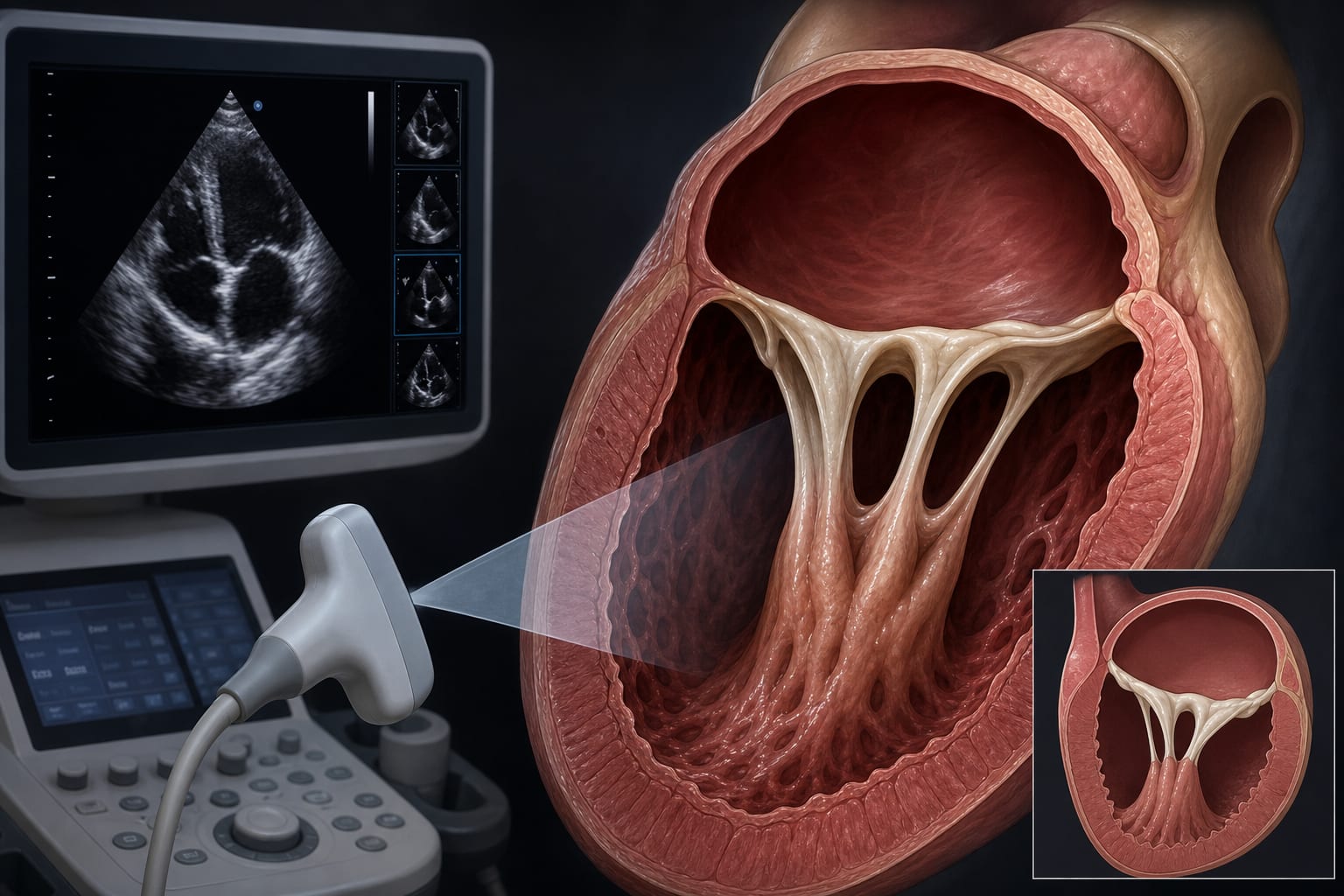
This case study presents a rare congenital defect characterized by the complete absence of mitral chordae tendineae and fusion of papillary muscles, diagnosed via transthoracic echocardiography (TTE). The findings were confirmed during surgery, leading to successful mechanical valve replacement and tricuspid annuloplasty.

Background

Congenital Mitral Valve Dysplasia is a rare condition, comprising only 0.2–0.4% of congenital heart anomalies, and often presents diagnostic challenges due to its morphological diversity. The absence of chordae tendineae can lead to severe mitral dysfunction, which may be misinterpreted as acquired valvular disease. Understanding this anomaly is crucial for timely intervention and effective management.

Data Highlights

ParameterValue
Mitral Valve Area (xPlane)0.46 cm²
Mitral Valve Area (3DE)0.42 cm²
E Peak (CWD)2.97 m/s
Transmitral Gradient35 mmHg
Vena Contracta Width6.6 mm
Left Atrial Diameter64 mm
Left Ventricular Ejection Fraction43%
Systolic Pulmonary Artery Pressure85 mmHg

Key Findings

  • Transthoracic echocardiography (TTE) accurately diagnosed congenital absence of mitral chordae tendineae.
  • Fusion of papillary muscles was observed, contributing to severe mitral stenosis and regurgitation.
  • The patient exhibited significant left atrial enlargement and reduced left ventricular ejection fraction.
  • Surgical intervention included mechanical mitral valve replacement and tricuspid annuloplasty, resulting in a smooth recovery.
  • This case underscores the importance of TTE in identifying rare congenital heart defects.

Clinical Implications

Healthcare professionals should consider congenital mitral valve anomalies in patients presenting with unexplained mitral dysfunction. Early and accurate diagnosis via TTE can facilitate timely surgical intervention, improving patient outcomes.

Conclusion

This case highlights the critical role of transthoracic echocardiography in diagnosing rare congenital heart defects, emphasizing the need for awareness and understanding of such anomalies in clinical practice.
Related Resources & Content

  1. European Radiology, 2023 -- The Dark Papillary Muscle Sign: A New Prognostic Indicator in Cardiac Magnetic Resonance Imaging
  2. Pediatric Cardiology, 2008 -- Coronary Artery Anomaly Originating from the Incorrect Sinus in a 15-Year-Old Male Patient
  3. Pediatric Cardiology, 2024 -- Proceedings from the 2024 Fetal and Neonatal Cardiac Symposium in Chicago, IL
  4. European Heart Journal - Cardiovascular Imaging -- Multi-modality imaging assessment of native valvular regurgitation
  5. 2025 ESC/EACTS Guidelines for the management of valvular heart disease
  6. Pediatric Cardiology — Resection of Ross-Konno and Endocardial Fibroelastosis Following Hybrid Stage I Palliation in Infants: Effective Staged Rehabilitation of the Left Ventricle and Transition to Biventricular Circulation Post Fetal Diagnosis of Aortic Stenosis
  7. Multi-modality imaging assessment of native valvular regurgitation: an EACVI and ESC council of valvular heart disease position paper | European Heart Journal - Cardiovascular Imaging | Oxford Academic
  8. 2025 ESC/EACTS Guidelines for the management of valvular heart disease
  9. CLASP IID Trial and Registry: 2-Year Outcomes of Transcatheter Repair for Degenerative Mitral Regurgitation - PubMed

Original Source(s)

Related Content