Rim enhancement on MRI predicts long-term outcomes in extruded/migrated lumbar disc herniation managed with an inflammation-preserving protocol: a 6-year prospective cohort study - Report - MDSpire
Advertisement
Rim enhancement on MRI predicts long-term outcomes in extruded/migrated lumbar disc herniation managed with an inflammation-preserving protocol: a 6-year prospective cohort study
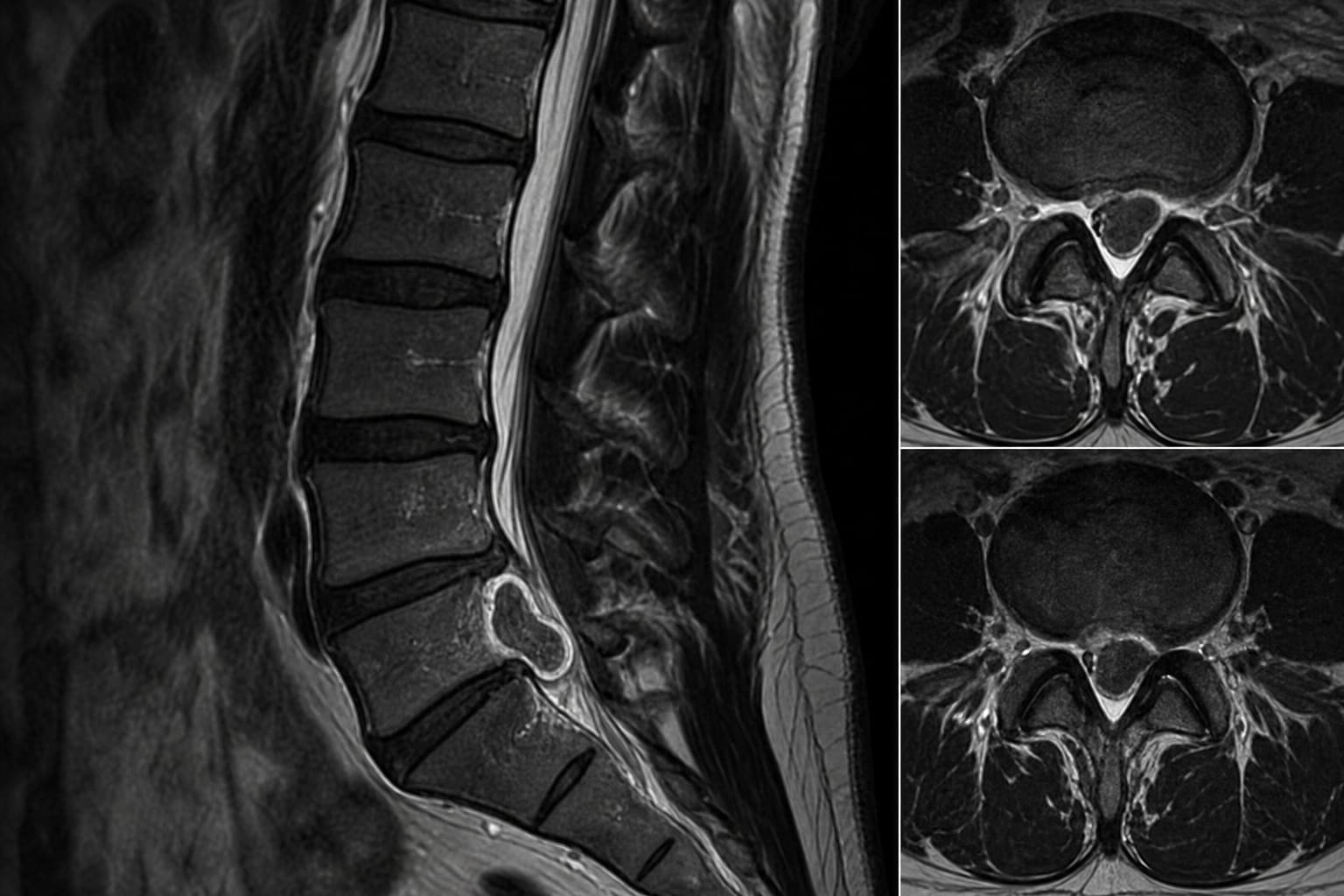
MRI Rim Enhancement as a Predictor of Long-Term Outcomes in Patients with Extruded or Migrated Lumbar Disc Herniation
Overview
This study evaluates the long-term outcomes of patients with extruded or migrated lumbar disc herniation (LDH) treated with an inflammation-sparing approach. It highlights the prognostic value of MRI rim enhancement in predicting herniated nucleus pulposus resorption and clinical efficacy over a 6-year follow-up.
Background
Lumbar disc herniation is a prevalent cause of low back pain and disability, significantly impacting quality of life. Conservative treatment is often the first-line management, yet traditional approaches may overlook the role of inflammation in promoting recovery. Understanding predictors of treatment outcomes, such as MRI findings, can enhance clinical decision-making and patient management.
Data Highlights
Parameter
Rim Enhancement Positive Group
Rim Enhancement Negative Group
Herniation Volume (1 year)
Significantly lower
Higher
Resorption Rate (3 years)
Higher
Lower
JOA Score Improvement (6 years)
Significantly greater
Lower
ODI Improvement (6 years)
Significantly greater
Lower
SLRT Positive Angle Improvement (6 years)
Significantly greater
Lower
Key Findings
66 patients with extruded or migrated LDH were followed for 6 years.
Rim enhancement on MRI was associated with a higher resorption rate of herniated nucleus pulposus.
Significant differences in clinical outcomes (JOA scores, ODI, SLRT) were observed between rim enhancement positive and negative groups.
Baseline herniation volume was the strongest predictor of JOA improvement rate.
No patients experienced progressive neurological deficits or cauda equina syndrome during follow-up.
Clinical Implications
The presence of rim enhancement on MRI may serve as a valuable prognostic indicator for clinicians managing patients with LDH. Understanding the relationship between imaging findings and clinical outcomes can guide treatment strategies and patient counseling.
Conclusion
The study demonstrates that MRI rim enhancement is a useful predictor of long-term outcomes in patients with extruded or migrated LDH treated conservatively. Further validation in controlled trials is necessary to confirm these findings.
Related Resources & Content
Positive Long-Term Results in Young Adults Following Surgical Intervention for Lumbar Disc Herniation, Springer, 2022 -- https://link.springer.com/article/10.1007/s00701-022-05375-8
Suboptimal Long-Term Results Following Lumbar Disc Herniation Surgery in Patients with Previous Lumbar Spine Operations, Springer, 2024 -- https://link.springer.com/article/10.1007/s00701-024-05932-3
A Multicenter Analysis of a Prognostic Model for Complications and Deterioration Following Lumbar Microdiscectomy from the Norwegian Spine Surgery Registry, Springer, 2021 -- https://link.springer.com/article/10.1007/s00701-021-04859-3
Prevalence, clinical predictors, and mechanisms of resorption in lumbar disc herniation: a systematic review, Orthopedic Reviews, 2024 -- https://orthopedicreviews.openmedicalpublishing.org/api/v1/articles/121399-prevalence-clinical-predictors-and-mechanisms-of-resorption-in-lumbar-disc-herniation-a-systematic-review.pdf
A Systematic Review of Treatment Guidelines for Lumbar Disc Herniation, Neurospine, 2025 -- https://www.e-neurospine.org/journal/view.php?number=1714&viewtype=pubreader