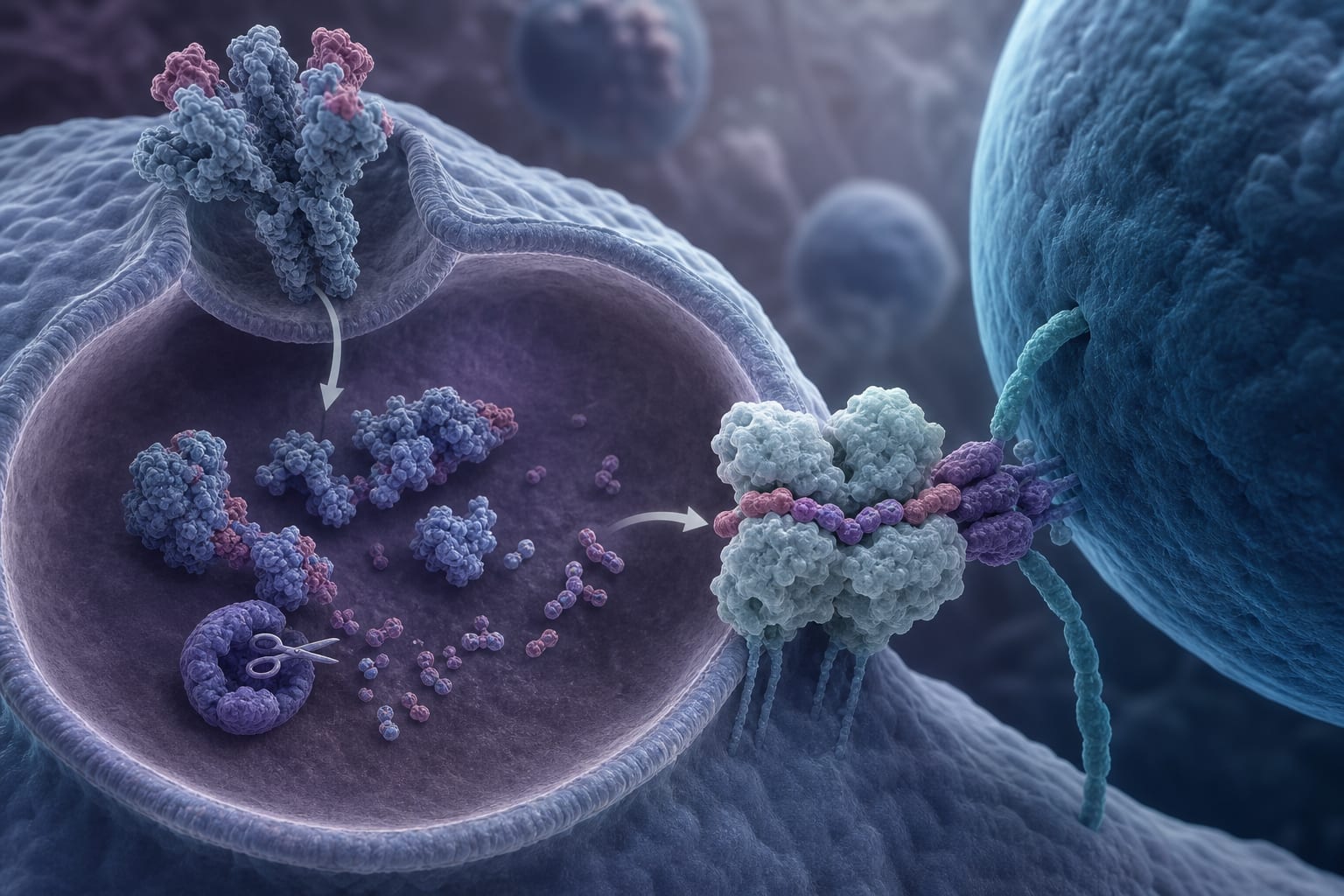
Clinical Report: Conformational Influence on Dominance of CD4+ T-cell Epitopes
Overview
This study investigates how the conformation of the SARS-CoV-2 spike protein influences CD4+ T-cell epitope dominance. Findings indicate that exposure circumstances, such as infection or vaccination, affect T-cell responses.
Background
Understanding CD4+ T-cell responses to SARS-CoV-2 is critical for developing effective vaccines and therapies. CD4+ T cells play a vital role in adaptive immunity, influencing antibody production and T-cell development.
Data Highlights
Protease-sensitive sites were identified at domain boundaries, confirming that spike protein structure limits proteolysis. The study analyzed CD4+ T-cell responses in two cohorts, revealing distinct patterns based on exposure type.
Key Findings
Protease-sensitive sites correspond to conformationally unstable regions of the spike protein.
CD4+ T-cell responses varied between stable and unstable peptide pools.
Exposure to spike via infection or vaccination influenced T-cell response patterns.
Distinct epitope dominance patterns may indicate exposure history.
Conformational changes in the spike protein affect T-cell recognition.
Clinical Implications
Clinicians should consider exposure history when evaluating immune responses in patients.
Conclusion
The study highlights the importance of spike protein conformation in shaping CD4+ T-cell responses.
by Samuel J. Landry, N. Kalaya Steede, Yali Tiomkin, Haley Smith, Ramgopal R. Mettu, Loren Gragert, Judith H. Aberle, Kevin J. Zwezdaryk, Crystal Zheng, Jay K. Kolls, Bronwyn M. Gunn, Amelie E. Murrell, Ivy V. Trinh, John S. Schieffelin, James E. Robinson, Elizabeth B. Norton