Predictive value of antioxidant and thyroid function indicators for non-suicidal self-injury in adolescents with major depressive disorder - Report - MDSpire

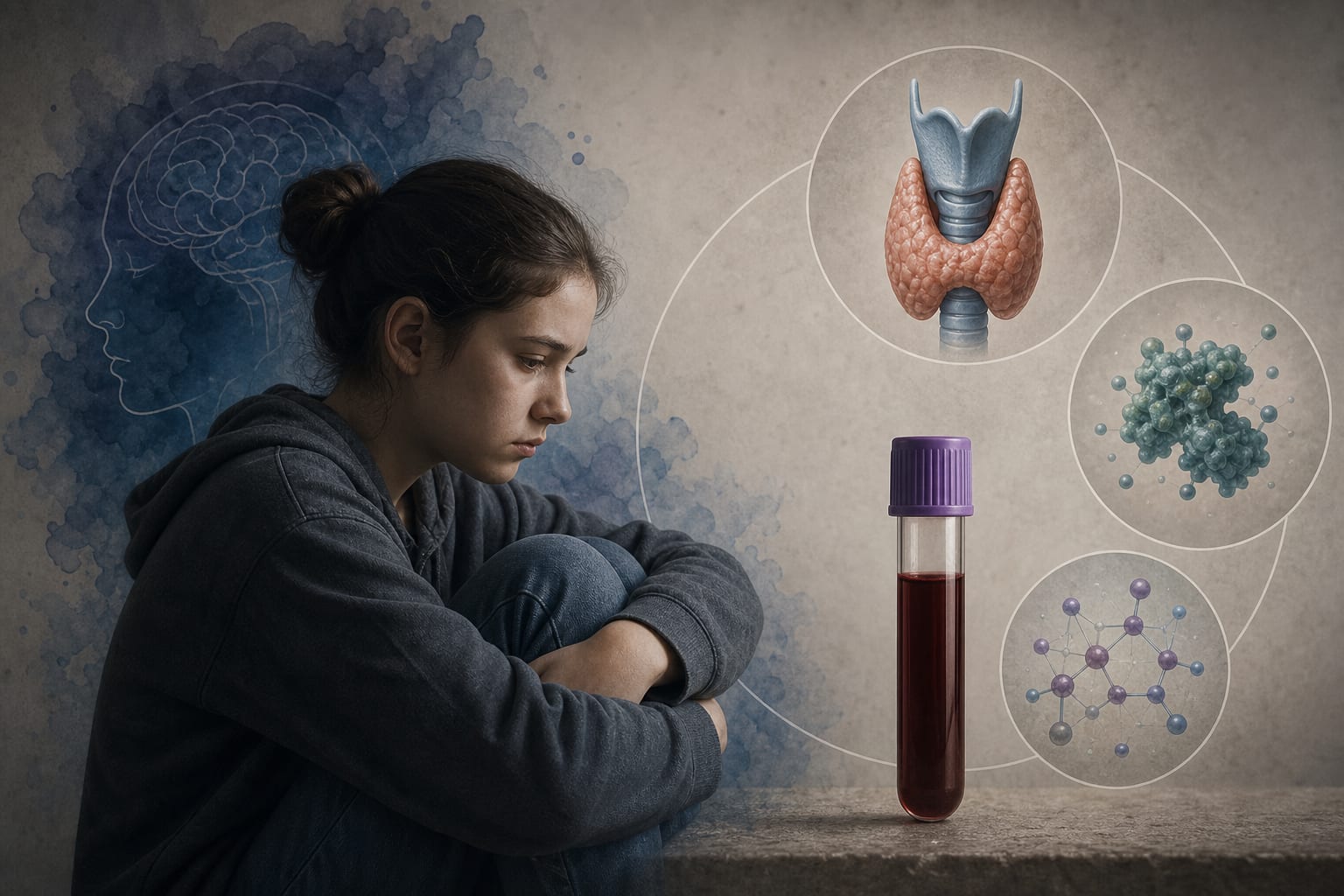
Predictive value of antioxidant and thyroid function indicators for non-suicidal self-injury in adolescents with major depressive disorder

  • By

  • Kefei Yang

  • Lewei Liu

  • Xianlong Zhang

  • Xianlin Sun

  • Pei Tang

  • Kai Zhang

  • Huanzhong Liu

  • June 1, 2026

  • 0 min

Share

Clinical Report: Predictive Role of Antioxidant Levels in Adolescent NSSI

Overview

This study investigates the predictive efficacy of antioxidant and thyroid biomarkers in adolescents with major depressive disorder (MDD) and non-suicidal self-injury (NSSI). Key findings indicate that reduced indirect bilirubin and elevated TSH levels are significant predictors of NSSI, particularly among females.

Background

Non-suicidal self-injury (NSSI) is prevalent among adolescents with major depressive disorder (MDD), with rates exceeding 40%. Understanding the underlying mechanisms and risk factors for NSSI is crucial for early identification and intervention. This study explores the role of antioxidant levels and thyroid function as potential predictive markers for NSSI in this vulnerable population.

Data Highlights

{'HAMD-17 Score': {'P-value': 'P < 0.001'}}

Key Findings

  • The prevalence of NSSI in adolescents with MDD was found to be 57.4%.
  • Females were identified as a higher risk group for NSSI with an odds ratio of 2.246.
  • The HAMD-17 score was a significant predictor of NSSI (OR = 1.183).
  • Lower levels of indirect bilirubin were associated with increased risk of NSSI (OR = 0.890).
  • Elevated TSH levels were also linked to NSSI risk (OR = 2.060).
  • The combination of sex, HAMD-17 score, indirect bilirubin, and TSH had an AUC of 0.776 for predicting NSSI.

Clinical Implications

Clinicians should consider the predictive value of thyroid function and antioxidant levels when assessing adolescents with MDD for NSSI risk. Targeted interventions focusing on these biomarkers may enhance management strategies for this high-risk population.

Conclusion

The findings underscore the importance of identifying biochemical markers in predicting NSSI among adolescents with MDD. Future research should explore therapeutic strategies that address these underlying factors.

Related Resources & Content

  1. BMC Psychiatry (Springer), 2024 -- Metabolic and Immune Dysregulation Linked to Suicide Risk in Adolescents with Major Depressive Disorder: A Cross-Sectional Analysis
  2. BMC Psychiatry (Springer), 2024 -- Association of Inflammatory Markers with Non-Suicidal Self-Injury in Adolescents Diagnosed with Major Depressive Disorder
  3. BMC Psychiatry (Springer), 2024 -- Connections Between Non-Suicidal Self-Injury and Cognitive Impairments in Depressed Adolescents
  4. The Global Prevalence of Nonsuicidal Self-Injury Among Adolescents
  5. BMC Psychiatry (Springer) — A Biomarker for Niacin-Induced Flushing Exhibiting Disorder-Specific Multivariate Associations in Adolescent Unipolar and Bipolar Depression
  6. Effects of interventions for self-harm in children and adolescents: a systematic review and meta-analysis
  7. Enzymatic biomarkers of oxidative stress in patients with depressive disorders. A systematic review
  8. The Global Prevalence of Nonsuicidal Self-Injury Among Adolescents

Original Source(s)

Related Content