Clinical Report: Most Miss Streamlined Neck Mass Dx Path
Overview
A retrospective study published in The Permanente Journal found that most patients diagnosed with malignant neck masses did not follow a streamlined diagnostic pathway, leading to longer diagnostic intervals. Key factors included empiric antibiotic use, delayed biopsies, and the need for multiple biopsies. The study reviewed electronic consult records for 4,103 adults referred for evaluation of neck or salivary gland masses, identifying 205 patients with newly diagnosed malignancy.
Background
The timely diagnosis of malignant neck masses is critical for effective treatment and improved patient outcomes. Delays in diagnosis can result from various factors, including inappropriate initial management strategies such as empiric antibiotic use and the complexity of distinguishing benign from malignant conditions. Understanding these delays can help refine diagnostic pathways.
Data Highlights
| Finding | Value |
|---|---|
| Median interval from primary care evaluation to pathologic diagnosis | 21 days |
| Percentage of patients diagnosed with malignancy | 5% |
| Median time to diagnosis with antibiotics | 41 days |
| Median time to diagnosis without antibiotics | 20 days |
| Percentage of patients requiring multiple biopsies | 42% |
| Diagnostic success rate for fine-needle aspiration | 56% |
| Diagnostic success rate for core needle biopsy | 74% |
| Diagnostic success rate for excisional biopsy | 100% |
Key Findings
- Only 18% of patients underwent the streamlined diagnostic pathway defined as specialist referral without empiric antibiotics or primary care physician–ordered imaging, followed by diagnostic biopsy at the initial visit.
- Empiric antibiotic use was associated with longer diagnostic intervals.
- 25% of patients had diagnostic intervals of at least 38 days.
- 58% of patients had biopsy performed at the initial specialist visit.
- Core needle biopsy had a higher diagnostic yield than fine-needle aspiration.
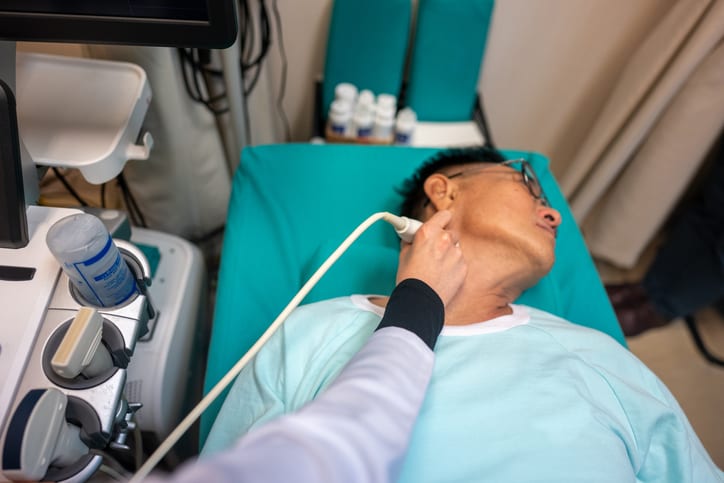
- Point-of-care ultrasound was used in only 18% of needle biopsies.
Clinical Implications
The findings suggest that adherence to established guidelines, including avoiding empiric antibiotics and optimizing the timing of biopsies, may improve diagnostic efficiency. Clinicians should consider the implications of initial management strategies on the overall diagnostic timeline.
Conclusion
The study highlights significant delays in the diagnosis of malignant neck masses due to non-adherence to streamlined pathways.
Related Resources & Content
- The Permanente Journal, 2023 -- Delays in Malignant Neck Mass Diagnosis: Missed Opportunities in Clinical Decision-Making
- Clinical Practice Guideline: Evaluation of the Neck Mass in Adults
- Frontiers in Oncology — Navigating the Diagnostic Pitfalls of Cystic and Solid Breast Masses: A Comparative Case Report of Metaplastic Carcinoma and Benign Lesions
- asco ai in oncology — PanCAM Pathological Model Improves Detection of Lymph Node Metastasis
- European Radiology — Application of Gadolinium-based Contrast Agents in the Diagnosis, Staging, and Monitoring of Head and Neck Cancers: Current Uses and Future Directions
- European Radiology — Enhancing Diagnostic Accuracy and Minimizing Unnecessary Biopsies of Thyroid Nodules Through Microflow Patterns and Greyscale Ultrasound Techniques
- NCCN Head and Neck Cancers Guidelines
- AAO-HNS Clinical Practice Guideline
- Clinical Practice Guideline: Evaluation of the Neck Mass in Adults
- Delays in Malignant Neck Mass Diagnosis: Missed Opportunities in Clinical Decision-Making | The Permanente Journal
- Diagnostic Yield of Neck Mass Imaging: Impact of Clinician Specialty | The Permanente Journal
- Evaluation of Neck Masses in Adults | AFP
- Fine‐Needle Aspiration Versus Core Needle Biopsy for Malignant Cervical Lymphadenopathy: A Meta‐Analysis and Systematic Review - PMC
- A percutaneous core needle biopsy of deep suprahyoid head and neck lesions with CT-guided: study of diagnostic performance and factors associated with diagnostic failure | BMC Medical Imaging | Springer Nature Link
This content is an AI-generated, fully rewritten summary based on a published scholarly article. It does not reproduce the original text and is not a substitute for the original publication. Readers are encouraged to consult the source for full context, data, and methodology.