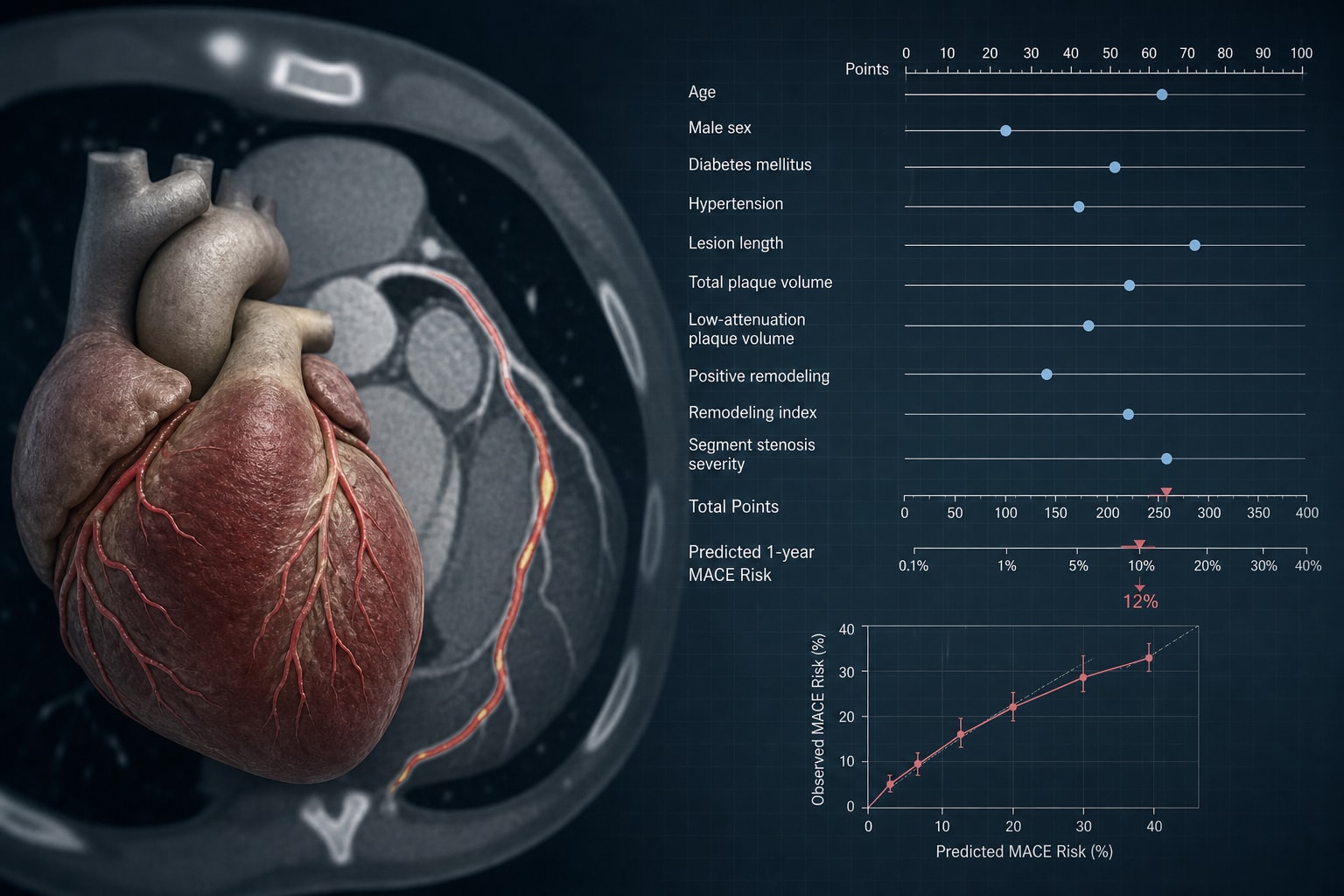
Clinical Report: Creation of a Risk Prediction Model for Major Adverse Cardiovascular Events
Overview
This study developed a nomogram-based risk prediction model for major adverse cardiovascular events (MACE) in patients with coronary artery disease (CAD) using quantitative data from coronary computed tomography angiography (CCTA).
Background
The incidence of major adverse cardiac events (MACE) significantly impacts the survival outcomes of patients with coronary artery disease (CAD). Accurate risk stratification is essential for effective management and intervention in these patients. This study explores the integration of quantitative CCTA parameters to enhance predictive capabilities for MACE.
Data Highlights
Parameter
AUC
Stenosis
0.735
Plaque Length
0.823
MLA
0.747
Fibrous Volume
0.704
PB
0.691
CACS
0.808
FAI
0.810
MAS
0.689
Combined Model
0.936
Key Findings
280 CAD patients were analyzed, with significant differences in various clinical and CCTA-derived parameters between MACE and non-MACE groups.
Independent risk factors for MACE included severe stenosis, longer plaque length, larger fibrous plaque volume, and elevated plaque burden (PB), coronary artery calcium score (CACS), perivascular fat attenuation index (FAI), and myocardial mass/volume ratio (MAS).
Larger minimal lumen area (MLA) was identified as a protective factor against MACE.
The combined risk prediction model achieved an AUC of 0.936, outperforming individual indicators.
External validation confirmed robust discrimination (AUC = 0.932) and excellent calibration (Hosmer-Lemeshow P = 0.382).
Clinical Implications
The findings should be interpreted with caution due to the short follow-up duration and the predominance of soft endpoints.
Conclusion
The study presents a nomogram for predicting MACE in CAD patients using CCTA-derived parameters.