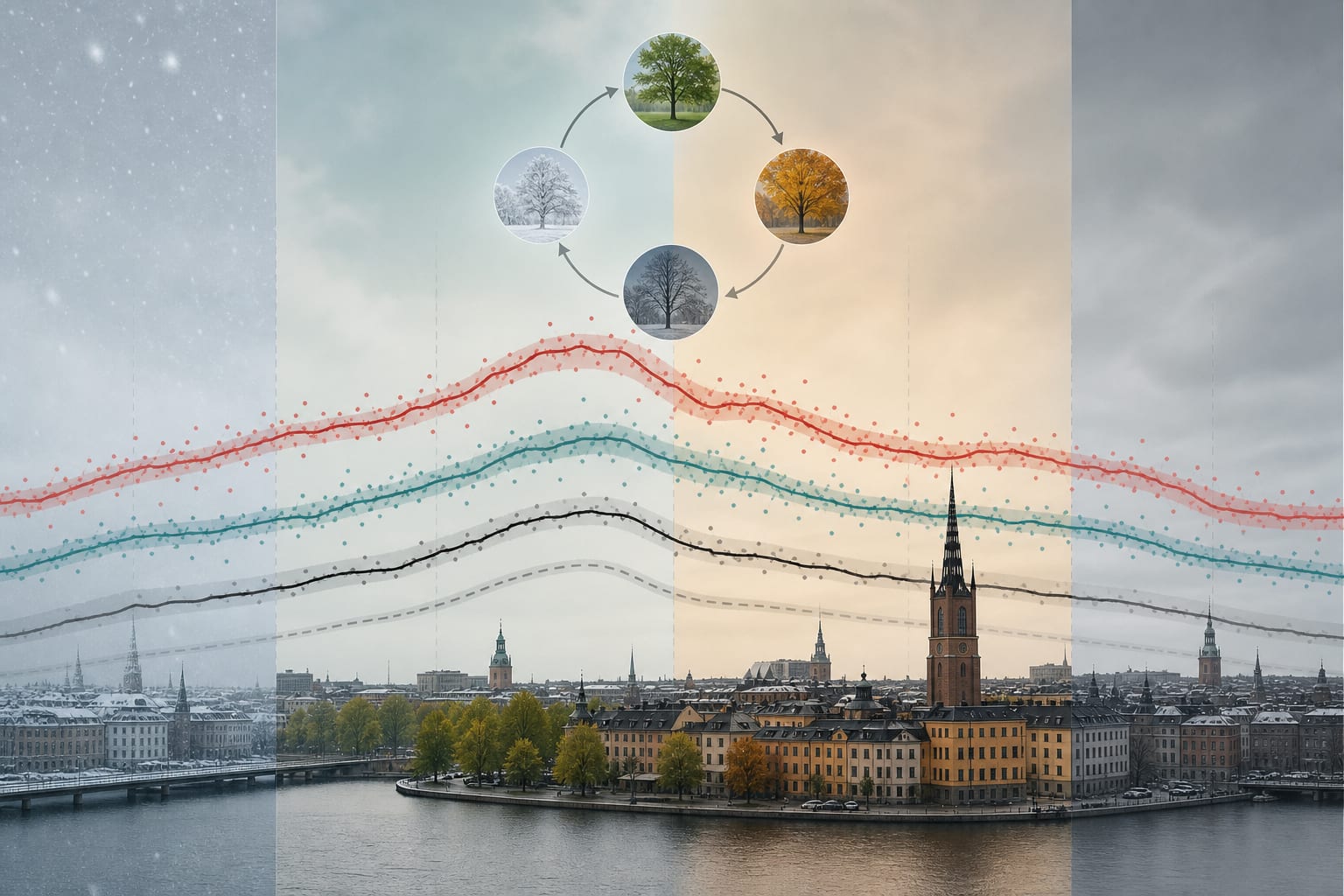
When seasonal structure dominates: rethinking causal attribution in environmental epidemiology
-
By
-
Erling Häggström Gunfridsson
-
June 5, 2026
-
0 min
Clinical Report: Reassessing Causal Attribution in Environmental Epidemiology
Overview
Revise to clarify the distinction between modeling conventions and causal effects.
Background
Understanding causal relationships in environmental epidemiology is crucial for public health, as it informs interventions aimed at reducing morbidity and mortality linked to environmental exposures. However, the seasonal co-variation of environmental factors complicates the identification of unique causal pathways. This study emphasizes the need for careful consideration of seasonal adjustments in epidemiological models to improve causal inference.
Data Highlights
Daily mortality data from Stockholm County (1987-2016) were analyzed using quasi-Poisson regression models, revealing significant variability in associations for temperature and nitrogen dioxide (NO₂) based on seasonal adjustment specifications.
Key Findings
- Reproducible associations in environmental epidemiology may arise from common modeling conventions rather than stable causal mechanisms.
- Seasonal adjustment is a critical component of the inferential framework, influencing the interpretation of causal relationships.
- Different seasonal representations can redistribute overlapping variation among correlated predictors, affecting estimated associations.
- Collinearity limits identifiability, complicating the distinction between correlated explanations in environmental time-series data.
- Greater transparency in modeling choices is essential for responsible interpretation of environmental epidemiological evidence.
Clinical Implications
Clinicians should be aware of the potential for misinterpretation of environmental epidemiological data due to seasonal confounding. It is important to consider the implications of seasonal patterns when designing studies and interpreting results related to environmental exposures and health outcomes.
Conclusion
The study underscores the importance of addressing seasonal patterns in environmental epidemiology to enhance the reliability of causal inferences. Improved modeling practices are necessary for accurate public health guidance.
Related Resources & Content
- Drugs - Real World Outcomes, Variation in Adverse Event Reporting by Season and Location, 2016 -- Variation in Adverse Event Reporting by Season and Location
- American Journal of Epidemiology, Exploring the Complex Effects of Spatial Exposures on Health Throughout the Life Course, 2021 -- Exploring the Complex Effects of Spatial Exposures on Health Throughout the Life Course
- American Journal of Epidemiology, Enhancing Environmental Epidemiology Techniques to Address the Cancer Challenge, 2021 -- Enhancing Environmental Epidemiology Techniques to Address the Cancer Challenge
- Open Forum Infectious Diseases, Investigating the Link Between Environmental Factors and Respiratory Syncytial Virus Infections in Japan: A Spatiotemporal Study, 2021 -- Investigating the Link Between Environmental Factors and Respiratory Syncytial Virus Infections in Japan: A Spatiotemporal Study
- Extreme Heat Action Profile, WHO, 2025 -- Extreme Heat Action Profile
- Association between all-cause mortality and locally-defined extreme heat events: A global systematic review and meta-analysis, ScienceDirect, 2025 -- Association between all-cause mortality and locally-defined extreme heat events
- Interrupted Time Series Analysis in Environmental Epidemiology: A Review of Traditional and Novel Modeling Approaches, Current Environmental Health Reports, 2025 -- Interrupted Time Series Analysis in Environmental Epidemiology
- Extreme Heat Action Profile
- Association between all-cause mortality and locally-defined extreme heat events: A global systematic review and meta-analysis - ScienceDirect
- Interrupted Time Series Analysis in Environmental Epidemiology: A Review of Traditional and Novel Modeling Approaches | Current Environmental Health Reports | Springer Nature Link
This content is an AI-generated, fully rewritten summary based on a published scholarly article. It does not reproduce the original text and is not a substitute for the original publication. Readers are encouraged to consult the source for full context, data, and methodology.