HDAC1-mediated CDK1 decrotonylation inhibits colorectal cancer proliferation by regulating cell cycle and apoptosis - Report - MDSpire

HDAC1-mediated CDK1 decrotonylation inhibits colorectal cancer proliferation by regulating cell cycle and apoptosis

  • By

  • Dongling Li

  • Qinrui Cai

  • Ling Lin

  • Li Li

  • Yao Chen

  • Tianlin Feng

  • Xiaoya Zhou

  • Jia Xie

  • Xiaohong Fu

  • Chuanwei Li

  • Jun Xiao

  • Fan Yang

  • June 16, 2026

  • 0 min

Share

Clinical Report: Inhibition of Colorectal Cancer Growth through HDAC1-Driven CDK1 Decrotonylation

Overview

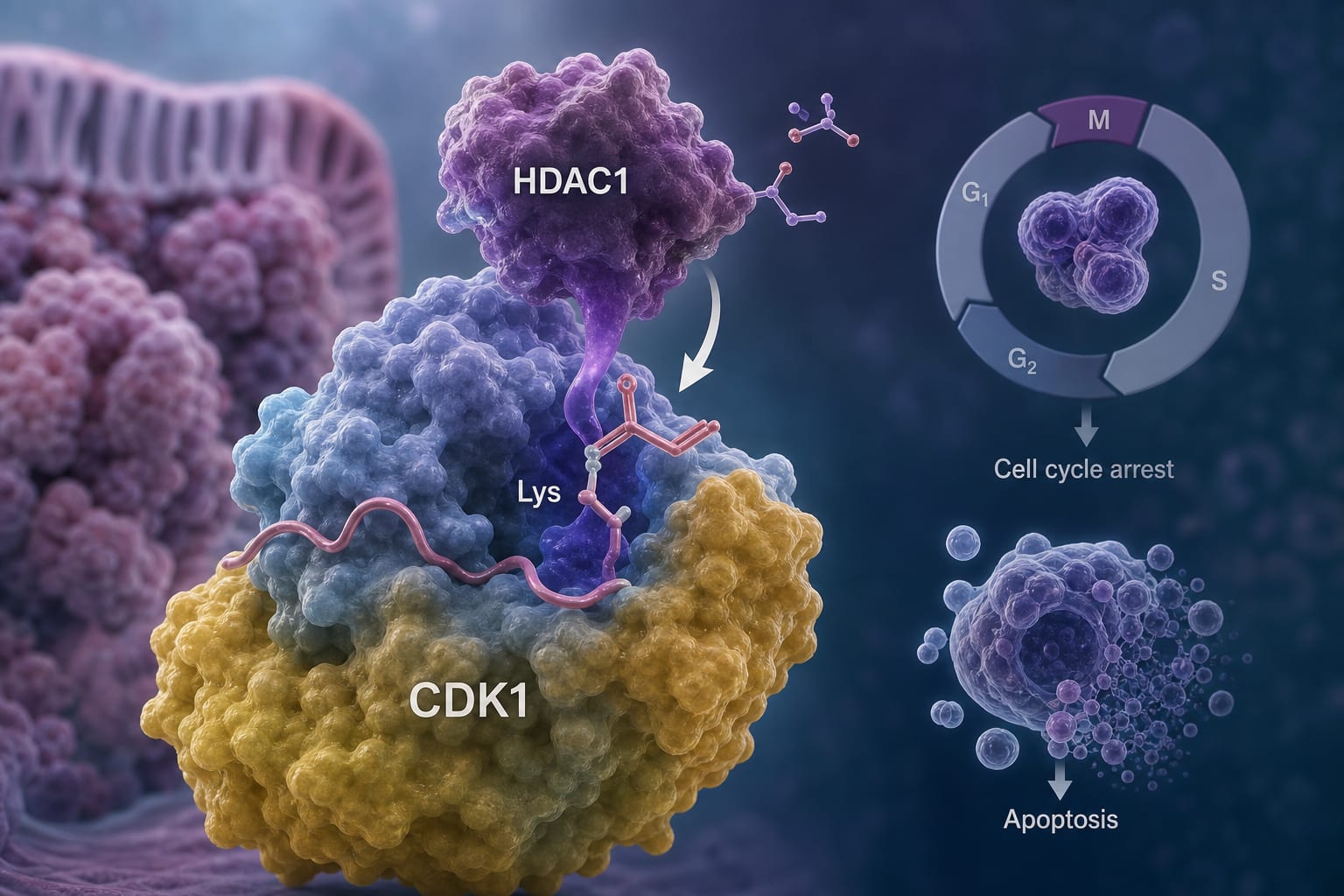
This study identifies elevated levels of crotonylation in colorectal cancer (CRC) tissues compared to normal tissues. The decrotonylation of CDK1 at lysine 9 significantly inhibits CRC cell proliferation and migration by inducing cell cycle arrest and apoptosis.

Background

Colorectal cancer is a leading cause of cancer-related mortality worldwide, with a projected increase in incidence. Understanding the molecular mechanisms underlying CRC proliferation is crucial for developing effective treatment strategies. Post-translational modifications, particularly crotonylation, have emerged as significant regulators of cancer biology, yet their role in CRC remains underexplored.

Data Highlights

FindingDetails
Crotonylation LevelsSignificantly elevated in CRC tissues compared to adjacent normal tissues.
CDK1 K9 DecrotonylationInhibits CRC proliferation and migration in vitro and in vivo.
Cell Cycle ArrestInduces G2/M phase arrest in CRC cells.
Apoptosis InductionPromotes apoptosis in CRC cells.
Synergistic EffectCDK1 K9 decrotonylation enhances efficacy of CDK1 inhibitor RO-3306.

Key Findings

  • Global crotonylation is significantly higher in CRC tissues than in normal tissues.
  • Decrotonylation of CDK1 at lysine 9 inhibits CRC cell proliferation and migration.
  • CDK1 K9 decrotonylation leads to G2/M phase cell cycle arrest.
  • Induction of apoptosis is observed following CDK1 K9 decrotonylation.
  • Decrotonylation of CDK1 increases sensitivity to the CDK1 inhibitor RO-3306.

Clinical Implications

The findings suggest that targeting crotonylation and decrotonylation processes may offer new therapeutic avenues for CRC treatment. Enhancing the efficacy of existing CDK1 inhibitors through modulation of CDK1 crotonylation could improve patient outcomes.

Conclusion

This study highlights the critical role of crotonylation in CRC proliferation and suggests that targeting this modification may provide a novel strategy for therapeutic intervention in colorectal cancer.

Related Resources & Content

  1. Journal of Gastroenterology, 2022 -- Epigenetic Modulation of Pancreatic Adenocarcinoma in the Context of Cancer Immunotherapy
  2. Frontiers in Immunology, 2026 -- HDAC7 controls anti-viral and anti-tumor immunity by CD8+ T cells
  3. CIP2A Modulates MYC Translation Through Its 5′UTR in Colorectal Carcinoma
  4. Frontiers in Immunology, 2026 -- Baicalin suppresses colorectal cancer proliferation and induces M1 polarization of tumor-associated macrophages by promoting proteasomal degradation of HK2
  5. Metastatic colorectal cancer: ESMO Clinical Practice Guideline for diagnosis, treatment and follow-up - PubMed
  6. FDA D.I.S.C.O. Burst Edition: FDA approvals of Augtyro (repotrectinib) for NTRK gene fusion-positive solid tumors and Krazati (adagrasib) for KRAS G12C-mutated colorectal cancer | FDA
  7. Histone deacetylase (HDAC) 1 and 2 complexes regulate both histone acetylation and crotonylation in vivo | Scientific Reports
  8. Metastatic colorectal cancer: ESMO Clinical Practice Guideline for diagnosis, treatment and follow-up - PubMed
  9. FDA D.I.S.C.O. Burst Edition: FDA approvals of Augtyro (repotrectinib) for NTRK gene fusion-positive solid tumors and Krazati (adagrasib) for KRAS G12C-mutated colorectal cancer | FDA
  10. Histone deacetylase (HDAC) 1 and 2 complexes regulate both histone acetylation and crotonylation in vivo | Scientific Reports

Original Source(s)

Related Content