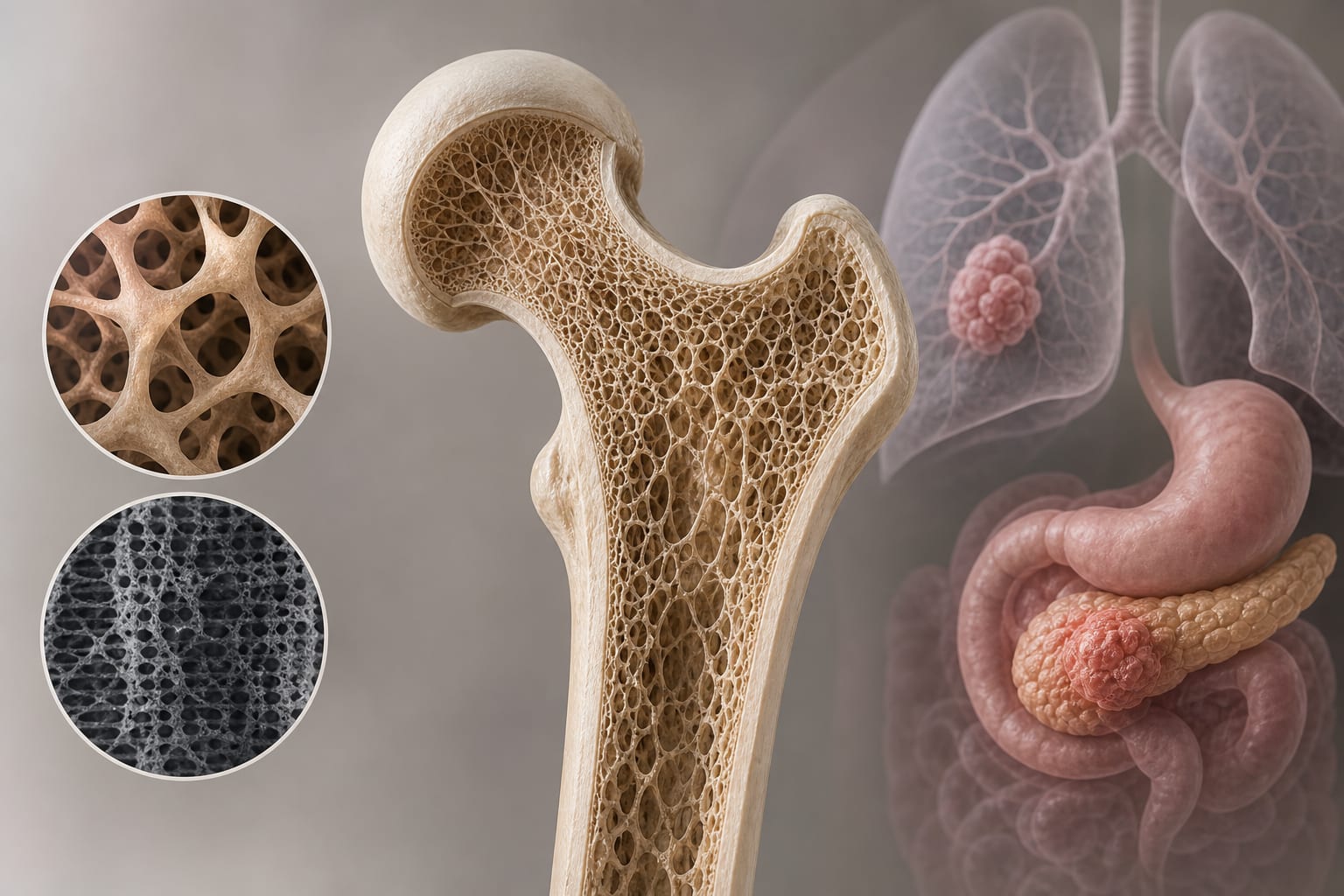
Clinical Report: Musculoskeletal Health in Patients with Neuroendocrine Tumors
Overview
This study evaluates musculoskeletal health in patients with neuroendocrine tumors (NETs), revealing significant impairments in bone density and muscle mass.
Background
Neuroendocrine tumors (NETs) are increasingly prevalent and can lead to various complications, including musculoskeletal health issues. Understanding the impact of NETs on bone and muscle health is crucial.
Data Highlights
Parameter
NET Patients
Healthy Controls
TBS (Trabecular Bone Score)
Degraded in 71%
Not specified
Osteopenia at Femoral Neck
59%
Not specified
Hypovitaminosis D Prevalence
68%
Not specified
Low RSMI (Sarcopenia)
37%
Not specified
Advanced Stage BMD
Lower than earlier stages
Not specified
Key Findings
71% of NET patients exhibited degraded TBS.
59% of patients had osteopenia at the femoral neck.
68% prevalence of hypovitaminosis D was observed in the NET cohort.
37% of patients showed low RSMI, indicative of sarcopenia.
Advanced-stage NETs were associated with significantly lower BMD and vitamin D levels.
Clinical Implications
The findings suggest that musculoskeletal health assessments should be integrated into the management of NET patients, particularly for those with advanced disease. Clinicians should monitor vitamin D levels and BMI as potential factors influencing patient outcomes.
Conclusion
This study highlights the significant musculoskeletal impairments in NET patients.
by Andrea Casabella, Iderina Hasballa, Anna Arecco, Mara Boschetti, Leonardo Della Sala, Davide Demontis, Alberto Sulli, Lara Vera, Alessandro Veresani, Diego Ferone, Sabrina Paolino, Manuela Albertelli