Sex-specific echocardiographic remodeling and prognostic value of left ventricular sphericity, pressure–dimension index, and myocardial work after durable LVAD implantation - Report - MDSpire
Advertisement
Sex-specific echocardiographic remodeling and prognostic value of left ventricular sphericity, pressure–dimension index, and myocardial work after durable LVAD implantation
Gender-based differences in echocardiographic remodeling and LVAD outcomes
Overview
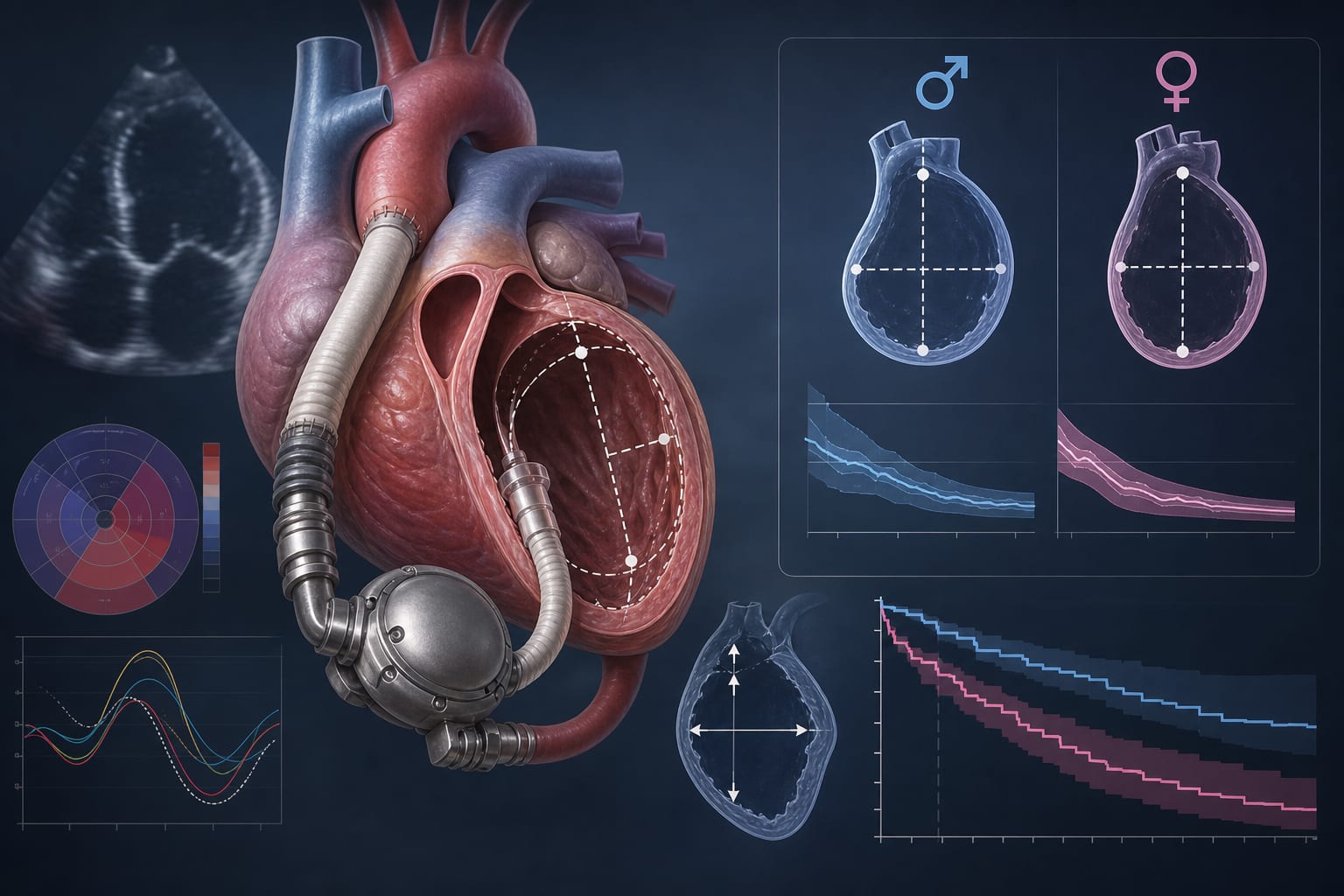
This study evaluates sex-specific remodeling patterns and the prognostic significance of left ventricular geometry and myocardial work following LVAD implantation. Findings indicate that men experience adverse changes in left ventricular sphericity and pressure-dimension index post-implantation, while women maintain stable geometry and higher pressure-dimension index.
Background
Understanding gender differences in outcomes after LVAD implantation is crucial for optimizing patient management and risk stratification. Previous studies have shown that sex-related differences can influence postoperative morbidity and mortality.
Data Highlights
Parameter
Men
Women
ΔLVSI
+0.045 (p = 0.001)
Stable (p = 0.766)
ΔPDI
−1.475 (p < 0.001)
−0.922 (p = 0.130)
Absolute PDI at 6 months
Lower
Higher (p = 0.041)
Key Findings
Men exhibited adverse sphericalization post-LVAD implantation (median ΔLVSI +0.045, p = 0.001).
Women showed a pattern of geometric resistance with stable LVSI (ΔLVSI p = 0.766).
Preoperative LVSI was independently associated with mortality (HR 1.47 per SD, p = 0.034).
Preoperative global work index was a robust predictor of mortality (HR 0.14 per SD, p < 0.001) and postoperative right heart failure (OR 0.41 per SD, p = 0.022).
Findings require cautious interpretation due to small sample size and attenuation after matching.
Clinical Implications
The study highlights the importance of considering sex-specific responses in LVAD patients, particularly regarding ventricular geometry and myocardial work.
Conclusion
The findings indicate that women may preserve left ventricular geometry and function better than men after LVAD implantation.
Federal prosecutors allege that a Florida physician and research staff fabricated clinical trial records that were submitted into database systems used to evaluate investigational drugs.