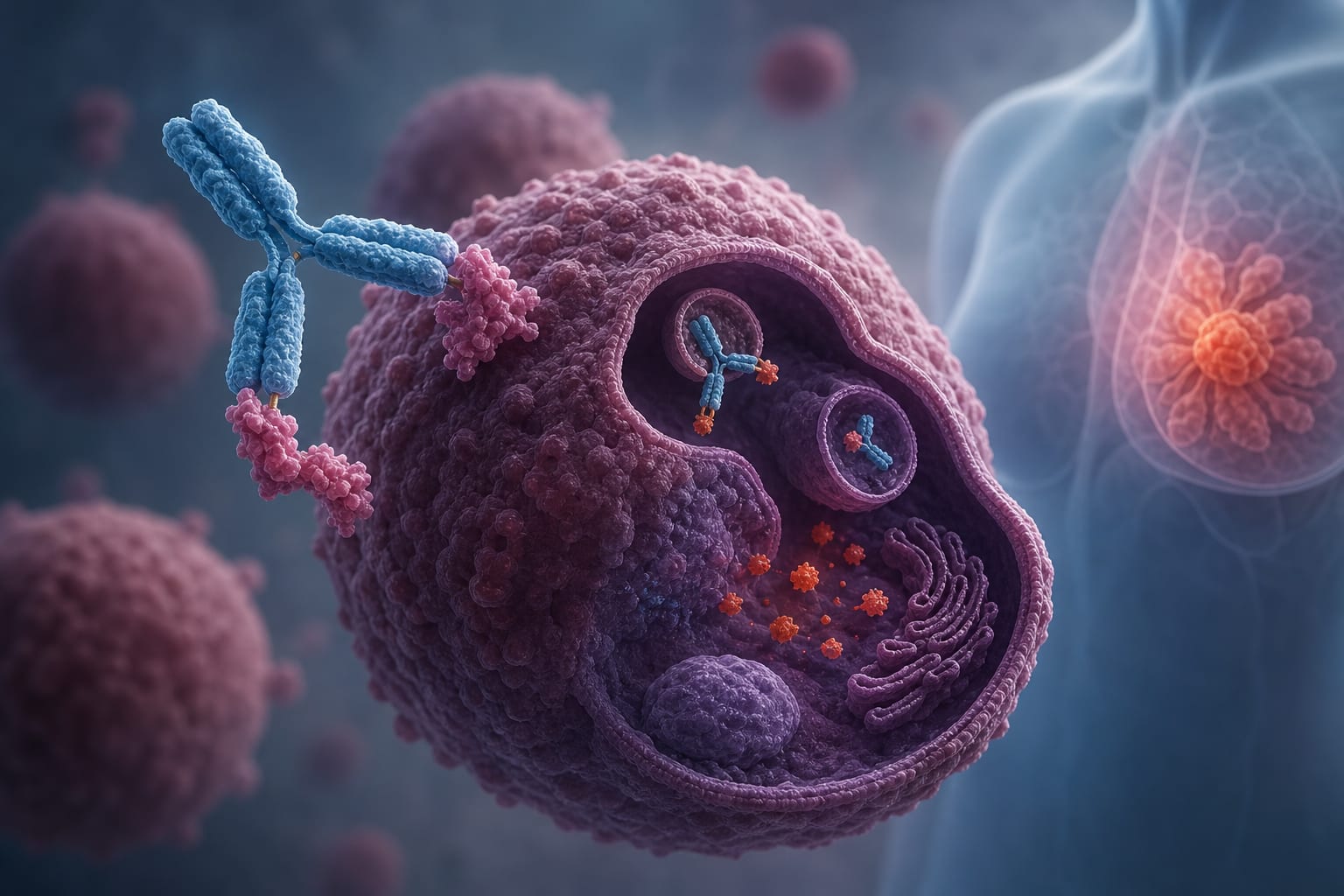
Management of toxicities from antibody – drug conjugates in breast cancer
-
By
-
Ajay Gogia
-
May 29, 2026
-
0 min
Clinical Report: Addressing Adverse Effects of Antibody-Drug Conjugates in Breast Cancer Treatment
Overview
This report synthesizes clinical-trial, post-marketing, and real-world data to develop a framework for managing toxicities associated with antibody-drug conjugates (ADCs) in breast cancer.
Background
Antibody-drug conjugates (ADCs) deliver targeted therapy combined with potent cytotoxic agents. As the use of ADCs like trastuzumab deruxtecan, sacituzumab govitecan, and datopotamab deruxtecan expands, effective management of treatment-related toxicities is essential.
Data Highlights
No numerical data provided in the source material.
Key Findings
- ADCs exhibit overlapping but distinct toxicity signatures influenced by payload, linker stability, and antigen expression.
- Management algorithms for pulmonary, gastrointestinal, hematologic, ocular, and mucosal adverse events are proposed.
- Real-world data reveal complex toxicity patterns that differ from conventional chemotherapy or immunotherapy.
- Current adverse-event management information is fragmented across various sources.
- Multidisciplinary coordination and early recognition of toxicities are emphasized.
Clinical Implications
Oncologists should be aware of the distinct toxicity profiles associated with different ADCs.
Conclusion
This review consolidates evidence on managing ADC-related toxicities in breast cancer.
Related Resources & Content
- The ASCO Post, 2021 -- Role of Antibody-Drug Conjugates Across Breast Cancer Subtypes
- The ASCO Post, 2020 -- More Antibody-Drug Conjugates on the Horizon for Breast Cancer
- Frontiers in Medicine, 2026 -- Cutaneous adverse events with antibody-drug conjugates: a FAERS-based pharmacovigilance study
- FDA -- FDA approves fam-trastuzumab deruxtecan-nxki with pertuzumab for unresectable or metastatic HER2-positive breast cancer
- Oncology Nursing Society -- FDA Approves Datopotamab Deruxtecan-Dlnk for Unresectable or Metastatic, HR-Positive, HER2-Negative Breast Cancer
- the asco post — ADCs vs Standard Chemotherapy: Cardiotoxicity in HER2-Positive Advanced Breast Cancer
- FDA Approves Datopotamab Deruxtecan-Dlnk for Unresectable or Metastatic Triple-Negative Breast Cancer
- FDA approves fam-trastuzumab deruxtecan-nxki with pertuzumab for unresectable or metastatic HER2-positive breast cancer | FDA
- label
- FDA Approves Datopotamab Deruxtecan-Dlnk for Unresectable or Metastatic, HR-Positive, HER2-Negative Breast Cancer | Oncology Nursing Society
- Datopotamab deruxtecan versus chemotherapy in previously treated inoperable/metastatic hormone receptor-positive, HER2-negative breast cancer: final overall survival analysis of the phase III TROPION-Breast01 study - ScienceDirect
- The safety of trastuzumab deruxtecan (T-DXd) in breast cancer brain metastases with a focus on interstitial lung disease/pneumonitis: A systematic review and meta-analysis - PubMed
- Pattern of granulocyte colony stimulating growth factors (G-CSGF) usage in patients treated with sacituzumab govitecan: A real world multicenter study using the TriNetX database. | Journal of Clinical Oncology
- Management of trastuzumab deruxtecan-related adverse events in breast cancer: Italian expert panel recommendations - PubMed
- US expert Delphi consensus on the prevention and management of stomatitis in patients treated with datopotamab deruxtecan - PubMed
- Easy as ABC: Managing Toxicities of Antibody-Drug Conjugates, Bispecific Antibodies, and CAR T-Cell Therapies | American Society of Clinical Oncology Educational Book
- Germline determinants of pneumonitis in patients with cancer treated with antibody drug conjugates. | Journal of Clinical Oncology
This content is an AI-generated, fully rewritten summary based on a published scholarly article. It does not reproduce the original text and is not a substitute for the original publication. Readers are encouraged to consult the source for full context, data, and methodology.