The aMAP score improves discrimination of prognostic models in hepatocellular carcinoma after radiofrequency ablation - Report - MDSpire

The aMAP score improves discrimination of prognostic models in hepatocellular carcinoma after radiofrequency ablation

  • By

  • Luchang Fan

  • Yiyan Zhang

  • Jianmin Ding

  • Yan Zhou

  • Jun Li

  • Qiong Wu

  • Shuqin Cheng

  • Fengmei Wang

  • Xiang Jing

  • June 17, 2026

  • 0 min

Share

Clinical Report: Enhancing Prognostic Model Accuracy in Hepatocellular Carcinoma Post-Radiofrequency Ablation with the aMAP Score

Overview

Expand on how the aMAP score improves predictive accuracy compared to existing models.

Background

Hepatocellular carcinoma (HCC) is a leading cause of cancer-related mortality worldwide, with radiofrequency ablation (RFA) being a common treatment for early-stage cases. Despite RFA's effectiveness, recurrence rates remain high, highlighting the need for reliable prognostic tools to guide patient management and follow-up strategies.

Data Highlights

ParameterValue
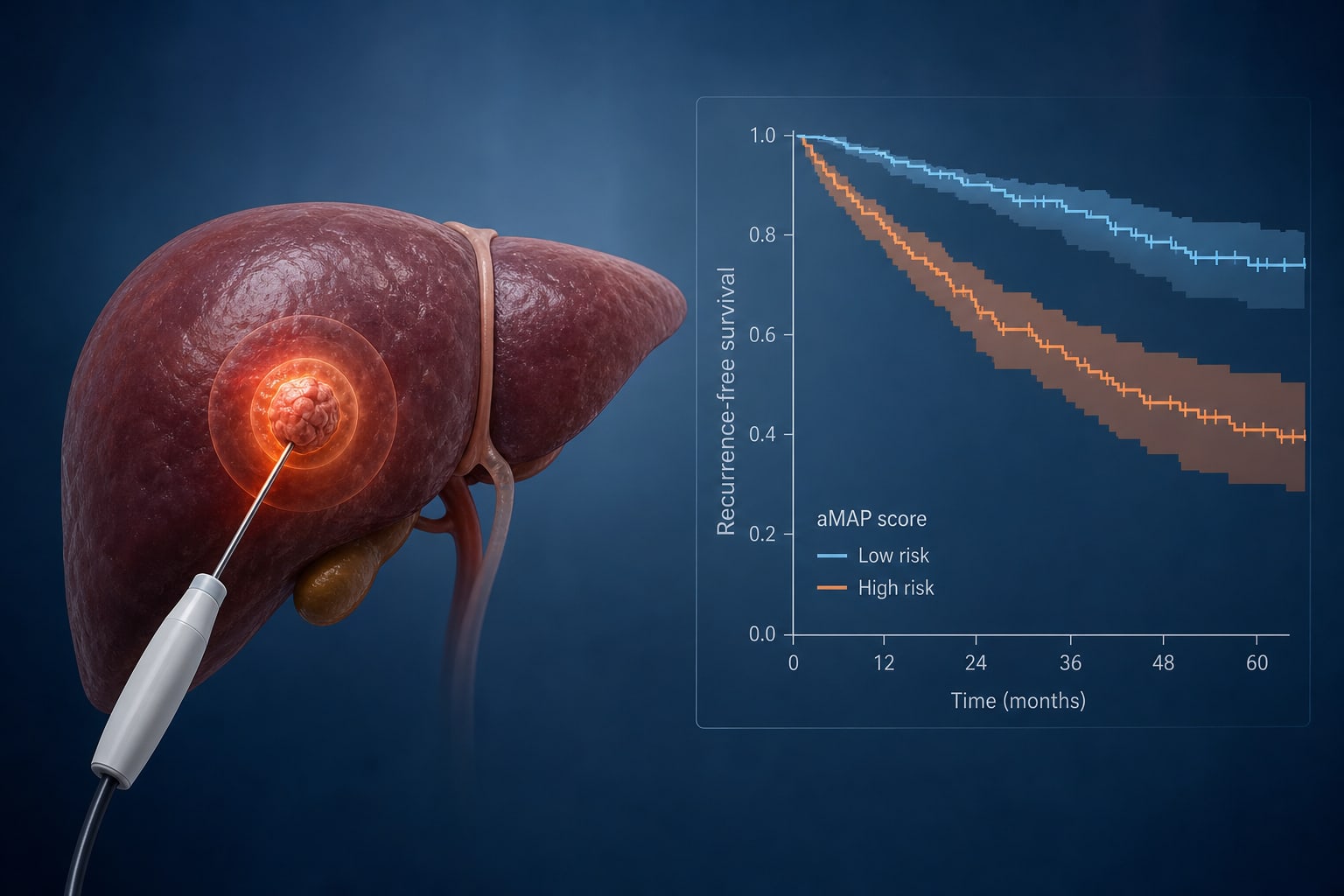
Patients with low aMAP score (≤ 63.55)197 (56.3%)
Patients with high aMAP score (> 63.55)153 (43.7%)
Recurrence-free survival (RFS) significance (p-value)0.016
Hazard Ratio (HR) for aMAP score1.40 (p = 0.028)
Incremental predictive value (IDI)2.6% (p = 0.036)
Net reclassification improvement (NRI)15.9% (p = 0.036)

Key Findings

  • The aMAP score is an independent prognostic factor for recurrence-free survival in HCC patients post-RFA.
  • Patients with low aMAP scores had significantly longer recurrence-free survival compared to those with high scores.
  • Incorporating the aMAP score into existing tumor-related models enhances predictive accuracy.
  • The study included a cohort of 350 HCC patients who underwent RFA.
  • Statistical methods used included Kaplan-Meier curves, Cox regression, and Fine-Gray method for sensitivity analysis.

Clinical Implications

The aMAP score can be utilized in clinical practice to better stratify HCC patients' risk of recurrence following RFA. This tool may aid in tailoring follow-up and treatment strategies, ultimately improving patient outcomes.

Conclusion

The aMAP score demonstrates significant potential as a prognostic tool for HCC patients post-RFA, enhancing the accuracy of existing predictive models for recurrence. Further validation in diverse cohorts is warranted.
Related Resources & Content

  1. European Radiology, Machine Learning-Based Assessment of Prognosis and Risk Stratification for Unresectable Hepatocellular Carcinoma Treated with Transarterial Chemoembolization or Intra-arterial Chemotherapy, 2024
  2. Frontiers in Oncology, Prognostic model for predicting recurrence-free survival in HBV-related hepatocellular carcinoma patients after combined treatment: a multicenter study, 2026
  3. npj Digital Medicine, Personalized Treatment Approaches Utilizing Artificial Intelligence for Unresectable Hepatocellular Carcinoma: Incorporating HSP90α for Prognostic Evaluation and Survival Forecasting, 2025
  4. Frontiers in Oncology, AAT score based on pretreatment indicators predicts outcomes in unresectable HCC patients treated with TACE, Sintilimab, and Bevacizumab, 2026
  5. EASL Clinical Practice Guidelines on the management of hepatocellular carcinoma - Journal of Hepatology, 2024
  6. Atezolizumab plus bevacizumab versus active surveillance in patients with resected or ablated high-risk hepatocellular carcinoma (IMbrave050): a randomised, open-label, multicentre, phase 3 trial - ScienceDirect, 2023
  7. aMAP risk score predicts hepatocellular carcinoma development in patients with chronic hepatitis - ScienceDirect, 2020
  8. EASL Clinical Practice Guidelines on the management of hepatocellular carcinoma - Journal of Hepatology
  9. Atezolizumab plus bevacizumab versus active surveillance in patients with resected or ablated high-risk hepatocellular carcinoma (IMbrave050): a randomised, open-label, multicentre, phase 3 trial - ScienceDirect
  10. aMAP risk score predicts hepatocellular carcinoma development in patients with chronic hepatitis - ScienceDirect

Original Source(s)

Related Content