Case Report: Hidden danger of stiff guidewire retention: masking effect on distal sealing during EVAR - Report - MDSpire

Case Report: Hidden danger of stiff guidewire retention: masking effect on distal sealing during EVAR

  • By

  • Yang Liu

  • Shengqing Wu

  • Dejie Chen

  • June 24, 2026

  • 0 min

Share

Clinical Report: The Risks of Retained Stiff Guidewires in EVAR

Overview

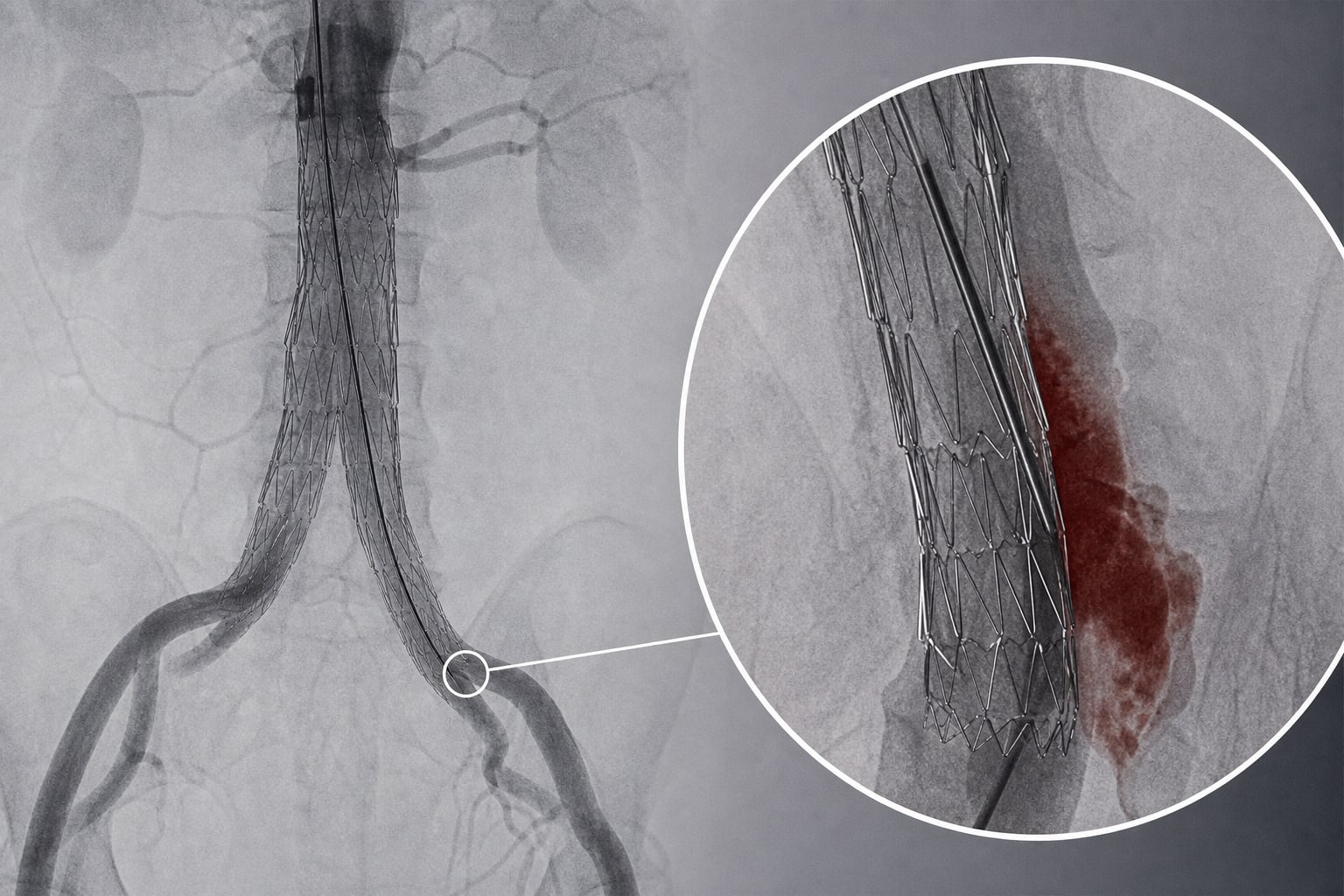
This case study highlights the potential for retained stiff guidewires to mislead completion angiography results in endovascular aneurysm repair (EVAR), possibly resulting in undetected type Ib endoleaks.

Background

Endovascular aneurysm repair (EVAR) is a widely accepted treatment for abdominal aortic aneurysms (AAA), known for its lower morbidity and mortality compared to open surgery. However, complications such as type Ib endoleaks can occur, often requiring immediate correction or reintervention. Understanding the technical pitfalls associated with EVAR, including the retention of guidewires, is crucial.

Data Highlights

No numerical data or trial data were presented in the article.

Key Findings

  • Retention of a stiff guidewire during EVAR can lead to a false impression of adequate distal sealing.
  • This oversight may conceal a type Ib endoleak, which can result in treatment failure.
  • Completion angiography is critical for verifying device deployment and excluding endoleaks.
  • Preoperative imaging can reveal significant anatomical challenges that may complicate EVAR.
  • Proper documentation of previous procedures is essential for planning subsequent interventions.

Clinical Implications

Clinicians should be aware of the potential for retained guidewires to affect angiographic results during EVAR.

Conclusion

This case underscores the importance of recognizing technical pitfalls in EVAR procedures.
Related Resources & Content

  1. Author(s)/Org, Source, Year -- Title
  2. UpToDate, 2026 -- Endoleak following endovascular aortic repair
  3. NCBI Bookshelf, 2025-2028 -- Endovascular Aortic Repair: What the Interventionalist Needs to Know from the Radiologist
  4. PMC, 2025 -- CIRSE Standards of Practice on Management of Endoleaks Following Endovascular Aneurysm Repair
  5. Pediatric Cardiology — Utilizing the Wire Twisting and Locking Method for Enhanced PDA Stent Placement in Neonates with Ductal-Dependent Pulmonary Circulation
  6. BJS (British Journal of Surgery) — Results of a Prospective Multicenter Trial on Endovascular Repair of the Aortic Arch Using a Standard Modular Inner Branched Stent-Graft: An IDEAL 2a Study
  7. WEB Embolization with Stent Support: Characteristics of Aneurysms, Clinical Outcomes, and a Case Study of Stent-Delivered WEB
  8. Utilizing the Wire Twisting and Locking Method for Enhanced PDA Stent Placement
  9. Results of a Prospective Multicenter Trial on Endovascular Repair of the Aortic Arch
  10. WEB Embolization with Stent Support: Characteristics of Aneurysms
  11. UpToDate
  12. Endovascular Aortic Repair: What the Interventionalist Needs to Know from the Radiologist - Diseases of the Chest, Heart and Vascular System 2025-2028 - NCBI Bookshelf
  13. CIRSE Standards of Practice on Management of Endoleaks Following Endovascular Aneurysm Repair - PMC
  14. Single Centre Evaluation of the Proposal of the European Society for Vascular Surgery Abdominal Aortic Aneurysm Guidelines to Stratify Surveillance after Endovascular Aortic Aneurysm Repair - Erasmus University Rotterdam
  15. To regress or not to regress? Outcomes of aneurysm sac behavior after Endovascular Aortic Aneurysm Repair: A systematic review and meta-analysis - PubMed
  16. Checking your browser - reCAPTCHA

Original Source(s)

Related Content