Development and validation of a clinical prediction model for postcontrast acute kidney injury in patients with postoperative acute kidney injury of acute Stanford type A aortic dissection - Report - MDSpire

Development and validation of a clinical prediction model for postcontrast acute kidney injury in patients with postoperative acute kidney injury of acute Stanford type A aortic dissection

  • By

  • Weiwei Zhao

  • Min Ge

  • YongQing Cheng

  • Ming Chen

  • Qing Zhou

  • Wenkui Yu

  • July 10, 2026

  • 0 min

Share

Clinical Report: Prediction Tool for Postcontrast Acute Kidney Injury in PO-AKI

Overview

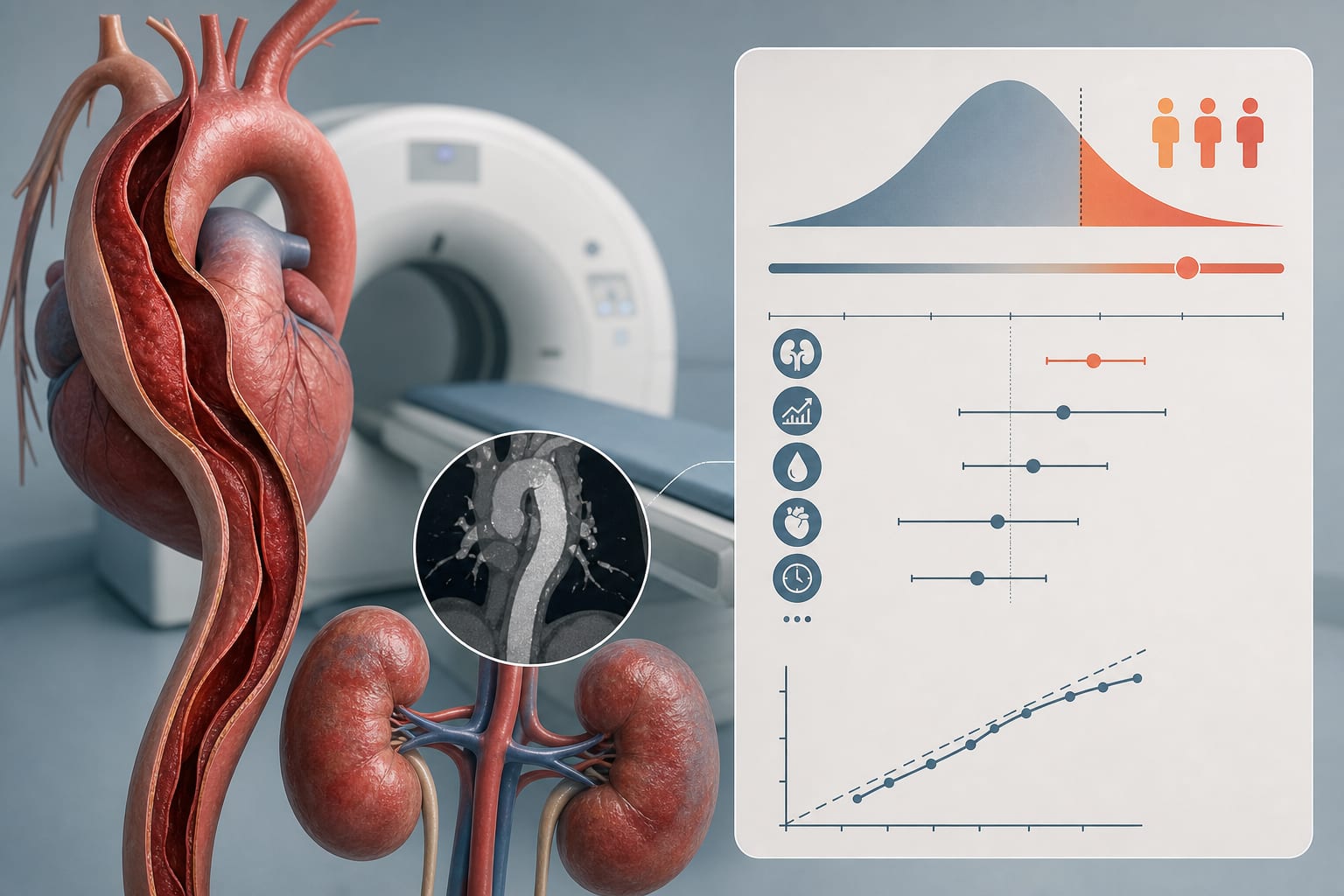
This study identifies independent risk factors for postcontrast acute kidney injury (PC-AKI) in patients with postoperative acute kidney injury (PO-AKI) following acute Stanford type A aortic dissection. A prediction model was developed and internally validated.

Background

Postcontrast acute kidney injury (PC-AKI) is a significant complication following contrast media exposure, particularly in patients with unresolved postoperative acute kidney injury (PO-AKI). Accurate risk stratification for PC-AKI in this vulnerable population is crucial. The high incidence of PO-AKI in acute Stanford type A aortic dissection patients further emphasizes the need for tailored predictive tools.

Data Highlights

MetricValue
PC-AKI Incidence9.8% (59/604)
Fully Recovered PO-AKI3.5%
Unrecovered PO-AKI52.5%
AUC0.848 (95% CI: 0.78–0.91)
Brier Score0.057
RR for Prolonged ICU Stay1.521 (95% CI: 1.19–1.97)
OR for Incomplete Renal Recovery2.554 (95% CI: 1.30–4.86)

Key Findings

  • PC-AKI incidence was 9.8% among the studied population.
  • Recovery status significantly stratified PC-AKI risk: 3.5% in fully recovered PO-AKI vs. 52.5% in unrecovered PO-AKI.
  • Independent predictors of PC-AKI included PO-AKI stage 3 and unrecovered PO-AKI before first CTA.
  • The prediction model showed good discrimination (AUC=0.848) and calibration (Brier=0.057).
  • PC-AKI was associated with prolonged ICU stay and incomplete renal recovery at discharge.

Clinical Implications

Understanding the dynamic recovery of AKI can inform decision-making regarding the safety of contrast-enhanced imaging in this high-risk group.

Conclusion

The study highlights the association between dynamic PO-AKI recovery and advanced AKI stage with the risk of PC-AKI.

Related Resources & Content

  1. Frontiers in Cardiovascular Medicine, 2026 -- Incidence and risk factors of acute kidney injury following Stanford type A aortic dissection surgery: a systematic review and meta-analysis
  2. Creation and Assessment of a Nomogram for Predicting Acute Kidney Injury After Percutaneous Nephrolithotomy
  3. Frontiers in Cardiovascular Medicine, 2026 -- Machine Learning Models for Predicting Postoperative Acute Kidney Injury in Pediatric Cardiac Surgery: A Systematic Review and Meta-Analysis
  4. Clinical Research in Cardiology -- Impact of Diuresis Induced by Furosemide with Isotonic Intravenous Fluid Replacement on Patients with Chronic Kidney Disease Undergoing Transcatheter Aortic Valve Replacement
  5. Overview of… | The American Association for Thoracic Surgery | AATS
  6. ESUR guidelines on Contrast Media - B. Renal adverse reactions
  7. Frontiers | Incidence and risk factors of acute kidney injury following Stanford type A aortic dissection surgery: a systematic review and meta-analysis
  8. Overview of… | The American Association for Thoracic Surgery | AATS
  9. ESUR guidelines on Contrast Media - B. Renal adverse reactions

Original Source(s)

Related Content