Neutrophils Associated with Tumors in Lung Adenocarcinoma: Exploring Mechanisms and Potential Therapeutic Approaches
-
By
-
Ruichen Zhang
-
July 20, 2026
---
Clinical Report: Neutrophils Associated with Tumors in Lung Adenocarcinoma
Overview
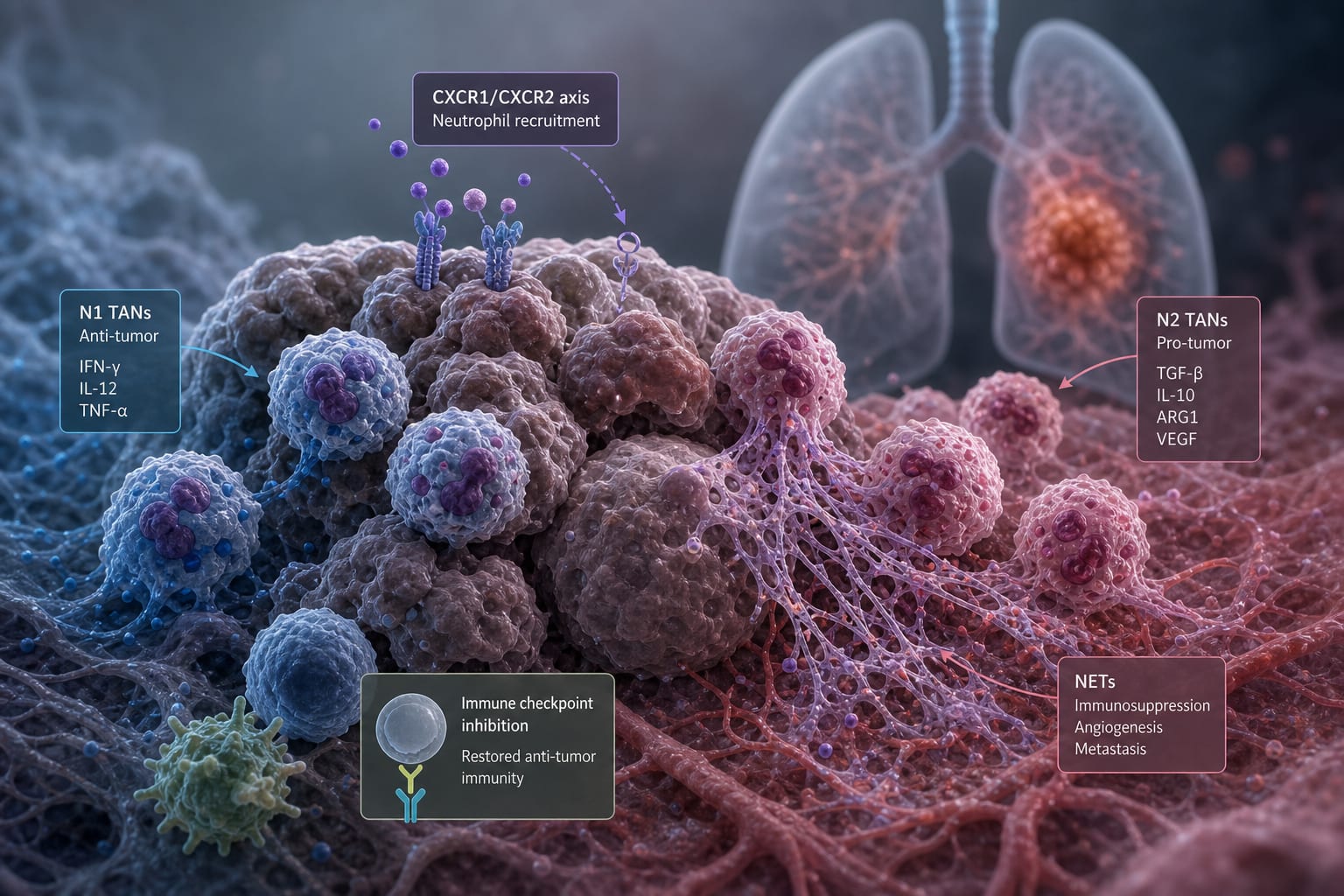
This review explores the dual roles of tumor-associated neutrophils (TANs) in lung adenocarcinoma (LUAD), highlighting their recruitment, polarization, and the formation of neutrophil extracellular traps (NETs).
Background
Lung adenocarcinoma (LUAD) is the most common subtype of non-small cell lung cancer (NSCLC) and is associated with significant morbidity and mortality. Despite advancements in immune checkpoint inhibitors (ICIs), resistance remains a major challenge in treatment.
Data Highlights
Recent studies have shown that TANs are present in high numbers in the tumor microenvironment of LUAD patients, and their levels correlate with disease progression and poor prognosis. Additionally, the expression of specific markers on TANs, such as CD66b and CD11b, has been linked to their functional states and roles in tumor dynamics.
Key Findings
TANs can exhibit both anti-tumorigenic (N1) and pro-tumorigenic (N2) phenotypes influenced by factors like TGF-β and IFN-γ.
Neutrophils can form NETs, which contribute to tumor promotion through mechanisms such as immunosuppression and metastasis.
Current therapeutic strategies targeting TANs include CXCR1/2 inhibitors, PAD4 inhibitors, and NET-degrading enzymes.
Challenges in targeting TANs include off-target toxicity and the lack of predictive biomarkers for treatment response.
Single-cell studies indicate that TANs exist along a functional spectrum rather than a simple N1/N2 classification.
Clinical Implications
Understanding the dual roles of TANs in LUAD may inform future research directions.
Conclusion
This review provides insights into the complex role of TANs in LUAD.
Related Resources & Content
Frontiers in Oncology, 2026 -- Exploring the tumor microenvironment in resectable lung cancer
Frontiers in Immunology, 2026 -- Mechanistic and functional characterization of NETs/IL-17 as a therapeutic target in EMT and brain metastasis of lung adenocarcinoma
roswell park comprehensive cancer center — Myeloma Experts Uncover Key Role for Neutrophils, Potential New Treatment Strategy
Frontiers in Immunology — Orchestration of the tumor microenvironment by citrus flavonoids: from preclinical mechanisms to translational therapeutic
Updated ASCO Guidelines for Treating Stage IV Non–Small-Cell Lung Cancer
Five-Year Outcomes With Pembrolizumab Versus Chemotherapy for Metastatic Non–Small-Cell Lung Cancer With PD-L1 Tumor Proportion Score ≥ 50%
Early and locally advanced non-small-cell lung cancer: ESMO Clinical Practice Guideline for diagnosis, treatment and follow-up - PubMed
Update 2025: Management of Non‑Small-Cell Lung Cancer | Lung | Springer Nature Link
Targeting neutrophils for cancer therapy | Nature Reviews Drug Discovery
Pretreatment neutrophil-to-lymphocyte ratio is associated with immunotherapy efficacy in patients with advanced cancer: a systematic review and meta-analysis | Scientific Reports
Elevated serum interleukin-8 is associated with enhanced intratumor neutrophils and reduced clinical benefit of immune-checkpoint inhibitors - PMC
CXCR2 antagonist navarixin in combination with pembrolizumab in select advanced solid tumors: a phase 2 randomized trial - PMC
---
This content is an AI-generated, fully rewritten summary based on a published scholarly article. It does not reproduce the original text and is not a substitute for the original publication. Readers are encouraged to consult the source for full context, data, and methodology.