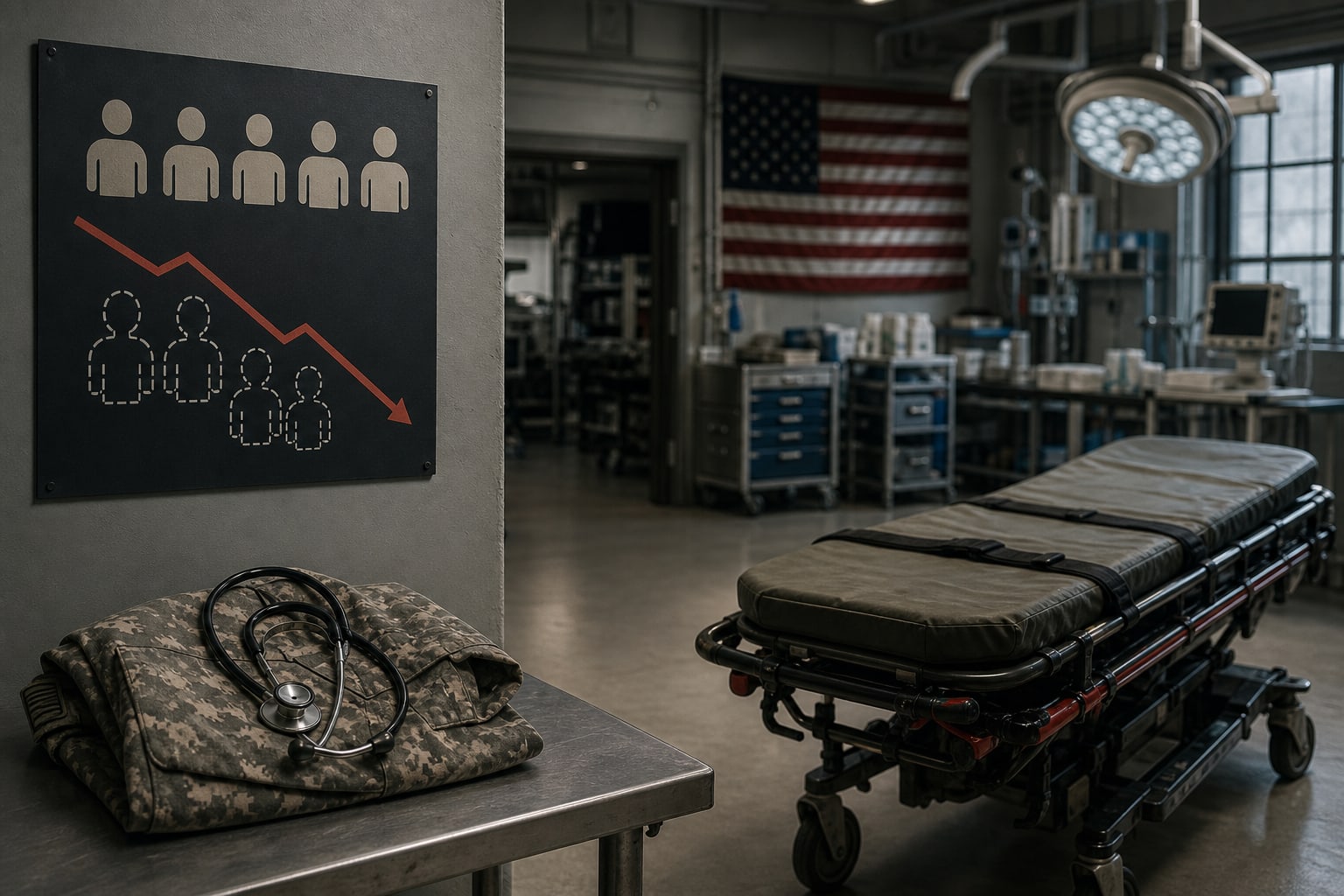
The military’s medical corps has a serious recruitment problem
-
By
-
Robert Krasner
-
June 1, 2026
-
0 min
Clinical Report: The Armed Forces Face Significant Challenges in Recruiting Medical Personnel
Overview
The U.S. military is experiencing significant challenges in recruiting medical personnel, exacerbated by high rates of physician separations and a substantial compensation gap compared to civilian roles. Key factors contributing to this issue include administrative burdens and clinical skill degradation.
Background
The readiness of the American military is critically dependent on its medical and technical workforce, which is currently facing recruitment challenges. The ongoing war in Iran has intensified scrutiny on military readiness, revealing vulnerabilities in the medical corps. With a projected physician shortage of up to 86,000 by 2036, the military's ability to attract and retain qualified medical personnel is increasingly vital.
Data Highlights
No numerical data available in the source material.
Key Findings
- The military medical corps struggles to maintain recruitment rates in the face of high physician separations.
- A 2024 RAND Corporation study indicates that many physicians leave after fulfilling service obligations due to pay disparity and administrative burdens.
- Military physicians in two-thirds of specialties do not reach the 20th percentile of civilian compensation, with gaps exceeding $400,000 annually for procedural specialists.
- Clinical skills of emergency medical officers are degrading due to assignments without direct patient care.
- The Uniformed Services University trains only a fraction of the needed military physicians, relying heavily on civilian programs.
- Many potential recruits are deterred by perceived exclusionary institutional policies.
Clinical Implications
The military must address the compensation and administrative challenges faced by medical personnel to improve recruitment and retention. Structural reforms are necessary to adapt to the current healthcare landscape and attract qualified candidates.
Conclusion
The recruitment challenges faced by the military medical corps necessitate urgent attention to ensure operational readiness and effective healthcare delivery in military settings.
Related Resources & Content
- ADA News, ADA News, 2022 -- New ADA News series spotlights resources for recruiting, hiring, training dental team
- Ophthalmology Management, Ophthalmology Management, 2023 -- The New World of Physician Recruitment
- Retinal Physician, Retinal Physician, 2019 -- Retina and the Department of Defense
- The New Gastroenterologist — Resolving the Imbalance Between Gastroenterology Care Supply and Demand
- Clinical Practice Guidelines (CPGs) - Joint Trauma System
- JOINT TRAUMA SYSTEM CLINICAL PRACTICE GUIDELINE
- Mission Statement - Joint Trauma System
- Prehospital Whole Blood in Traumatic Hemorrhage — a Randomized Controlled Trial | New England Journal of Medicine
- Whole Blood Resuscitation for Injured Patients Requiring Transfusion: A Systematic Review, Meta-Analysis, and Practice Management Guideline from the Eastern Association for the Surgery of Trauma - Practice Management Guideline
- Prehospital Trauma Compendium: Transfusion of Blood Products in Trauma – A Position Statement and Re
- Evaluating the safety outcomes of whole blood versus component transfusion in trauma: A meta-analysis of 59,213 patients - ScienceDirect
- JOINT TRAUMA SYSTEM CLINICAL PRACTICE GUIDELINE Nursing Interventions, Wound Care, and Splint | | | --- | --- | --- | --- JOINT TRAUMA SYSTEM CLINICAL PRACTICE GUIDELINE Management in Prolonged Casualty Care | | | JOINT TRAUMA SYSTEM CLINICAL PRACTICE GUIDELINE The intent of this guideline is to provide non-medical and medical professionals | | | JOINT TRAUMA SYSTEM CLINICAL PRACTICE GUIDELINE who encounter extended casualty evacuatoi n times in austere environments with | | | JOINT TRAUMA SYSTEM CLINICAL PRACTICE GUIDELINE evidence-based guidance for interventoi ns necessary to improve casualty | | | JOINT TRAUMA SYSTEM CLINICAL PRACTICE GUIDELINE outcomes. | | | JOINT TRAUMA SYSTEM CLINICAL PRACTICE GUIDELINE CONTRIBUTORS | | | JOINT TRAUMA SYSTEM CLINICAL PRACTICE GUIDELINE | | | JOINT TRAUMA SYSTEM CLINICAL PRACTICE GUIDELINE LCDR Dana Flieger, NC, USN | | Maj Adam Kruse, USAF, MC | JOINT TRAUMA SYSTEM CLINICAL PRACTICE GUIDELINE CDR (Ret) Brenda Williams, NC, USN | | COL Christopher VanFosson, NC, USA | JOINT TRAUMA SYSTEM CLINICAL PRACTICE GUIDELINE Dr. Sean Keenan, MC, USA | | LCDR Taylor Brocuglio, NC, USN | JOINT TRAUMA SYSTEM CLINICAL PRACTICE GUIDELINE Dr. Dan (Trey) Mosely, MC, USA (Ret) | | SO1 Dave Allen, USN, SOIDC | JOINT TRAUMA SYSTEM CLINICAL PRACTICE GUIDELINE MSG Mike Remley, USA, 68W | | LTC Andrew Schaffrinna, MC, USA | JOINT TRAUMA SYSTEM CLINICAL PRACTICE GUIDELINE CPT Dawn Ostberg, NC, USA | | HMCS Mike Nakoneczny, USN, SOIDC | JOINT TRAUMA SYSTEM CLINICAL PRACTICE GUIDELINE CAPT Joshua Tobin, MC, USN | | SO1 Harrison Cady, USN, SOIDC | JOINT TRAUMA SYSTEM CLINICAL PRACTICE GUIDELINE Capt Katherine Dore, USAF, NC | | CPT Frances White, USA, SP | JOINT TRAUMA SYSTEM CLINICAL PRACTICE GUIDELINE CDR Courtney Powell, NC, USN | | HMCM Jermy Brower, USN, SWIDC | JOINT TRAUMA SYSTEM CLINICAL PRACTICE GUIDELINE MAJ Sabas Salgado, NC, USA | | LCDR Savannah Nguyen, NC, USN | JOINT TRAUMA SYSTEM CLINICAL PRACTICE GUIDELINE CPT Jamie Eastman, NC, USA | | SFC Paul Loos, USA, 18D | JOINT TRAUMA SYSTEM CLINICAL PRACTICE GUIDELINE LtCol Dana Mayer, USAF, NC | | Lt Col Remealle A. How, USAF, MC | JOINT TRAUMA SYSTEM CLINICAL PRACTICE GUIDELINE MAJ Asia Nakakura, USA, SP | | CDR J. Michael Van Gent, MC, USN | JOINT TRAUMA SYSTEM CLINICAL PRACTICE GUIDELINE CDR Stacy Stats, NC, USN | | COL Jennifer M. Gurney, MC, USA | JOINT TRAUMA SYSTEM CLINICAL PRACTICE GUIDELINE CAPT Thomas Fuller, NC, USN | | | JOINT TRAUMA SYSTEM CLINICAL PRACTICE GUIDELINE Previous contributors: Elizabeth Mann-Salinas, NC, USA(Ret); SFC Cody Creson, USA, 18D; Col Stacy | | | JOINT TRAUMA SYSTEM CLINICAL PRACTICE GUIDELINE Shackelford, USAF, MC; MAJ Douglas Powell, MC, USA; LTC Jamie Riesberg, MC, USA | | | JOINT TRAUMA SYSTEM CLINICAL PRACTICE GUIDELINE Original publicatoi n date: 22 Jul 2018 | Publicatoi n Date: 08 July 2025 | | Supersedes: 22 Jul 2018TABLE OF CONTENTS
- En Route Combat Casualty Care (ERCCC) - Joint Trauma System
This content is an AI-generated, fully rewritten summary based on a published scholarly article. It does not reproduce the original text and is not a substitute for the original publication. Readers are encouraged to consult the source for full context, data, and methodology.