NIH Study Links Two Common PFAS to Increased Risk of Aggressive Breast Cancer
-
November 5, 2026
Clinical Report: PFAS and Risk of ER-Negative Breast Cancer
Overview
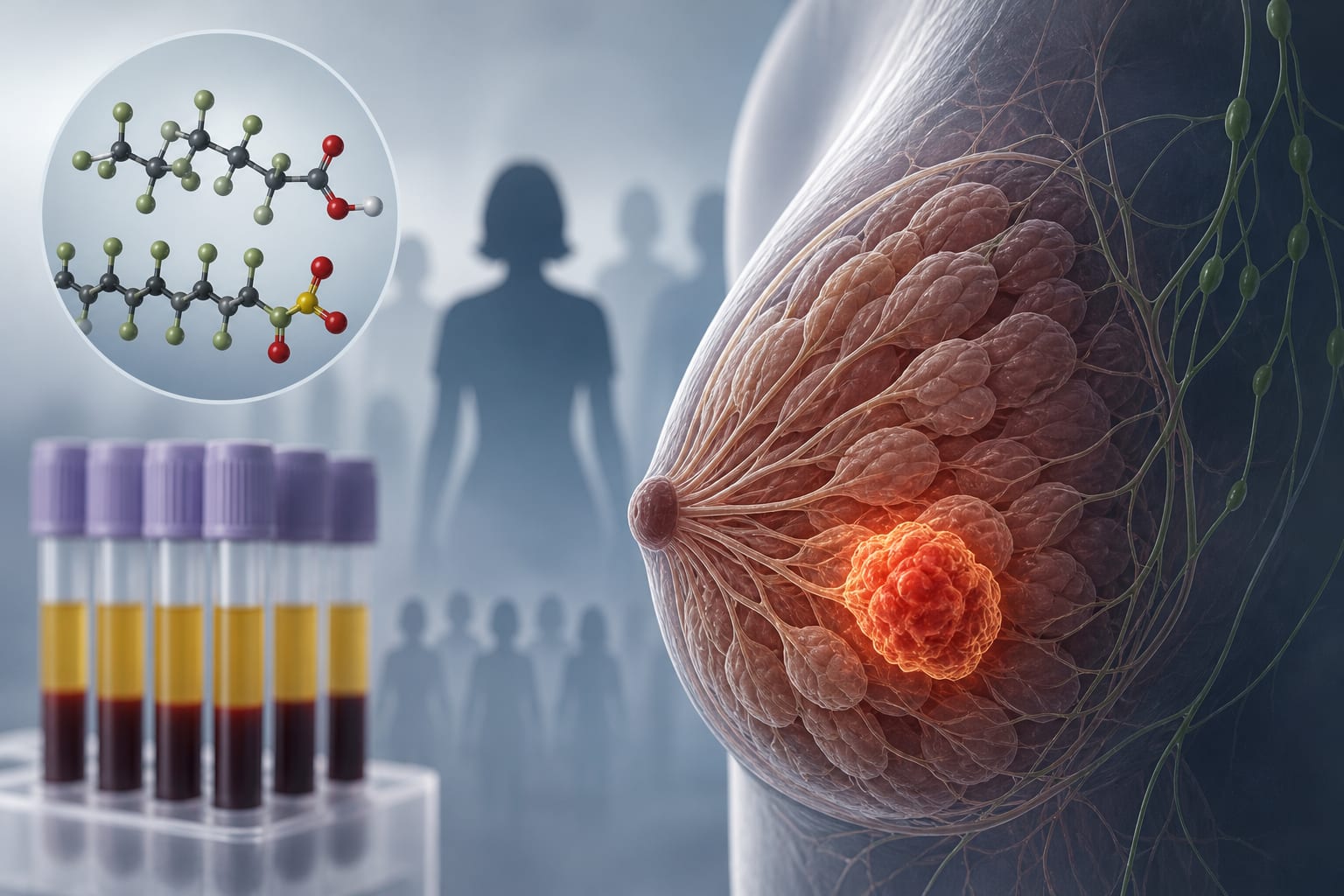
In a Sister Study analysis, higher prediagnostic blood concentrations of PFOA and PFOS were associated with higher incidence of estrogen receptor-negative (ER-negative) breast cancer. The highest exposure groups had 67% and 93% higher rates, respectively, than the lowest groups; neither chemical showed a clear association with overall breast cancer risk.
Background
Per- and polyfluoroalkyl substances (PFAS) are a broad class of chemicals used in consumer products that degrade slowly in the environment and may persist in the body. ER-negative breast cancers lack estrogen receptors and are generally more aggressive and associated with poorer outcomes than estrogen-responsive breast cancers. The article notes that fewer risk factors are established for ER-negative disease. Evidence syntheses cited in the supplied context have not found a clear association between PFAS and overall breast cancer risk.
Data Highlights
| Measure | Finding | Study context |
|---|---|---|
| PFOA and ER-negative breast cancer | 67% higher rate in the highest versus lowest blood-level group | Prediagnostic blood concentrations; relative difference between groups |
| PFOS and ER-negative breast cancer | 93% higher rate in the highest versus lowest blood-level group | Prediagnostic blood concentrations; relative difference between groups |
| Overall breast cancer risk | No clear association with either PFOA or PFOS | Reported by the NIH analysis |
| PFAS analysis population | 1,609 women who developed breast cancer and 2,269 comparison participants | Drawn from the Sister Study; participants had a sister with breast cancer |
| PFAS assessed | 17 substances | Measured in blood samples collected years before cancer diagnoses |
Key Findings
- The NIH analysis associated higher prediagnostic plasma concentrations of PFOA and PFOS with increased incidence of ER-negative breast cancer.
- The highest PFOA group had a 67% higher rate of ER-negative disease than the lowest group; the corresponding difference for PFOS was 93%. These are relative group differences, not individual probabilities.
- The analysis found no clear association between either chemical and overall breast cancer risk.
- Researchers assessed 17 PFAS in the Sister Study, which recruited 50,884 women aged 35–74 years in the United States and Puerto Rico from 2003 to 2009; the PFAS analysis included 1,609 cases and 2,269 comparison participants.
- The investigators reported that a meta-analysis of earlier research supported the ER-negative breast cancer finding. The supplied context also describes prior evidence syntheses as finding no clear association between PFAS and overall breast cancer risk.
- The authors proposed non-hormonal pathways, including altered gene activity or immune-system effects, as possible explanations, but the study did not examine these mechanisms. They called for further research, including assessment of newer PFAS replacements.
Clinical Implications
The findings describe an association and do not establish that PFOA or PFOS causes ER-negative breast cancer. The authors state that further research is needed, particularly in populations with greater PFAS exposure and for newer replacement PFAS; the supplied material does not report a change to breast cancer screening guidance based on PFAS exposure.
Conclusion
Higher PFOA and PFOS concentrations were associated with ER-negative breast cancer incidence in this analysis, while no clear association with overall breast cancer risk was observed. The authors identify further research as necessary to clarify the findings and assess newer PFAS.
Related Resources & Content
- National Institutes of Health, NIH News Release, 2026 — Two ‘forever chemicals’ associated with higher risk of aggressive breast cancer in NIH analysis
- United States Department of Health and Human Services, Press Room, 2026 — NIH Analysis Links Two “Forever Chemicals” to Increased Risk of Aggressive Breast Cancer
- The ASCO Post, 2025 — PFAS Contamination in Drinking Water May Be Linked to Several Rare Cancers
- The ASCO Post, 2023 — Exposure to PFAS and Phenols May Be Linked to Cancer Risk
- PubMed, 2026 — Per- and polyfluoroalkyl substances and the risk of thyroid and breast cancer: Evidence from a meta-analysis and computational toxicology
- Archives of Toxicology — Role of Per- and Polyfluoroalkyl Substances in Cancer Development
- Two ‘forever chemicals’ associated with higher risk of aggressive breast cancer in NIH analysis
- NIH Analysis Links Two “Forever Chemicals” to Increased Risk of Aggressive Breast Cancer
- Per- and polyfluoroalkyl substances and the risk of thyroid and breast cancer: Evidence from a meta-analysis and computational toxicology
- Recommendation: Breast Cancer: Screening | United States Preventive Services Taskforce
Based on findings from:
Two ‘forever chemicals’ associated with higher risk of aggressive breast cancer in NIH analysis
National Institutes Of Health, 2026.
https://www.nih.gov/news-events/news-releases/two-forever-chemicals-associated-higher-risk-aggressive-breast-cancer-nih-analysis
This content is an AI-generated, fully rewritten summary based on a published scholarly article. It does not reproduce the original text and is not a substitute for the original publication. Readers are encouraged to consult the source for full context, data, and methodology.