Clavicular Gorham-Stout disease: a rare case report and literature review - Report - MDSpire

Clavicular Gorham-Stout disease: a rare case report and literature review

  • By

  • Bingyan Mao

  • Qi Peng

  • Jicai Li

  • Zuoquan Qin

  • Shenke Xie

  • Zhiwei Qin

  • July 2, 2026

  • 0 min

Share

Clinical Report: Clavicular Involvement in Gorham-Stout Disease

Background

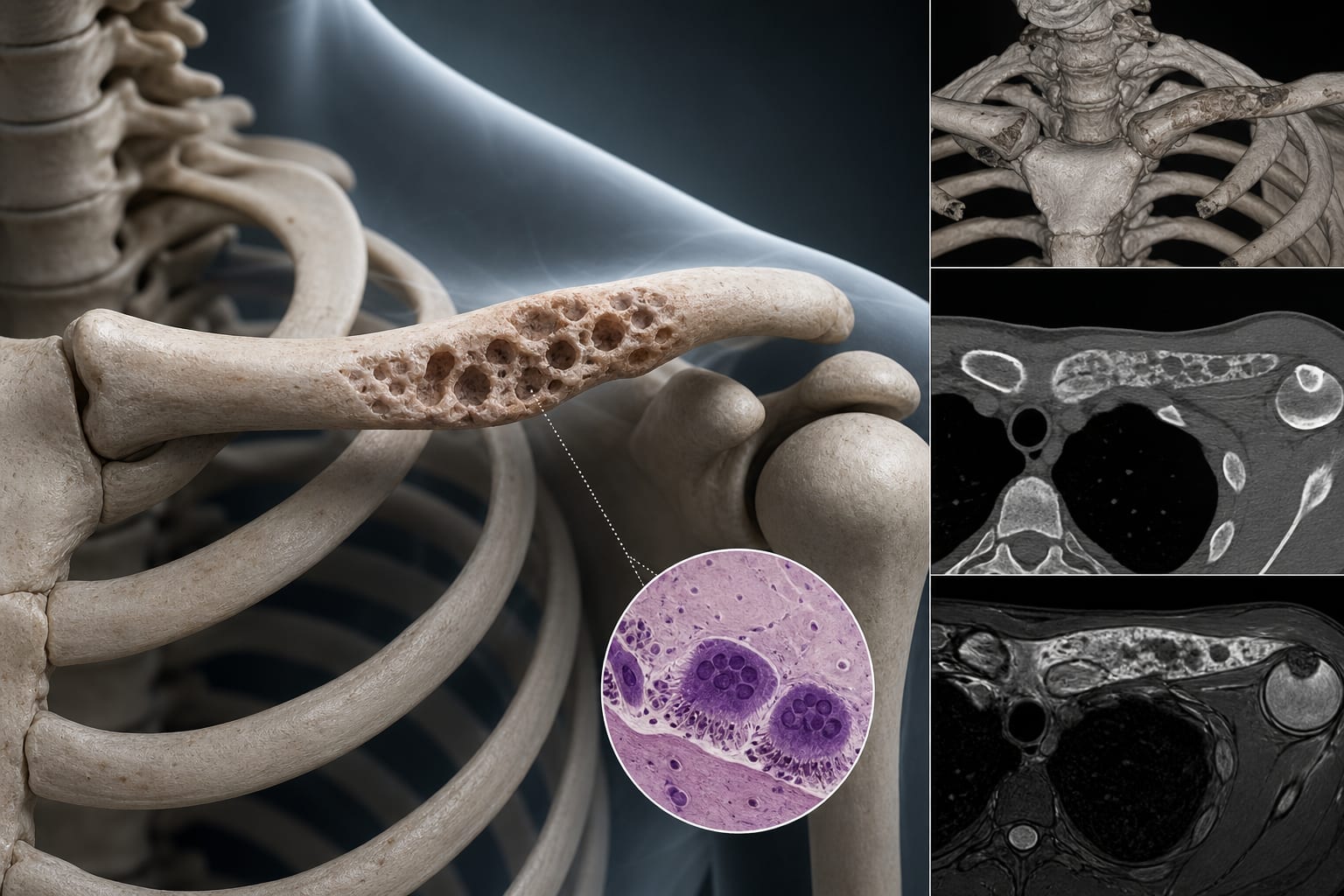
Gorham-Stout disease is a rare osteolytic disorder characterized by painless bone resorption, primarily affecting adolescents. With approximately 400 cases reported globally, its diagnosis is challenging due to heterogeneous presentations and the need to exclude other conditions. Unilateral clavicular involvement is particularly rare, as noted in the literature.

Data Highlights

Case report of a 15-year-old male with progressive clavicular bone resorption post-trauma. Key biochemical markers included:

  • 25-OH VitD: 18 ng/mL (reference range: 30–100 ng/mL)
  • N-MID Osteocalcin: 23.43 ng/mL (reference range: 4.91–22.31 ng/mL)
  • PINP: 339.36 ng/mL (reference range: 15.3–52.7 ng/mL)
  • β-CTx: 601.92 pg/mL (reference range: <584 pg/mL)

Key Findings

  • Gorham-Stout disease is characterized by progressive bone resorption and low incidence.
  • Diagnosis relies on clinical, imaging, and pathological evaluations, excluding other diseases.
  • Monitoring biochemical markers related to bone turnover is essential for early diagnosis.
  • Individualized treatment plans are crucial, considering lesion site and patient needs.

Clinical Implications

Healthcare professionals should be vigilant for signs of Gorham-Stout disease in patients presenting with unexplained bone resorption.

Conclusion

This case highlights the complexities of diagnosing and managing Gorham-Stout disease, particularly with rare presentations such as clavicular involvement.
Related Resources & Content

  1. International Society for the Study of Vascular Anomalies, ISSVA, 2025 -- Classification, diagnosis, and sites of involvement
  2. Gorham-Stout disease with thoracic involvement: pathogenic mechanisms, respiratory complications, and multimodal therapies, Orphanet Journal of Rare Diseases, 2026
  3. Current concepts from diagnosis to management in Gorham–Stout disease: a systematic narrative review of about 350 cases, PMC
  4. The Role of Clavicular Length as a Potential Risk Factor in Sternoclavicular Joint Osteoarthritis
  5. Archives of Orthopaedic and Trauma Surgery (Springer) — Shoulder Tenosynovial Giant Cell Tumor: A Review of Cases and Existing Literature
  6. Is Non-Surgical Reduction and Stabilization Possible for Acute High-Grade Acromioclavicular Joint Separations? Insights from a Surgeon’s Experience
  7. Frontiers in Surgery — Arthroscopic one-stage management of diffuse shoulder pigmented villonodular synovitis with concomitant full-thickness rotator cuff tear and acromial bone erosion: a rare case report
  8. Complex Lymphatic Anomalies: A Comprehensive Review of Imaging Features and Diagnostic Considerations
  9. https://www.issva.org/UserFiles/file/ISSVAClassificationSchemaandGlossary_combined_v1.pdf
  10. Gorham-Stout disease with thoracic involvement: pathogenic mechanisms, respiratory complications, and multimodal therapies | Orphanet Journal of Rare Diseases | Springer Nature Link
  11. Current concepts from diagnosis to management in Gorham–Stout disease: a systematic narrative review of about 350 cases - PMC
  12. Frontiers | Sirolimus treatment for intractable lymphatic anomalies: an open-label, single-arm, multicenter, prospective trial
  13. Targeted treatment in complex lymphatic anomaly: a case of synergistic efficacy of trametinib and sirolimus
  14. Classification | International Society for the Study of Vascular Anomalies

Original Source(s)

Related Content