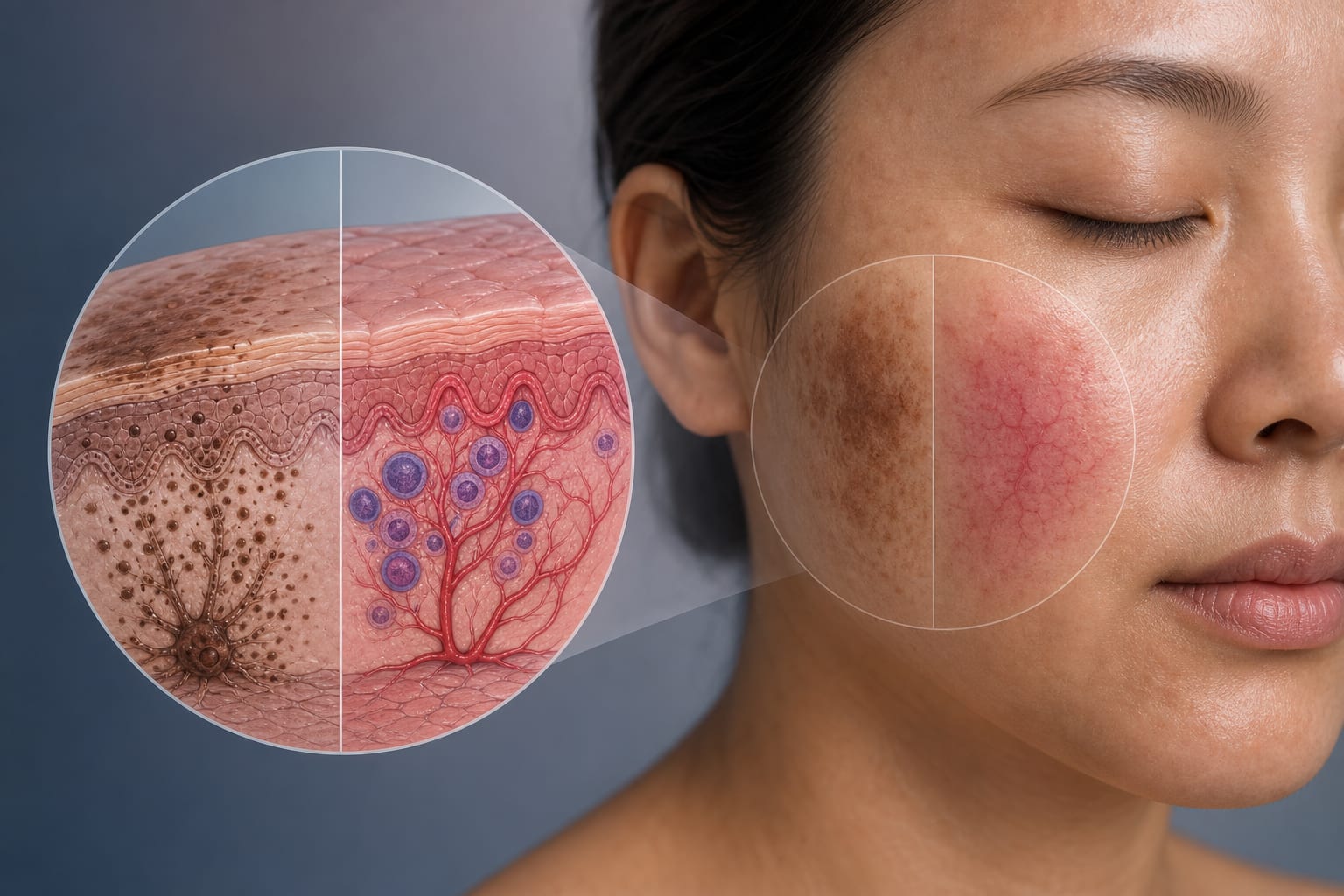
Correction: Exploring the Interplay of Pigmentation and Inflammation in the Mechanisms Underlying Melasma and Rosacea Comorbidity
-
By
-
Xueli Li
-
Huanyu Shi
-
Yanyan Feng
-
June 9, 2026
Correction: Exploring the Interplay of Pigmentation and Inflammation in Melasma
Overview
This report corrects the author affiliation in the article discussing the mechanisms underlying melasma and rosacea comorbidity. The updated affiliation reflects the accurate institutional association of the authors.
Background
Melasma and rosacea are both inflammatory skin conditions that can significantly impact patients' quality of life. Understanding the interplay between pigmentation and inflammation is crucial for developing effective treatment strategies. The correction in author affiliation emphasizes the importance of accurate representation in scientific communication.
Data Highlights
No numerical or trial data is presented in the correction article.
Key Findings
- The author affiliation was corrected to reflect the accurate institution.
- Melasma and rosacea share overlapping features that warrant further investigation.
- Current literature suggests a complex interaction between genetic and environmental factors in rosacea.
- Recent studies highlight the role of immune dysfunction in the pathophysiology of rosacea.
- Phenotype-based care is emphasized in recent clinical guidelines for rosacea and melasma.
Clinical Implications
Clinicians should ensure accurate author affiliations in published research to maintain the integrity of scientific literature. Additionally, understanding the comorbidity of melasma and rosacea can inform treatment approaches.
Conclusion
The correction serves as a reminder of the importance of accuracy in scientific publications, particularly in the context of complex skin conditions like melasma and rosacea.
Related Resources & Content
- Li, X., Shi, H., Feng, Y., Front. Med., 2026 -- Correction: Exploring the Interplay of Pigmentation and Inflammation in the Mechanisms Underlying Melasma and Rosacea Comorbidity
- Frontiers in Immunology — The lipid–inflammation axis in rosacea: mechanistic insights and therapeutic implications
- Frontiers in Immunology — The association between atopic dermatitis and rosacea: a comprehensive review from comorbidities to pathogenic mechanisms
- Optometric Management — Recognizing and Treating Ocular Rosacea in Darker Skin Tones
- Optometric Management — Recognizing and Treating Ocular Rosacea in Darker Skin Tones
- National Rosacea Society Introduces Updated Rosacea Treatment Algorithms | Rosacea.org
- Global consensus on the management of melanin hyperpigmentation disorders - Passeron - 2026 - Journal of the European Academy of Dermatology and Venereology - Wiley Online Library
- Delphi consensus on melasma management by international experts and pigmentary disorders society - PubMed
- Frontiers | Advances in the pathogenesis of rosacea
- Melasma - StatPearls - NCBI Bookshelf
- Frontiers | Beyond the boundaries of pigmentation and inflammation: understanding the mechanistic basis of melasma–rosacea comorbidity
- Intradermal Injection of Tranexamic Acid for the Treatment of Adult Melasma: A Systematic Review and Meta-Analysis of Randomized Controlled Trials - Ling-Ya Chen, Yi-No Kang, Khanh Dinh Hoang, Kee-Hsin Chen, Chiehfeng Chen, 2025
- Efficacy of Widely Used Topical Drugs for Rosacea: A Systematic Review and Meta-Analysis - PubMed
- Treatment of redness in rosacea with potassium-titanyl-phosphate (KTP) 532 nm laser with and without topical 1% ivermectin cream: a randomized split-face trial - PubMed
Based on findings from:
Correction: Beyond the boundaries of pigmentation and inflammation: understanding the mechanistic basis of melasma–rosacea comorbidity
Xueli Li, Huanyu Shi, Yanyan Feng. Frontiers In Medicine, 2026.
https://www.frontiersin.org/journals/medicine/articles/10.3389/fmed.2026.1893292/full
This content is an AI-generated, fully rewritten summary based on a published scholarly article. It does not reproduce the original text and is not a substitute for the original publication. Readers are encouraged to consult the source for full context, data, and methodology.