Prognostic significance of the advanced lung cancer inflammation index for long-term mortality in patients with acute myocardial infarction and diabetes - Report - MDSpire

Prognostic significance of the advanced lung cancer inflammation index for long-term mortality in patients with acute myocardial infarction and diabetes

  • By

  • Hongqiang Li

  • Jiachen Luo

  • Gang Li

  • Fei Yang

  • Yidong Wei

  • July 6, 2026

  • 0 min

Share

Prognostic Value of the Advanced Lung Cancer Inflammation Index in Predicting Long-Term Mortality Among Diabetic Patients with Acute Myocardial Infarction

Overview

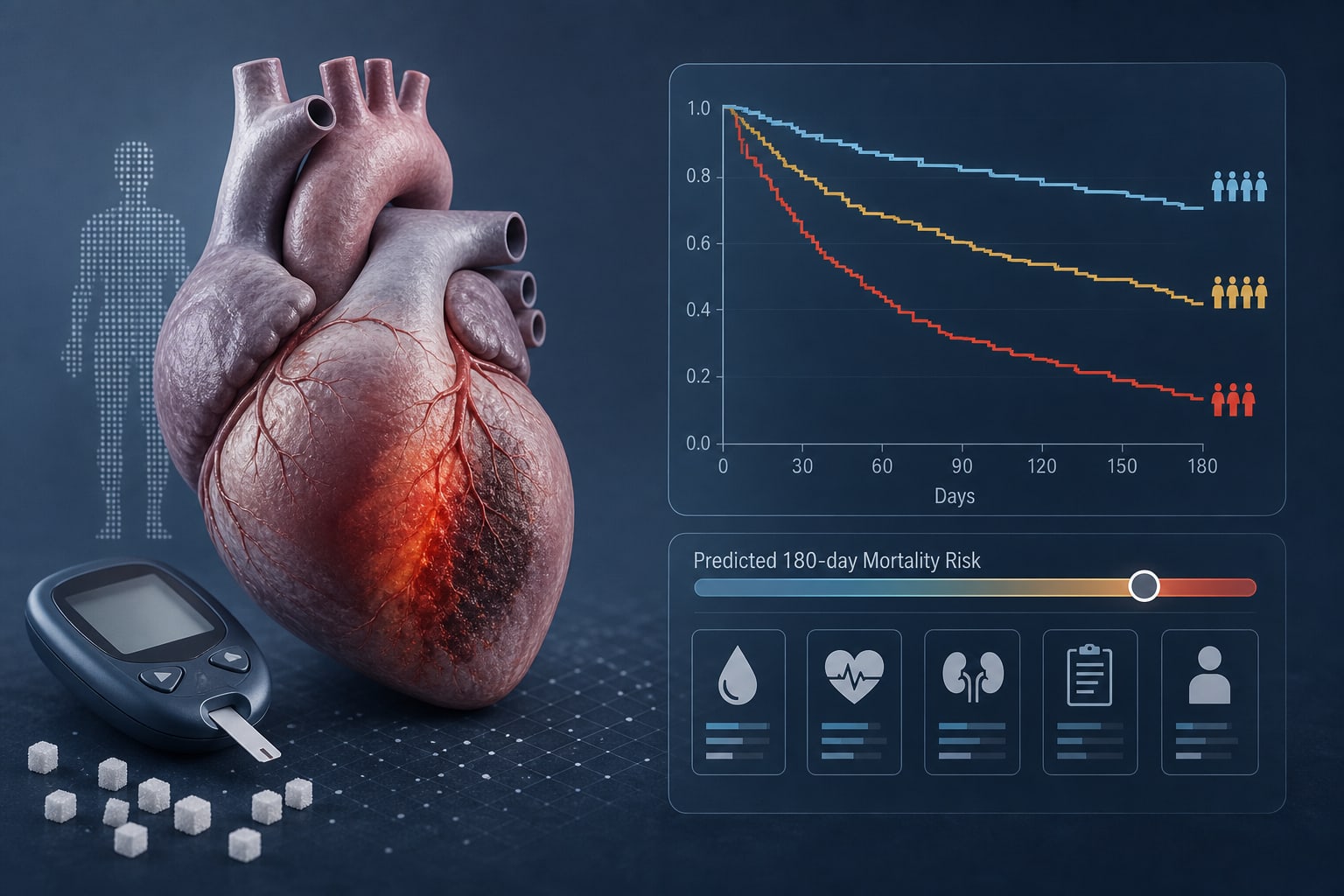
The study investigates the prognostic significance of the Advanced Lung Cancer Inflammation Index (ALI) in predicting long-term mortality among diabetic patients with acute myocardial infarction (AMI).

Background

Acute myocardial infarction (AMI) is a leading cause of cardiovascular death, particularly in patients with diabetes, who experience worse outcomes due to shared inflammatory pathways. Identifying effective biomarkers that reflect the interplay of inflammation and metabolism is crucial for improving risk assessment and management in this high-risk population.

Data Highlights

ALI TertileAll-Cause Mortality RateCardiovascular Mortality Rate
T1 (Lowest)27.8%23.6%
T3 (Highest)7.9%7.4%

Key Findings

  • Patients in the highest ALI tertile (T3) had significantly lower all-cause mortality rates compared to those in the lowest tertile (T1).
  • Higher ALI was independently associated with a 67% reduction in the risk of all-cause mortality (HR = 0.33, 95% CI: 0.18–0.61, P < 0.001).
  • A significant non-linear relationship was observed between continuous ALI and mortality outcomes.
  • Adding ALI to the GRACE score improved risk reclassification and discrimination for all-cause mortality.
  • Lower admission ALI levels correlate with increased long-term mortality in diabetic AMI patients.

Clinical Implications

The Advanced Lung Cancer Inflammation Index (ALI) can serve as a prognostic tool for assessing long-term mortality risk in diabetic patients with acute myocardial infarction.

Conclusion

The study highlights the prognostic value of ALI in predicting long-term mortality among diabetic AMI patients.

Related Resources & Content

  1. Frontiers in Oncology, 2026 -- Prognostic significance and model evaluation of the modified advanced lung cancer inflammation index in locally advanced resectable gastric cancer patients with neoadjuvant chemotherapy
  2. Frontiers in Cardiovascular Medicine, 2026 -- Combined prognostic value of lipoprotein(a) and an integrated inflammatory-lipid index in patients with acute coronary syndrome and type 2 diabetes mellitus
  3. Frontiers in Cardiovascular Medicine, 2026 -- The association between systemic immune-inflammation index and mortality of elderly chronic bronchitis patients complicated by acute myocardial infarction
  4. Frontiers in Oncology, 2026 -- Association of systemic immune-inflammation index with all-cause mortality in lung cancer patients undergoing radiotherapy: a retrospective cohort study
  5. Cardiovascular Disease and Risk Management: Standards of Care in Diabetes—2026 - PMC
  6. Prognostic Value of the Systemic Immune-Inflammation Index in Patients With Acute Myocardial Infarction: A Systematic Review and Meta-Analysis - PubMed
  7. Empagliflozin after Acute Myocardial Infarction - PubMed
  8. 10. Cardiovascular Disease and Risk Management: Standards of Care in Diabetes—2026 - PMC
  9. Prognostic Value of the Systemic Immune-Inflammation Index in Patients With Acute Myocardial Infarction: A Systematic Review and Meta-Analysis - PubMed
  10. Empagliflozin after Acute Myocardial Infarction - PubMed

Original Source(s)

Related Content