Effectiveness and Safety of Tildrakizumab in Managing Moderate-to-Severe Scalp Psoriasis Among Obese Patients Over a 52-Week Period
-
By
-
Howard L. Sofen
-
Ranga Gogineni
-
Tushar Nishandar
-
Jerry Bagel
-
May 9, 2026
Clinical Report: Effectiveness and Safety of Tildrakizumab in Scalp Psoriasis
Overview
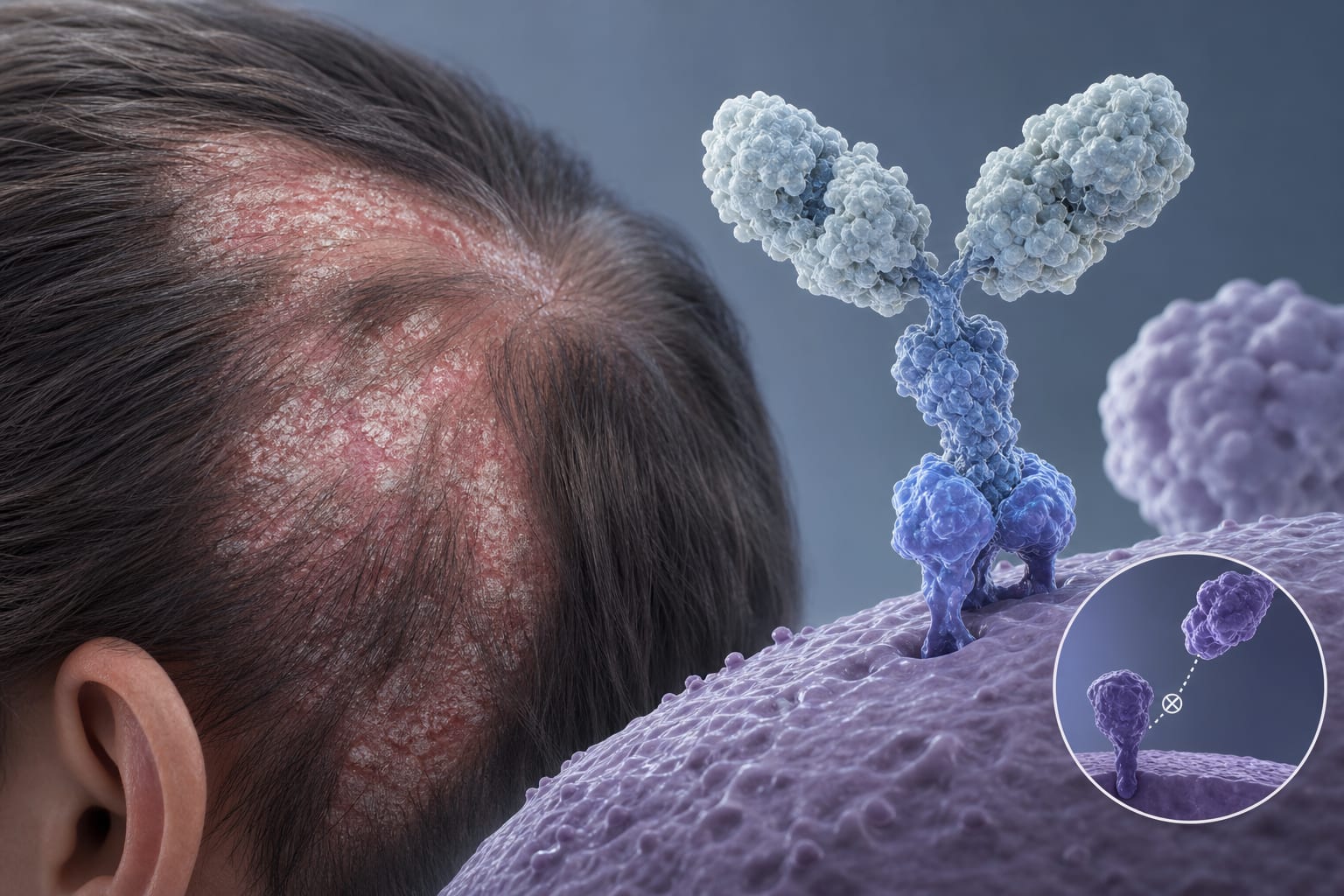
This study evaluates the efficacy and safety of tildrakizumab in treating moderate-to-severe scalp psoriasis among obese patients over 52 weeks. Results indicate that tildrakizumab is effective regardless of obesity status, with no new safety concerns identified.
Background
Psoriasis affects approximately 8 million adults in the USA, with a significant proportion experiencing scalp involvement, which poses unique treatment challenges. Obesity is a common comorbidity in psoriasis patients and may influence treatment efficacy. Understanding the impact of obesity on treatment outcomes is crucial for optimizing care in this population.
Data Highlights
In a 52-week Phase 3b trial, tildrakizumab demonstrated significant efficacy in improving scalp psoriasis symptoms in both obese and non-obese patients, with no new safety signals reported.
Key Findings
- Tildrakizumab led to greater improvement in scalp psoriasis compared to placebo, regardless of obesity status.
- Patients treated with tildrakizumab were more likely to achieve prespecified treatment outcomes.
- The efficacy of tildrakizumab was consistent between patients with and without obesity.
- No new safety signals were identified during the trial.
- Obesity does not appear to negatively impact the effectiveness of tildrakizumab in treating scalp psoriasis.
Clinical Implications
Healthcare providers can confidently prescribe tildrakizumab for moderate-to-severe scalp psoriasis in obese patients, knowing that it maintains efficacy and safety. This finding supports the inclusion of biologic therapies in treatment plans for patients with psoriasis and obesity.
Conclusion
Tildrakizumab is an effective treatment option for moderate-to-severe scalp psoriasis in patients with obesity, with consistent efficacy and safety profiles. These results reinforce the importance of addressing comorbidities in psoriasis management.
Related Resources & Content
- Efficacy and safety of tildrakizumab for the treatment of moderate-to-severe plaque psoriasis of the scalp: Week 52 results from a phase 3b, randomized, double-blind, placebo-controlled trial - ScienceDirect, 2026
- Tildrakizumab Improves Disease Severity and Patient-Reported Outcomes in Moderate-to-Severe Chronic Plaque Psoriasis: A Prospective Real-World Study - Dermatology and Therapy, 2026
- French guidelines on systemic treatments for moderate-to-severe psoriasis in adults: Update 2025 - PubMed
- conexiant — Combo Therapy for Psoriasis With Obesity
- Clinical Rheumatology — Assessment of ixekizumab's safety and effectiveness in active psoriatic arthritis patients, with and without the use of conventional disease-modifying antirheumatic drugs: Findings from the SPIRIT-P1 and SPIRIT-P2 studies over three years
- Drug Safety — Evaluating the Tolerability of Ixekizumab in Chinese Adults Suffering from Moderate-to-Severe Plaque Psoriasis: Insights from a 12-Week Prospective, Single-Arm, Multicenter Observational Study
- Combo Therapy for Psoriasis With Obesity
- French guidelines on systemic treatments for moderate-to-severe psoriasis in adults: Update 2025 - PubMed
- Efficacy and safety of tildrakizumab for the treatment of moderate-to-severe plaque psoriasis of the scalp: Week 52 results from a phase 3b, randomized, double-blind, placebo-controlled trial - ScienceDirect
- Effectiveness of Tildrakizumab 200 mg in Moderate-to-Severe Plaque Psoriasis: A Multicenter Real-World Study Analyzing Patient Outcomes by Weight, PASI, BMI, and Previous Therapies | Dermatology and Therapy | Springer Nature Link
Based on findings from:
Efficacy and Safety of Tildrakizumab for Treatment of Moderate-to-Severe Scalp Psoriasis in Patients with Obesity Over 52 Weeks
Howard L. Sofen, Ranga Gogineni, Tushar Nishandar, Jerry Bagel. Dermatology And Therapy, 2026.
https://link.springer.com/article/10.1007/s13555-026-01774-2
This content is an AI-generated, fully rewritten summary based on a published scholarly article. It does not reproduce the original text and is not a substitute for the original publication. Readers are encouraged to consult the source for full context, data, and methodology.