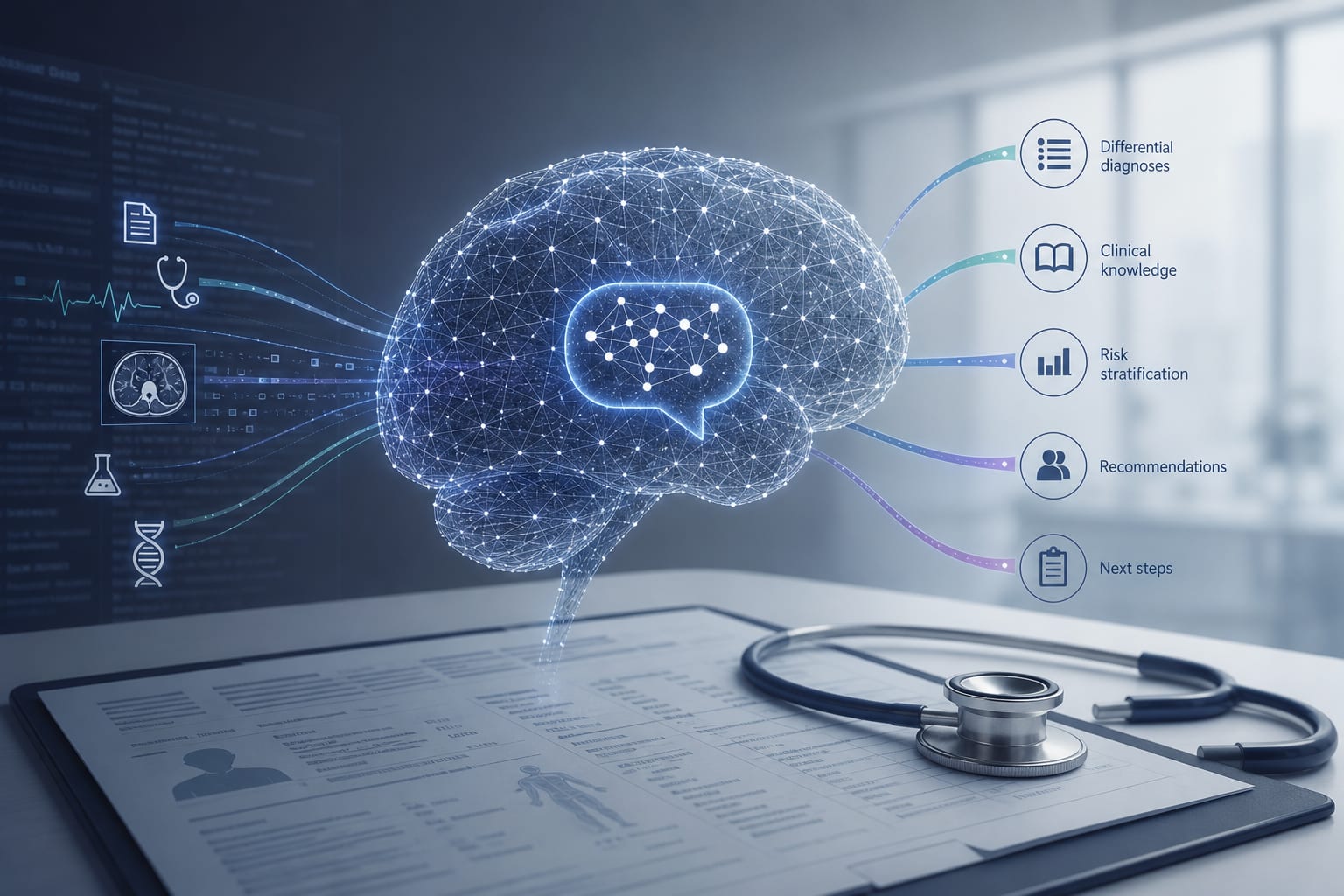
Application of large language models in medical diagnosis: A bibliometric review
By
Quan Zhang
Haokun Wang
Hongjuan Li
Fengbo Jiao
Hongchen Zhou
Meiyu Li
June 17, 2026
Clinical Scorecard: Utilization of Large Language Models for Medical Diagnosis: A Bibliometric Analysis
At a Glance
Category Detail
Condition Medical Diagnosis Key Mechanisms Large language models (LLMs) assist in generating differential diagnostic suggestions and synthesizing clinical knowledge. Target Population Physicians utilizing decision-support tools in clinical settings. Care Setting Clinical practice and academic research.
Key Highlights
LLMs like ChatGPT and Flan-PaLM are being explored for diagnostic support. Over 70% of psychiatrists reported using ChatGPT in professional practice. LLMs demonstrated diagnostic performance comparable to board-certified physicians in some studies. The integration of LLMs raises ethical, legal, and practical challenges. A bibliometric analysis is needed to map the research landscape of LLMs in diagnostics. Guideline-Based Recommendations
Diagnosis
LLMs should be used as clinician-facing decision-support tools. Management
Further empirical investigation is required to establish clinical utility. Monitoring & Follow-up
Ongoing assessment of model reliability and interpretability is necessary. Risks
Concerns regarding data privacy and regulatory governance must be addressed. Patient & Prescribing Data
Patients undergoing diagnostic evaluation in various specialties.
LLMs may assist in synthesizing and interpreting patient information.
Clinical Best Practices
Ensure final clinical judgment remains under physician oversight. Utilize LLMs to enhance interaction with electronic health records and medical literature. Related Resources & Content