Case Study: Demyelination Associated with Tumor Necrosis Factor Inhibitors in Neuro-Behçet Disease
-
By
-
Eloise Norman
-
Gabor Major
-
September 24, 2026
Clinical Scorecard: Case Study: Demyelination Associated with Tumor Necrosis Factor Inhibitors in Neuro-Behçet Disease
At a Glance
Category | Detail |
|---|---|
Condition | Neuro-Behçet disease, with new neurologic symptoms and MRI lesions developing after TNF inhibitor treatment. |
Key Mechanisms | TNF inhibitor-associated demyelination may be difficult to distinguish from neurologic involvement of Behçet disease or another demyelinating condition. |
Target Population | Patients with Neuro-Behçet disease receiving TNF inhibitors, particularly those who develop new neurologic symptoms. |
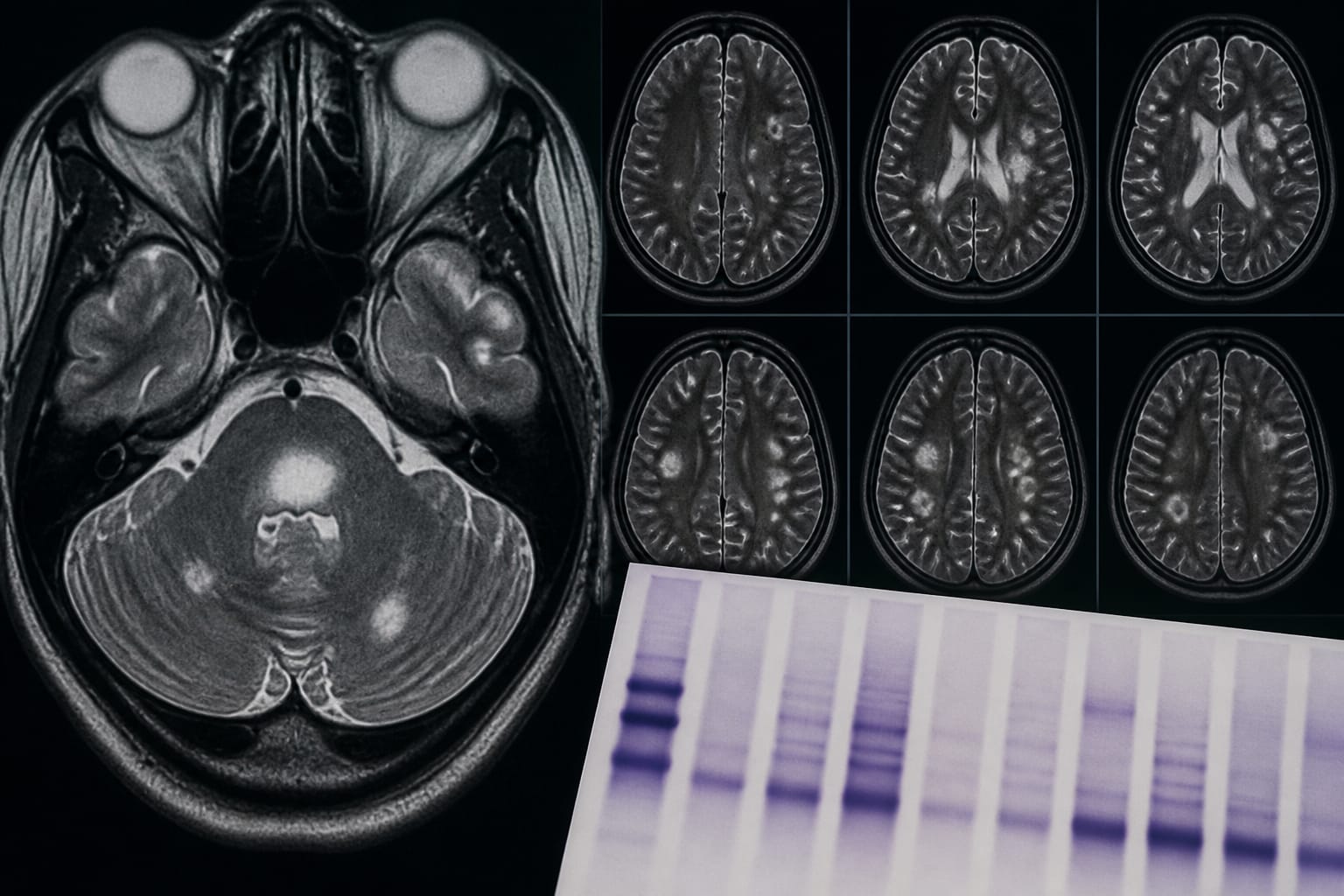
Care Setting | Clinical evaluation with neurologic assessment, MRI, and CSF analysis; the reported MRI lesions involved the pons, cerebellum, and basal ganglia. |
Key Highlights
Patient diagnosed with Neuro-Behçet disease based on International Criteria.
MRI showed hyperintense lesions in the pons, cerebellum, and basal ganglia.
New neurologic symptoms developed after TNF inhibitor initiation.
Differentiation between Neuro-Behçet disease and demyelinating conditions is challenging.
TNF inhibitor-associated demyelination has an incidence below 13 per 10,000 person-years.
Guideline-Based Recommendations
Diagnosis
Utilize International Criteria for Behçet's Disease for diagnosis.
Conduct CSF analysis and MRI for neurological symptoms.
Management
Consider discontinuation of TNF inhibitors upon new neurologic symptoms.
Monitoring & Follow-up
Regular follow-up MRI and CSF studies to assess lesion progression.
Risks
Potential for TNF inhibitor-induced demyelinating disease.
Patient & Prescribing Data
Individuals with Neuro-Behçet disease treated with TNF inhibitors.
New neurologic symptoms warrant thorough evaluation and possible treatment adjustment.
Clinical Best Practices
Prompt assessment of new neurologic symptoms in patients on TNF inhibitors.
Differential diagnosis between Neuro-Behçet disease and multiple sclerosis.
Related Resources & Content
EULAR recommendations for the management of Behçet's syndrome: 2025 update - PubMed
The effectiveness of the anti-tumor necrosis factor therapy infliximab in neuro-Behçet’s disease: a systematic review and meta-analysis - PMC
Global burden of TNF-α inhibitors associated demyelinating diseases: A global disproportionality analysis - PubMed
Frontiers in Immunology — Two cases of probable Neuro-Behçet syndrome treated with autologous HSCT
Acta Neuropathologica — Altered Expression of Atypical NMDA Receptors in Diffuse Astrocytoma with MYB or MYBL1 Changes as a Potential Inducer of Autoimmune Encephalitis
Frontiers in Immunology — Severe cerebellitis as a manifestation of infliximab-associated overlap of neurosarcoidosis and myelin oligodendrocyte glycoprotein antibody-associated disease – case report
Frontiers in Oncology — Primary central nervous system lymphoma and tumefactive demyelinating lesions in multiple sclerosis: a retrospective observational cohort study
EULAR recommendations for the management of Behçet's syndrome: 2025 update - PubMed
The effectiveness of the anti-tumor necrosis factor therapy infliximab in neuro-Behçet’s disease: a systematic review and meta-analysis - PMC
Global burden of TNF-α inhibitors associated demyelinating diseases: A global disproportionality analysis - PubMed
Based on findings from:
Clinical Images: Tumor necrosis factor inhibitor–associated demyelination in a case of neuro-Behçet disease
Eloise Norman, Gabor Major. Acr Open Rheumatology, 2026.
https://acrjournals.onlinelibrary.wiley.com/doi/10.1002/acr2.90159
This content is an AI-generated, fully rewritten summary based on a published scholarly article. It does not reproduce the original text and is not a substitute for the original publication. Readers are encouraged to consult the source for full context, data, and methodology.