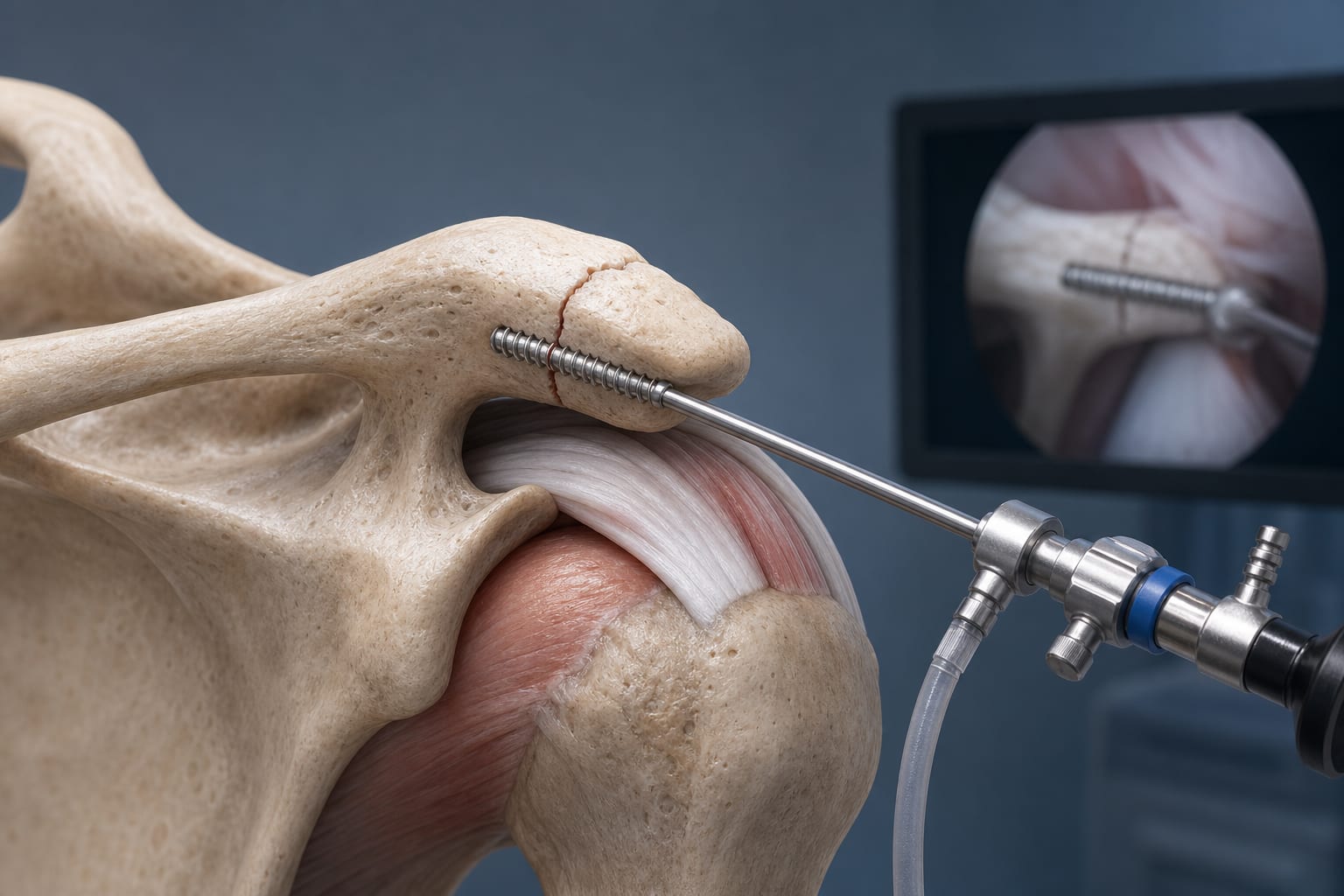
Evaluation of Arthroscopic Cannulated Screw Fixation for Fractures of the Coracoid Process
-
By
-
Yang Yang
-
Fang Chen
-
Chao Feng
-
Qiyuan Pan
-
ZhiJun Zhao
-
July 16, 2026
Clinical Scorecard: Evaluation of Arthroscopic Cannulated Screw Fixation for Fractures of the Coracoid Process
At a Glance
| Category | Detail |
|---|
| Condition | Coracoid Process Fractures |
| Key Mechanisms | Minimally invasive arthroscopic treatment versus traditional open surgery. |
| Target Population | Patients with coracoid process fractures, including those with concomitant shoulder injuries. |
| Care Setting | Orthopedic and Joint Surgery Department |
Key Highlights
- Arthroscopy group showed less intraoperative blood loss and shorter hospitalization.
- Significant postoperative improvement in pain and shoulder function in the arthroscopy group.
- No significant differences in screw placement accuracy between groups.
- Both groups had comparable operative duration and fracture healing time.
- Concurrent treatment of associated shoulder pathologies was possible with arthroscopy.
Guideline-Based Recommendations
Diagnosis
- Imaging examinations to confirm coracoid process fracture displacement ≥1 cm.
Management
- Minimally invasive arthroscopic treatment preferred for coracoid fractures with associated injuries.
Monitoring & Follow-up
- Evaluate postoperative outcomes using VAS, Constant-Murley, and UCLA scores.
Risks
- Potential for neurovascular injuries or infections, though not observed in this study.
Patient & Prescribing Data
17 patients with coracoid process fractures treated between January 2020 and October 2025.
Arthroscopic treatment resulted in superior early postoperative outcomes compared to open surgery.
Clinical Best Practices
- Consider arthroscopic approach for coracoid fractures to minimize blood loss and hospitalization.
- Ensure accurate screw placement through careful surgical technique.
- Monitor for associated shoulder injuries during treatment.
Related Resources & Content