Short-term quantitative CT changes in synchronous ground-glass nodules during immune checkpoint inhibitor therapy in patients with lung cancer - Scorecard - MDSpire
Advertisement
Short-term quantitative CT changes in synchronous ground-glass nodules during immune checkpoint inhibitor therapy in patients with lung cancer
Clinical Scorecard: Quantitative CT Assessment of Short-term Changes in Concurrent Ground-Glass Nodules During Immune Checkpoint Inhibitor Treatment in Lung Cancer Patients
At a Glance
Category
Detail
Condition
Lung Cancer with Synchronous Ground-Glass Nodules
Key Mechanisms
Immune checkpoint inhibitors (ICIs) improve survival but do not target ground-glass nodules (GGNs).
Target Population
Patients with lung cancer receiving ICI therapy and exhibiting synchronous GGNs.
Care Setting
Retrospective matched cohort study evaluating CT changes in lung cancer patients.
Key Highlights
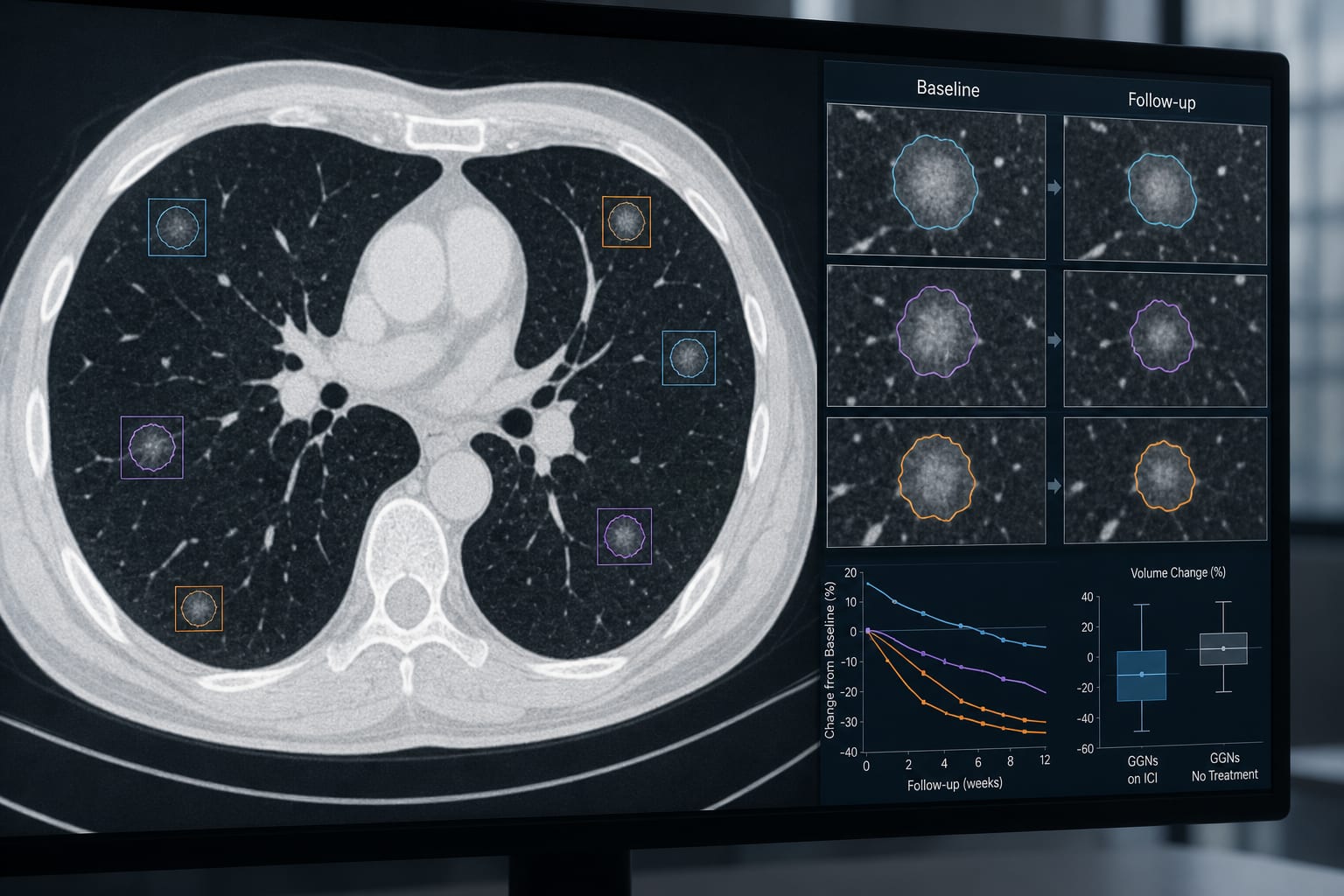
Nodules in the ICI group showed a regression rate of 23.6% compared to 1.8% in controls (p<0.001).
Improvement in Lung-RADS category was more common in the ICI group (8.2% vs 1.8%; p=0.018).
Nodules in the ICI group had lower monthly increases in diameter, volume, surface area, and mass.
Part-solid nodules showed larger volume reduction than pure GGNs.
Nodules with Lung-RADS ≥ 4A had a significant decrease in entropy.
Guideline-Based Recommendations
Diagnosis
Quantitative CT scans should be utilized to assess changes in GGNs during ICI therapy.
Management
Monitor GGNs in lung cancer patients receiving ICIs for potential regression.
Monitoring & Follow-up
Regular follow-up CT scans are recommended to evaluate nodule characteristics and changes.
Risks
Consider the risk of overtreatment for GGNs while ensuring timely intervention for malignant lesions.
Patient & Prescribing Data
Lung cancer patients with synchronous GGNs undergoing ICI treatment.
ICIs may lead to favorable changes in the growth patterns of GGNs.
Clinical Best Practices
Utilize quantitative imaging to characterize temporal changes in GGNs.
Conduct subgroup analyses based on nodule density and Lung-RADS category.